Smart urban areas: A milestone in Vietnam–Germany cooperation

With funds of nearly 2 million EUR from BMUV, the SUA project stands as a flagship example of scientific research being effectively translated into practical applications, helping address urgent challenges posed by rapid urbanisation, climate change, and the shift towards a carbon-neutral economy.

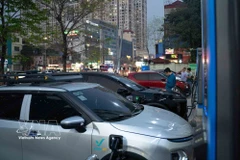
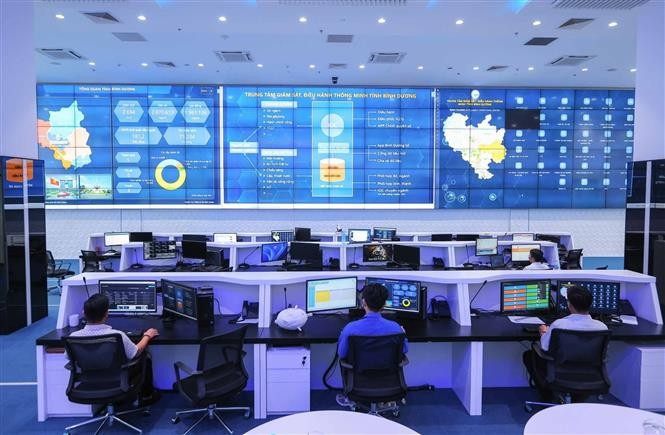
The Binh Duong Provincial Intelligent Operations Centre (IOC) is tasked with monitoring, supervising, and managing activities across several critical sectors, including public security, traffic control, smart transportation, and emissions monitoring. (Photo: VNA)

Hanoi (VNA) - A workshop on smart urban areas was jointly organised in Hanoi on May 6 by the National Innovation Centre (NIC), the Federal Ministry for the Environment, Nature Conservation, Nuclear Safety and Consumer Protection (BMUV) of the Federal Republic of Germany, and TU Dortmund University.

Speaking at the event, NIC Director Vu Quoc Huy said the “Smart Urban Areas – Solutions for Sustainable Urban Development” (SUA) project marks a significant milestone in three years of successful cooperation between the governments, businesses, and leading universities of Vietnam and Germany. With funds of nearly 2 million EUR from BMUV, the SUA project stands as a flagship example of scientific research being effectively translated into practical applications, helping address urgent challenges posed by rapid urbanisation, climate change, and the shift towards a carbon-neutral economy.

After three years of implementation, the SUA project has achieved pioneering breakthroughs. For the first time, a “Digital Twin” model has been applied to optimise building management. The Digital Twin is a 3D replica of a real-world structure that provides detailed data on construction materials, high-efficiency water pumping systems, the interaction between building envelopes and the surrounding microclimate, and the environmental impact of green architectural features.

Launched in 2022, the SUA project aims to develop innovative models for cities and urban areas in the digital era. Its dual goals are to tackle the challenges of rapid urbanisation, global economic development, and prolonged climate change while simultaneously enhancing urban quality of life in the future.

The project's core objective is to monitor and test climate adaptation and energy-saving measures in Vietnam based on scientific evidence, through the integration of smart technologies, sensor-based measurements, and the use of Digital Twin models for buildings. During its initial three-year pilot phase, the project focused on developing scalable models applicable across different localities, with a long-term vision of creating sustainable and smart residential areas./.
VNA

See more

At the inauguration of the community digital library in Quang Phu ward, Da Nang city. (Photo: VNA)

RoK locality-funded digital library makes debuts in Da Nang

After more than 10 months of construction, the project has been completed and put into use, featuring all the components of a modern digital library, including over 1,000 book titles, an e-book repository, tablet and desktop computers, dedicated study areas, and spaces for digital knowledge exploration and research.

Representatives of police forces from seven southern provinces and cities sign a coordination agreement at the conference. (Photo: VNA)

Police boost inter-provincial coordination to curb IUU fishing

Police forces from Lam Dong, Ca Mau, An Giang, Can Tho, Vinh Long, Dong Thap, and Ho Chi Minh City held a joint review on January 12 in Xuan Huong - Da Lat ward, Lam Dong province, strengthening efforts to combat organisations and individuals arranging or brokering illegal border crossings for illegal fishing overseas.

Police of Lam Dong province have worked around the clock to complete the Quang Trung Campaign. (Photo published by VNA)

Lam Dong police complete Quang Trung Campaign six days ahead of schedule

Under the campaign, the force was tasked with building 27 of the 41 houses requiring reconstruction across the province, accounting for nearly 66% of the total. All 27 houses were completed, and by January 9, they had been fully handed over for use, earlier than the January 15 deadline.

More trains added to serve Lunar New Year demand. (Illustrative photo: VNA)

More trains added to serve Lunar New Year demand

The railway sector will add more Thong Nhat (reunification) trains and regional services to meet the sharply rising travel demand of people and tourists during the 2026 Lunar New Year (Tet), Vietnam’s largest traditional festival.

The “Not Alone” campaign is rolled out widely across social media platforms nationwide. (Photo: VNA)

"Not Alone" Campaign: Over 8 million students, teachers, parents equipped with online safety skills

Implemented from October 6 to November 30, 2025, the campaign’s achievements were also reflected in its impressive outreach. On social media platforms, “Not Alone” generated more than 1.5 billion views and reached over 40 million people, with the participation of more than 1,000 key opinion leaders. Millions of creative contents using hashtags such as #khongmotminh and #NiemTinSo attracted strong community engagement.

The Vietnam Exposition Centre (VEC) in Dong Anh district, Hanoi (Photo: VNA)

Spring flower fair to open in February

The fair will feature flowers, ornamental plants, bonsai, orchids, peach and apricot blossoms, kumquat trees, along with Tet decorations such as lanterns, folk paintings, ceramics, handicrafts and feng shui items.

Elderly people take part in activities at a daytime care centre for senior citizens. (Photo: VNA)

Making breakthroughs via policies for older persons

The Politburo’s Resolution No. 72-NQ/TW on groundbreaking solutions to strengthen the protection, care and improvement of public health sets the target of raising average life expectancy to 75.5 years by 2030, with at least 68 years lived in good health.