Vietnam navigates reshaping of global coffee map

The launch of the Global Coffee Alliance (GCA) in Hanoi on March 26 marked a pivotal shift – from a production powerhouse to a centre of ideas, coordination, and leadership in the global coffee industry.

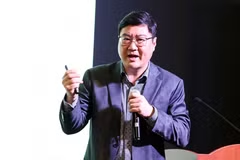
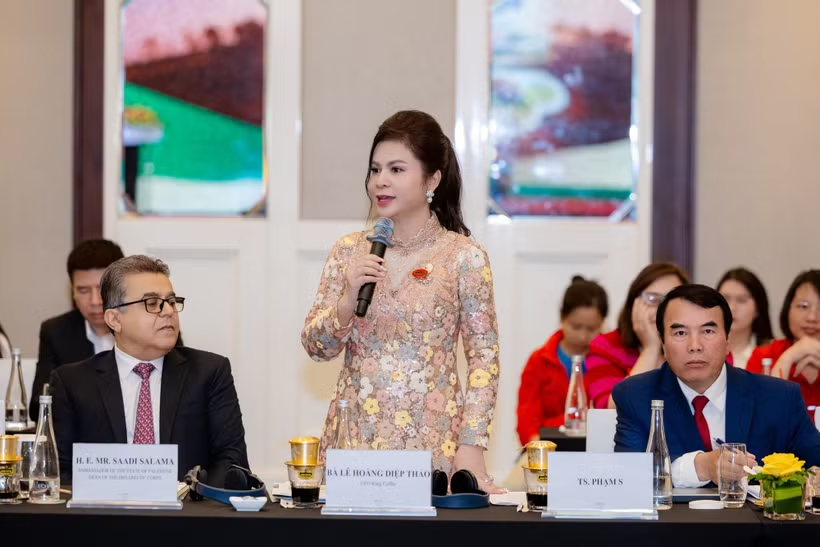
Le Hoang Diep Thao, founder and CEO of TNI King Coffee underscores that the alliance is not merely about connection but about creation (Photo: VietnamPlus)

Hanoi (VNA) – Vietnam is no longer content with being the world’s “raw coffee warehouse”. It is stepping decisively into a new role – a proactive architect reshaping the global coffee value chain through strategic initiatives and growing international influence.

The launch of the Global Coffee Alliance (GCA) in Hanoi on March 26 marked a pivotal shift – from a production powerhouse to a centre of ideas, coordination, and leadership in the global coffee industry.

From production giant to agenda-setter

Le Hoang Diep Thao, founder and CEO of TNI King Coffee, underscored that the alliance is not merely about connection but about creation.

“The global coffee industry now stands at a critical crossroads,” she said, stressing Vietnam’s role as a dynamic bridge between the East and the West. Drawing on proven experiences – from rapid digital economic growth to transformative changes in coffee production, Vietnam is positioning itself as a driver of innovation and sustainability.

This leadership is underpinned by strong performance. In the 2024–2025 crop year, Vietnam’s coffee exports reached a record 8.4 billion USD, up 45% year-on-year, evidence not only of commercial success but also of increasing control over supply chains amid market volatility.

Vietnamese enterprises are also redefining product standards. Leveraging premium Robusta and Arabica beans from the Central Highlands, companies are expanding into deep processing and exporting Halal-certified products to demanding markets such as the UAE, Iran and Malaysia. Strategic ventures in Laos and Timor-Leste, along with franchise expansion in the UK, the US and the Republic of Korea, reflect a broader ambition to globalise Vietnamese coffee technology and business models, according to the entrepreneur.

Looking ahead to 2040, Thao articulated a clear ambition: for Vietnam and other producing nations to move beyond raw exports and take command of high-value processing, firmly establishing national brands on the global stage.
anh-king-coffee-5.jpg
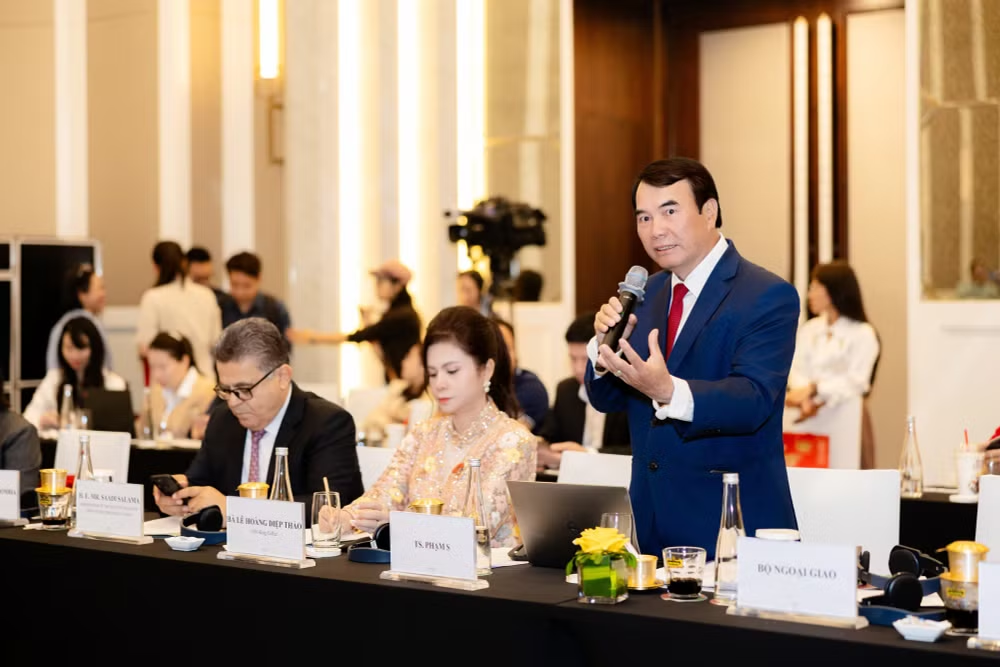
Dr Pham S, former Vice Chairman of the Lam Dong provincial People’s Committee, points to shifting global consumption trends as a major opportunity (Photo: VietnamPlus)

International observers echo this assessment. Saadi Salama, Ambassador of Palestine to Vietnam, described the country as uniquely positioned across the entire value chain – from cultivation to consumption – making it a compelling model of how coffee can drive economic development and international connectivity.

Building shared ecosystem for value and sustainability

The signing of the Global Coffee Alliance Declaration 2026 signals the start of a coordinated effort to build a more integrated global coffee ecosystem – one that balances trade fairness, innovation and environmental responsibility.

Tran Chi Dung, Secretary General of the Vietnam Logistics Business Association, emphasised that future cooperation must go beyond trade to embrace “supply chain diplomacy”. This approach integrates knowledge sharing, understanding of people’s livelihoods, practical solutions and cultural exhange, aiming to optimise the global flows of goods, information and resources.

“Ensuring faster and more efficient circulation of cost, human and product information worldwide is the key challenge,” he said, affirming Vietnam’s readiness to help build and operate an effective global coffee supply network.

The diversity of challenges among coffee-producing nations underscores the need for collaboration. While Timor-Leste is advancing organic coffee production to access premium markets, Laos is striving to deal with productivity constraints. Angola, with its long-standing coffee farming tradition, is working to build a more sustainable and equitable industry.

Against this backdrop, Dr Pham S, former Vice Chairman of the Lam Dong provincial People’s Committee, pointed to shifting global consumption trends as a major opportunity. As demand for environmentally friendly products rises, the current scarcity of organic coffee cultivation presents a golden chance for countries willing to act early.

For nations facing productivity and cultivation challenges, he stressed that targeted interventions – improved plant varieties, better farming techniques, and stronger regional cooperation – will be decisive. Technology transfer and coordinated planning of growing areas, he added, are “key levers” to unlock long-term growth./.
VNA

See more

Prime Minister Le Minh Hung chairs a working session with the Hanoi People's Committee and ministries on rental housing development in the capital on May 25, 2026. (Photo: VNA)

Rental housing a strategic segment serving public needs: PM

The PM said rental housing development must be integrated with urban planning, land-use planning, public transport, industrial zones and labour market development, with priority given to major cities, industrial parks and key economic corridors with full infrastructure.

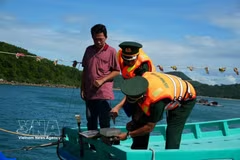
A border guard checks VMS on a fishing boat. (Photo: VNA)

An Giang subsidises VMS upgrades to fight illegal fishing

The provincial budget will cover 50% of actual invoiced costs, capped at 5 million VND (192 USD) per vessel for upgrades and 11 million VND for replacements, with vessel owners paying the remainder. The policy is framed as a shared state-citizen responsibility aimed at driving regulatory compliance. The support runs through December 31, 2026.

Cargo transit through Nanning International Railway Port before heading to Vietnam’s Yen Vien station. (Photo: VNA)

Vietnam, China add cross-border rail link in trade push

China Railway Nanning Group said a container train hauling 170 tonnes of calcium hydroxide left Guigang station in the Guangxi Zhuang Autonomous Region on May 23 afternoon. The shipment transited through Nanning International Railway Port before heading to Vietnam’s Yen Vien station. The corridor is a new cross-border logistics addition following the launch of the Liuzhou-Nanning-Vietnam rail service.

Customers conduct transactions at the head office of Bao Viet Securities Company in Hanoi. (Photo: VNA)

SOE equitisation urged to improve quality, attract foreign capital

Major policies have been introduced to strengthen the financial market and improve the role of SOEs. Notably, Politburo Resolution No.79-NQ/TW dated January 6, 2026 on State economic development requires SOEs to serve as the core force of the State economy, operate effectively under market principles and adopt modern, transparent governance standards with regional and international competitiveness.

Director of the Agency for Domestic Market Management and Development Tran Huu Linh joins celebrities during the “Vitality of Vietnamese Goods” livestream session (Photo: gdnd)

From tradition to digitalisation: Elevating Vietnamese goods

For many years, the campaign “Vietnamese people prioritise using Vietnamese goods” has played an important role in promoting domestic consumption and supporting local businesses. Today, alongside traditional trade fairs and distribution channels, digital platforms are creating new opportunities for Vietnamese products to increase their competitiveness.

Vice Chairman of the National Assembly (NA) Nguyen Hong Dien receives a delegation from the European Chamber of Commerce in Vietnam (EuroCham) in Hanoi on May 22. (Photo: VNA)

Vietnam, EU promote substantive, effective economic cooperation

The NA always attaches importance to improving institutional frameworks and building a comprehensive, transparent and development-enabling legal environment to support both domestic and foreign businesses, including European enterprises operating in Vietnam, said NA Vice Chairman Nguyen Hong Dien.

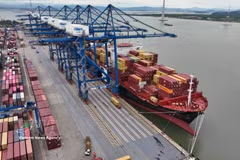
Exports and imports are handled at Hai Phong International Container Terminal. (Photo: VNA)

Vietnam seen as attractive investment destination for 2026–2035

The article described Vietnam as strategically positioned along major regional maritime routes, including the East – West corridor linking the Americas, the Middle East, India and Europe, and the North – South corridor connecting China and Southeast Asia, helping make the country a gateway for international trade.