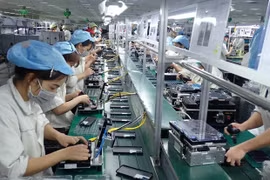
Illustrative image (Photo: baotainguyenmoitruong.vn)
Hanoi (VNA) – Vietnam aims to become a developed country by 2045 and achieve net zero emissions by 2050. It is considered an ambitious goal but also a challenge for a developing country like Vietnam.
The development of eco-industrial parks and closed circular production chain are considered effective solutions to contribute to the realisation of the goal.
However, the development of eco-industrial parks is not an easy task when there are many obstacles in terms of mechanism, determination and participation of enterprises.
An eco-industrial park is known as a "community" of businesses that produce and provide services with the goal of developing and protecting the environment at the same time. The standards of an eco-industrial park require a large amount of investment to meet the regulations.
Accordingly, infrastructure must comply with the law, protect the environment and labourers while ensuring basic services. Besides, clean production, efficient use of resources and a minimum of 25% of land for green buildings. Eco-industrial parks must have a mechanism to monitor and manage inputs and outputs, effectively operate resources and emissions.
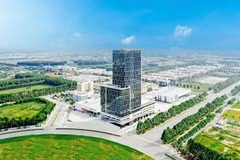
Pham Hong Diep, Chairman of the Board of Directors of Shinec JSC, the investor of Nam Cau Kien Industrial Park in Hai Phong city, said that the park has over 40% of the land area for parks, trees, public areas, and infrastructure. Currently, all waste water, exhaust gas, dust and waste from factories in the industrial park has been treated and measured by electronic systems and automatically monitored round the clock to ensure a clean and green ecosystem.
According to the chairman, investment in eco-industrial parks will increase the costs by about 30% compared to normal ones. However, the Nam Cau Kien Industrial Park has set a goal that by 2030, it will achieve net zero emissions, forwarding to a model in the same kind which helps to inspire investors nationwide to have a sustainable investment view, investment for the future economic development closely associated with environmental protection, thereby creating many symbiotic ecosystems.
Forming a circular production chain in the industrial park is considered one of the important criteria of an eco-industrial park. At present, many industrial zones find it hard to form a circular production chain, but at Nam Cau Kien, there are three circular production chains and the fourth circular production chain is being built.
In a summary report on the development of industrial parks and economic zones over the past three decades released by the Ministry of Planning and Investment, which has been approved by the Government, by 2030, 40-50% of localities will have plans to convert existing industrial parks to eco-industrial parks, and up to 10% of localities have orientations to build new eco-industrial parks in order to attract investment.
This will greatly contribute to the realisation of the country's net zero commitment by 2050.
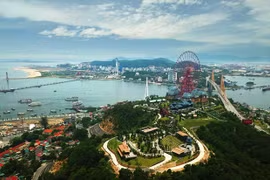
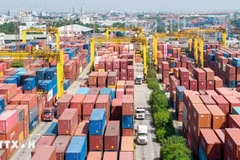
 Illustrative image (Photo: baodautu.vn)
Now, Vietnam has more than 400 industrial parks, but a few of those industrial parks have plans to convert themselves into eco-industrial parks.
According to economic expert Mai Van Sy, there are many difficulties in the development of eco-industrial parks. There is still no specific incentive mechanism for developing eco-industrial parks, and the investment in eco-industrial parks requires much more significant capital, forcing businesses to make reasonable calculations in terms of profit.
Besides that, while developing an eco-industrial park, planning areas for trees and landscapes from the beginning is essential, he said.
Hoang Tuan Anh, General Director of the Shinec JSC, said the increased investment is one of the difficulties. The development cannot be done if there is no synchronised mindset from the beginning.
Building an eco-industrial park must meet a lot of criteria. Of which, there are some criteria that are difficult to carry out, such as building a circular economic chain. In order to form the chain, many investors and businesses must join hands in developing the chain.
To promote the development of eco-industrial parks and green growth, the Government issued Decree No. 35/2022/ND-CP regulating the management of industrial parks and economic zones.
This decree is expected to create a premise and motivation for the eco-industrial park model playing a positive role in green growth, towards sustainable development goals.
According to Deputy Minister of Planning and Investment Nguyen Thi Bich Ngoc, the eco-industrial parks can only really play a positive role in the national sustainable development strategy when they are multiplied with support in terms of policy, technology, finance and information, and close connection between domestic agencies and international organisations.
According to Dao Phan Long, an expert in the mechanical engineering industry, in order to accelerate the process of gaining net zero emission in industrial parks, it is necessary to soon concretise preferential policies for eco-industrial parks in Decree 35/2022/ND-CP. At the same time, the State should have some special incentives for enterprises or investors who develop or convert eco-industrial parks successfully./.