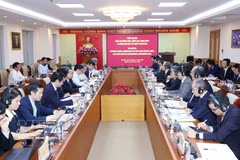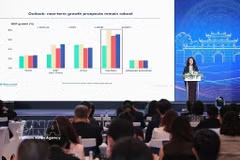
Hanoi (VNA) – Vietnam’s gross domestic product (GDP) in the third quarter of 2026 was estimated to expand 9.95% year-on-year, higher than the growth rates of 8.15% in the first quarter and 8.81% in the second, Director of the National Statistics Office under the Ministry of Finance Nguyen Thi Huong said at a press conference on October 3.
Huong said that despite complex developments in the global situation, Vietnam’s socio-economic performance in the third quarter and first nine months continued to deliver positive and important results across most sectors.
Agriculture, forestry and fisheries grew 4.21%, contributing 5.14% to the overall increase in gross value added; industry and construction rose 12.50%, contributing 51.57%; and services expanded 9.54%, contributing 43.29%.
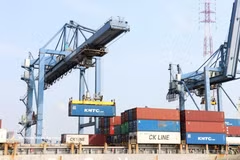
On the expenditure side, final consumption in Q3 increased 8.96% year-on-year, gross capital formation 21.39%, exports of goods and services 23.27%, and imports 28.75%.
In the first nine months, GDP was estimated to increase 9.01% from the same period last year. Agriculture, forestry and fisheries grew 4.02%, contributing 5.35% to overall gross value added growth; industry and construction rose 11.21%, contributing 49.62%; and services expanded 8.69%, contributing 45.03%.
In the economic structure, agriculture, forestry and fisheries accounted for 10.65% of GDP in the first nine months; industry and construction 38.35%; services 42.97%; and taxes less subsidies on products 8.03%. In terms of GDP use, final consumption rose 8.51% year-on-year; gross capital formation expanded 17.88%; while exports of goods and services increased 21.29%, and imports 27.19%.
Regarding local GRDP, 12 of the 34 localities recorded growth of at least 10% in the first nine months. Quang Ninh led with 12.54%, followed by Ha Tinh 12.36%, Hai Phong 12.08%, Bac Ninh 11.81% and Ninh Binh 11.31%.
Localities with lower GRDP growth included Son La at 5.59%, Vinh Long 7.32%, Ca Mau 7.37% and Dong Thap 7.44%, mainly due to declines in electricity output and the relatively large share of agriculture in their economic structures.
Overall, high growth was concentrated mainly in localities with strong industrial foundations and large-scale processing and manufacturing sectors, supported by investment, exports and expanding services, thereby contributing positively to national economic growth.
Huong attributed the positive Q3 and nine-month results to the involvement of the entire political system under the leadership of the Party Central Committee and its Politburo and Secretariat, as well as the Government’s and Prime Minister’s timely, flexible and effective direction and management.
She said ministries, sectors and localities had synchronously implemented key tasks and measures to promote economic growth and strive to achieve double-digit growth in 2026.
The completion and operation of the two-tier local administration model had also helped expand development space, strengthen regional connectivity and improve the effectiveness of State management, while promoting decentralisation, administrative reform and more efficient mobilisation and use of development resources, she added./.