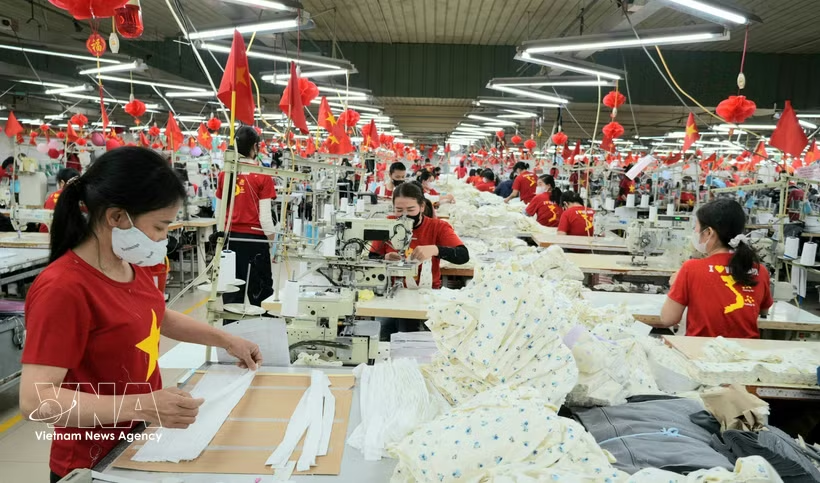
Vietnam targets 48 billion USD in textile-garment exports

Experts said the 48-billion-USD target should also be viewed as an opportunity for Vietnam's garment and textile industry to improve productivity and increase value added for more sustainable competitiveness.

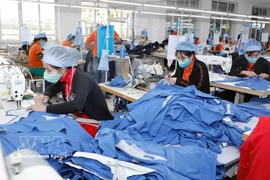
Workers at a textile and garment company. (Photo: VNA)

Hanoi (VNA) – Vietnam’s textile and garment industry is facing both opportunities and challenges amid complex and unpredictable developments in the global market, prompting businesses to improve growth quality, optimise production costs and enhance adaptability in pursuit of an export turnover of about 48 billion USD in 2026.

The target is considered an important milestone that requires concerted efforts from management agencies and the business community. Companies are taking measures to retain existing orders, seek new partners and diversify export markets. Truong Van Cam, Vice Chairman of the Vietnam Textile and Apparel Association (VITAS), said the industry is being significantly affected by changes in trade policies and tariff barriers in major consumer markets.

The US, Vietnam’s largest textile and garment export market, currently imposes a 12.5% tariff on Vietnamese textile and garment products, putting Vietnamese exporters at a disadvantage compared with some rivals subject to a 10% rate.

Cam noted that the challenge goes beyond the 2.5 percentage-point tariff difference, as higher production and logistics costs could affect selling prices, order retention and export market share.
Businesses are also facing rising prices of raw materials, supplies and production equipment, along with higher transportation and logistics costs. Delays in the delivery of fabrics and other input materials have further disrupted production schedules and affected delivery deadlines.

Orders for the final months of the year have become increasingly differentiated. While some companies have secured orders through September or October, and some knitwear producers have sufficient orders to maintain production through the end of the year, many garment manufacturers have yet to finalise fourth-quarter orders as expected.

Against this backdrop, businesses are shifting from pursuing output volume to prioritising higher-value orders with suitable commercial terms and greater production efficiency.
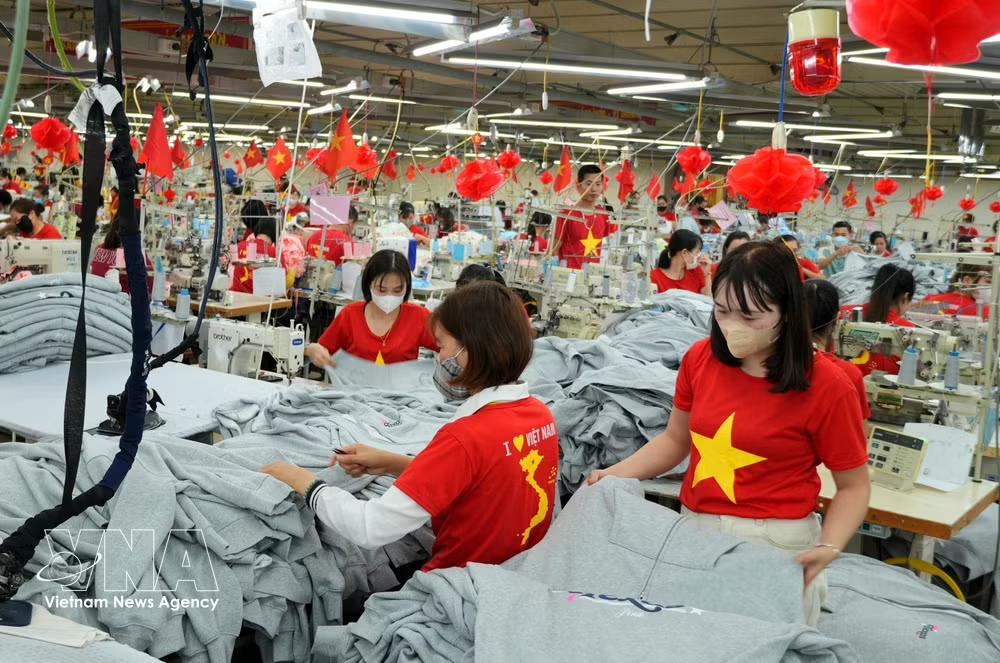
vnanet-garment2.jpg
Checking quality of products before packaging. (Photo: VNA)

Meanwhile, increasingly stringent technical and sustainability requirements in demanding markets such as the EU and the US, including those related to labour standards, traceability, ESG practices, green production, circular economy and carbon emissions reduction, are becoming important conditions for maintaining and securing orders.

VITAS statistics show that textile and garment exports reached nearly 31.7 billion USD in the first eight months of 2026, up 2.9% year-on-year.

To cope with market pressures, the industry is stepping up trade promotion, participating in major international trade fairs, accelerating digital transformation, improving product quality, strengthening control over input materials and increasing value added.

Tran Van Quy, General Director of Trung Quy Textile and Garment Co. in Ho Chi Minh City, said the company has secured orders through the end of the year, adding that effective cost control combined with product quality will enable businesses to remain adaptable.

Experts said the 48-billion-USD target should also be viewed as an opportunity for the industry to improve productivity and increase value added for more sustainable competitiveness./.
VNA

See more

An automotive and motorcycle parts production line at Vietnam Precision Industrial Co., Ltd. No. 1 in Ba Thien 2 Industrial Park, Phu Tho province (Photo: VNA)

Vietnam moves to fast-track foreign investment through institutional reforms

Under the draft Law, the Government will periodically adjust market access restrictions for foreign investors based on socio-economic conditions and management requirements. This approach could shorten policy lags amid rapid changes in international capital flows, technology and supply chains, while Vietnam is shifting its investment attraction focus from quantity to quality and efficiency.

Helicopters perform a flypast at the opening ceremony of the Vietnam Defence Expo 2024. (Photo: VNA)

128 companies from 31 countries register for Vietnam Defence Expo 2026

Vietnam Defence Expo 2026 will cover about 123,800 sq.m and feature seven main areas, including indoor and outdoor exhibition spaces, a defence experience and military games area, a space showcasing defence-economic products and the cultural heritage of Vietnam’s three regions, a VIP reception area, grandstand and performance areas, and common facilities.

Professor Dato Dr Ahmad Ibrahim, an expert in technology, digital transformation and agricultural value chains at UCSI University (Photo published by VNA)

Malaysia-Vietnam cooperation potential under NAP 2.0: expert

By leveraging their complementary strengths under the NAP 2.0 framework, Malaysia and Vietnam have considerable potential to deepen cooperation to build a more technology-driven, sustainable, and resilient agricultural sector in Southeast Asia.

VinFast electric cars are gathered at Hai Phong Port, ready to be loaded onto a ship for export. (Photo: VNA)

Going global: The competition challenge for "Made in Vietnam" cars

The growing number of exporters shows that Vietnam’s automobile industry is entering a new stage of development. However, international markets also present major challenges related to localisation, supporting industries, technological capabilities, human resources and country-specific technical standards.

Ports in Ho Chi Minh City are always bustling with ships loading and unloading cargo (Photo: VNA)

Ho Chi Minh City helps businesses effectively leverage FTAs

Ho Chi Minh City will implement a range of tasks and solutions to enhance business competitiveness, promote sustainable exports, expand markets, and enable local businesses to engage more deeply in global value and supply chains. The move is also expected to contribute to the development of Ho Chi Minh City as a regional hub for trade, logistics and international economic integration.

Illustrative image (Photo: VNA)

Livestreaming helps Vietnamese goods break past local markets

Once a product goes digital, it can transcend geography entirely. Consumers no longer need to visit a store or craft village in person to learn where a product comes from, how it's made, or whether it's worth buying. They can do all of that, and decide to buy, from a screen.

The south-central province of Khanh Hoa on September 16 announces investment approval decisions and investment registration certificates for five projects worth nearly 10.82 trillion VND (415.96 million USD). (Photo: VNA)

Khanh Hoa approves industrial projects with investment of 10.8 trillion VND

The south-central province of Khanh Hoa on September 16 announced investment approval decisions and investment registration certificates for five projects worth nearly 10.82 trillion VND (415.96 million USD), including three industrial park infrastructure projects and two foreign-invested ones.

A view of a ceremony to kick off the Northern Industry and Trade Fair - Bac Ninh 2026 on September 16, 2026 (Photo: VNA)

Northern industry-trade fair 2026 opens in Bac Ninh

The Northern Industry and Trade Fair - Bac Ninh 2026 features more than 222 booths with over 200 participating organisations and businesses, showcasing and introducing industrial and trade products from provinces and cities in the region, One Commune One Product (OCOP) items, typical rural industrial products, traditional craft village products, signature products of businesses, as well as regional trade, tourism and food products.