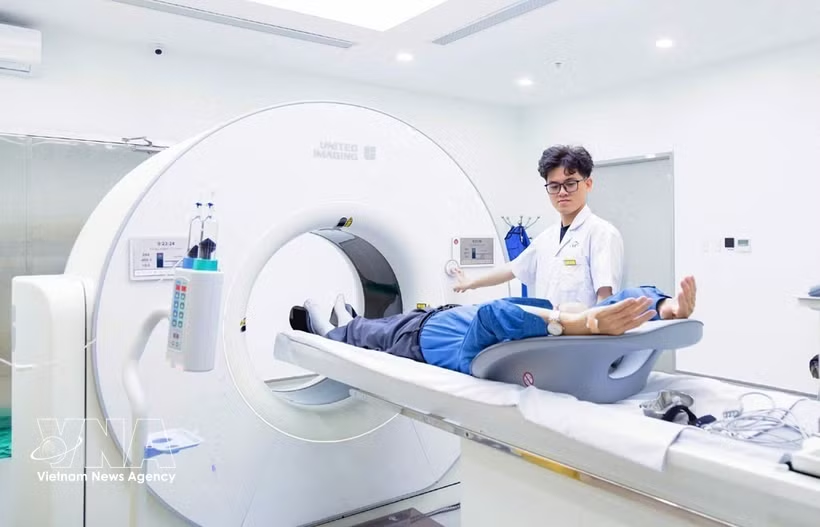
Hanoi (VNA) – Although financial leasing offers significant advantages for private healthcare providers, outstanding financial leases for medical equipment currently stand at only around 1 trillion VND (38.45 million USD), highlighting the need to remove bottlenecks and introduce tailored policies to expand this financing channel.
Financial leasing can provide medium- and long-term financing, cover up to 100% of equipment costs and use revenue generated from equipment operations to service lease payments.
There is considerable room to expand this financing source as private healthcare faces growing investment needs, while Resolution No. 72-NQ/TW on breakthrough solutions to strengthen the protection, care and improvement of people’s health has opened new development space for the private healthcare sector.
Dr Nguyen Khanh Phuong, Director of the Health Strategy and Policy Institute, said that as of June 2026, Vietnam had around 450 private hospitals and more than 50,000 clinics, yet private-sector hospital beds accounted for only about 6% of the national total.
According to Phuong, new policies are gradually establishing a clearer position, role and development direction for private healthcare. At the same time, rapid population ageing, growing healthcare demand and rising purchasing power are creating greater room for private providers to expand their scale and service capacity, driving greater investment in facilities, technology and medical equipment.
Some research organisations forecast that Vietnam’s medical equipment market could reach 2.5–4 billion USD annually in the coming period and remain among the fastest-growing markets in the Asia-Pacific region.
Financial leasing is essentially a medium- and long-term financing method under which a leasing company purchases equipment at a hospital’s request and leases it for most of the asset’s useful life. The ability of such equipment to generate steady revenue over many years provides the basis for financial leasing to become a financing option, easing the pressure of upfront investment.
Revenue generated by the equipment itself can service lease obligations, while hospitals do not need to mobilise large amounts of capital at the outset. This is the essence of asset-based financing backed by cash-generating assets, a model widely used in Germany, Japan and the Republic of Korea for high-tech medical equipment.
Bottlenecks remain
Despite the substantial potential, financial leasing for medical equipment remains relatively small. Data from the Vietnam Financial Leasing Association (VILEA) shows that outstanding financial leases in this sector stand at around 1 trillion VND, equivalent to approximately 2.3% of Vietnam’s medical equipment market, valued at around 1.7 billion USD a year.
To tap this potential, VILEA General Secretary Pham Xuan Hoe pointed to several bottlenecks that need to be removed. He said many private healthcare facilities currently face difficulties in accessing land, completing investment procedures, determining healthcare service prices, receiving health insurance reimbursements, and navigating socialisation mechanisms, as well as bidding and procurement procedures for equipment.
These constraints directly affect cash flows and businesses’ access to financing, thereby limiting the expansion of financial leasing in the sector.
Another barrier is the preference for asset ownership. According to Hoe, many business owners and clinic operators still want machinery and equipment to be owned and registered in their own names. The defining feature of financial leasing, however, is that businesses can use assets to generate cash flow without necessarily having to own them from the outset.
The VILEA also believes that specific mechanisms are needed to further promote the role of financial leasing in the economy, particularly in the private healthcare sector./.
See more
Livestreaming helps Vietnamese goods break past local markets
Once a product goes digital, it can transcend geography entirely. Consumers no longer need to visit a store or craft village in person to learn where a product comes from, how it's made, or whether it's worth buying. They can do all of that, and decide to buy, from a screen.
Vietnam to remain regional growth leader for 2026-2035: Report
Vietnam may remain the growth leader in Southeast Asia in the 2026-2035 period, according to a report released by the US’s Bain & Company and Singapore’s DBS Bank and Vriens & Partners on September 16.
Khanh Hoa approves industrial projects with investment of 10.8 trillion VND
The south-central province of Khanh Hoa on September 16 announced investment approval decisions and investment registration certificates for five projects worth nearly 10.82 trillion VND (415.96 million USD), including three industrial park infrastructure projects and two foreign-invested ones.
Northern industry-trade fair 2026 opens in Bac Ninh
The Northern Industry and Trade Fair - Bac Ninh 2026 features more than 222 booths with over 200 participating organisations and businesses, showcasing and introducing industrial and trade products from provinces and cities in the region, One Commune One Product (OCOP) items, typical rural industrial products, traditional craft village products, signature products of businesses, as well as regional trade, tourism and food products.
Bac Ninh promotes agricultural products through livestream
More than 300 products from Bac Ninh, Hanoi, Hung Yen, Son La, Thai Nguyen and Phu Tho were showcased during a livestream session held by the Bac Ninh Farmers' Union, ranging from traditional foods, agricultural products and medicinal herbs to natural products, OCOP goods, handicrafts and craft village products.
Ho Chi Minh City mooncake sellers roll out new flavours, deep discounts
Mooncake stalls on city streets, in shops and inside malls are busier than usual. Retailers have expanded display space, moved products to more visible spots, and rolled out promotions to push sales through the season's final days.
Flexible fiscal policy helps drive economic growth
According to the Ministry of Finance, State budget revenue in the first eight months of 2026 was estimated at 2.02 quadrillion VND (77.7 billion USD), equivalent to 80% of the annual estimate and up 16% year-on-year. Domestic revenue reached 1.75 quadrillion VND, accounting for 86.6% of total revenue and rising 16.6%.
Reference exchange rate up 6 VND on September 17
The State Bank of Vietnam set the daily reference exchange rate at 25,632 VND/USD on September 17, up 6 VND from the previous day.
Vietnam, Austria exchange experience in crypto-asset market supervision
An Austrian official proposed that the two sides step up exchanges through the International Organisation of Securities Commissions (IOSCO) and hold online technical meetings for experts to share information and discuss issues of common interest.
Vietnamese goods step up market expansion in Russia
The Vietnamese participants are showcasing a wide range of products, including beverages, fresh and dried fruit, processed foods, instant foods and dipping sauces, while seeking distribution partners, expanding their market presence and increasing brand recognition in the country.
VietnamPrintPack 2026 kicks off in Ho Chi Minh City
VietnamPrintPack 2026 serves as a hub connecting the supply chain, showcasing breakthrough solutions in automation, digital printing, radio-frequency identification (RFID)-integrated smart packaging, and eco-friendly materials across Vietnam's industrial landscape.
Two new power projects to add 400 MW to Quang Tri's wind power capacity
In the list of wind power projects included in the revised Power Development Plan VIII, Quang Tri has 30 projects with a combined capacity of 2,609 MW incorporated into the plan, bringing the total number of planned wind power projects in the province to 77.
China, Vietnam see broad scope for high-tech agricultural cooperation: scholar
China and Vietnam are geographically close, sharing mountains and rivers, as well as many cultural similarities and complementary agricultural resources.
Vietnam deepens global supply-chain integration
Deputy Minister of Industry and Trade Phan Thi Thang said Vietnam remains a top priority for international corporations and buyers seeking new sources of supply, thanks to its 17 FTAs, stable investment environment, improving production capacity and strategic location in Southeast Asia.
Vietravel Airlines resumes Hanoi – Da Lat route
Resuming the route is part of the carrier's year-end operating plan. It's a concrete step toward optimising the airline's domestic network, and a sign of its commitment to helping Lam Dong province revitalise tourism following the airport upgrades, its representative said.
Vietnam, Malaysia see potential for smart agriculture cooperation
Prof. Tan Jian Ping, Director of the Centre of Excellence for Sustainable Technologies for Agricultural Advancement and a Zero-Waste Economy (STARGAZE) at Xiamen University Malaysia (XMUM), said NAP 2.0 focuses on applying Industry 4.0 technologies, including the Internet of Things (IoT), unmanned aerial vehicles, artificial intelligence (AI), automation and biotechnology.
Vietnam, Argentina eye broader Mercosur access amid free trade push
During the 30th Export Day, organised on September 15 in Buenos Aires by the Chamber of Exporters of the Argentine Republic (CERA) under the theme "New Export Frontier: The Transformation Underway," Vietnamese Ambassador to Argentina Ngo Minh Nguyet highlighted that Vietnam considers Argentina and Mercosur important partners in South America and sees broad potential to deepen trade and investment ties.
Greening agriculture through low-emission crop production
The scheme to sustainably develop 1 million ha of high-quality, low-emission rice in the Mekong Delta by 2030 is advancing, said Nguyen Quoc Manh, Deputy Director of the Department of Plant Production and Protection at the Ministry of Agriculture and Environment.
Reference exchange rate continues upward trend
The State Bank of Vietnam set the daily reference exchange rate at 25,626 VND/USD on September 16, up 9 VND from the previous day.
Cao Bang develops organic farming zones linked to European markets
Around 2,353ha of farmland in the province meets organic standards, including more than 2,332ha of spice-growing areas cultivating cinnamon, star anise and ginger that have obtained internationally recognised certifications such as USDA (US), EU and JAS (Japan).