Cao Bang develops organic farming zones linked to European markets

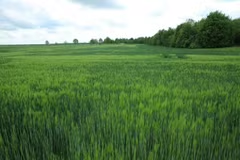
Around 2,353ha of farmland in the province meets organic standards, including more than 2,332ha of spice-growing areas cultivating cinnamon, star anise and ginger that have obtained internationally recognised certifications such as USDA (US), EU and JAS (Japan).

DACE launches organic spice processing, preservation and export plant in Cao Bang (Photo: VNA)

Cao Bang (VNA) – The Cao Bang provincial People's Committee held a working session on September 15 with Developing Agriculture and Consulting Environment Co., Ltd (DACE) and international partners to discuss solutions for developing sustainable green agricultural material zones and connecting local farm produce with European markets.

Speaking at the meeting, Chairman of the provincial People's Committees Le Hai Hoa tressed the province's goal of bringing its high-quality spices and agricultural products deeper into the European market through DACE's connections. Cao Bang is pursuing an agricultural production model based on the principle of "three no's": no genetically modified seeds, no herbicides and no chemical pesticides.

The provincial leader said organic farming development should go beyond increasing economic value, with greater emphasis placed on improving people's livelihoods and ensuring sustainable incomes, particularly for ethnic minority communities, while gradually fostering a culture of green production among local residents.

Cao Bang currently has about 8,400ha of short-term industrial crops and other field crops. Its spice-growing area covers nearly 795ha, including 408ha of ginger and 236ha of turmeric, while medicinal plants account for 116ha. Notably, around 2,353ha of farmland in the province meets organic standards, including more than 2,332ha of spice-growing areas cultivating cinnamon, star anise and ginger that have obtained internationally recognised certifications such as USDA (US), EU and JAS (Japan).

To complete the value chain, DACE is also developing an organic spice processing, preservation and export plant in Dong Khe commune.

At the meeting, DACE Director Tran Van Hieu and international experts spoke highly of Cao Bang's potential for organic agricultural products, particularly ginger, which has begun gaining a foothold in European markets. However, the partners noted that the current production scale remains modest and that cultivation areas need to be expanded to meet growing demand from high-end markets.

In concluding the meeting, Hoa asked provincial departments and agencies to step up communications and raise awareness among farmers and businesses about sustainable production. He also expressed his expectation that the Dong Dang–Tra Linh Expressway, once completed, would help reduce logistics costs and increase returns for producers.

The province aims to have ginger grown in the Thuong Thon area receive Demeter certification – regarded as one of the most stringent standards for biodynamic and organic agriculture – for the first time by December 2026. The move is expected to mark an important breakthrough in transforming local agricultural production practices.

Besides spices, Cao Bang plans to gradually expand its production-processing-consumption ecosystem to other potential agricultural products, including silkworms, bamboo, black jelly, pineapple, passion fruit and guava. The province will also continue calling for international partners to support and connect investors in developing local agriculture in a sustainable and modern direction./.

VNA

See more

Electronic components are produced at a factory in Hanoi. (Photo: VNA)

Hanoi's imports surge 41% in first eight months of 2026

Hanoi aims to achieve average annual export growth of at least 12% during 2026-30, with the city seeking to diversify export markets, boost high-tech and value-added products and reduce reliance on traditional markets.

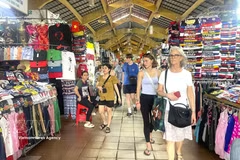
Ben Thanh Market in Ho Chi Minh City attracts a large numbers of domestic and international visitor.( Photo: VNA)

Vietnam targets 50 million international visitors by 2030

The Ministry of Culture, Sports and Tourism has outlined three scenarios for 2027–2030. Under the high-growth scenario, international arrivals would rise 15–18 percent annually to reach 45–50 million, while domestic tourism would reach around 160 million trips. Total tourism revenue is projected at 80–90 billion USD.

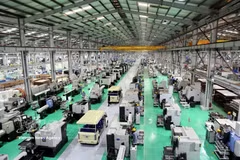
Factories and production facilities in the Chu Lai Open Economic Zone, Da Nang city, are equipped with modern production lines. (Photo: VNA)

Ready-built factories gain from new manufacturing FDI wave

Ready-built factories attracted 73% of new manufacturing FDI in northern Vietnam over the past two quarters, as foreign investment continued to surge at the region's industrial hubs during the first eight months of 2026. The trend points to growing demand for premises that can be put into operation quickly.

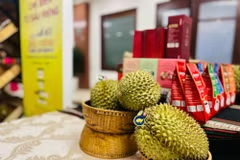
Vietnamese durian industry pivots from volume to value

Vietnamese durian industry pivots from volume to value

Durian has morphed from a high-value crop into a strategic Vietnamese export. But as output climbs and importing markets tighten rules on quality, food safety and traceability, the industry must pivot from volume growth to sustainable value chains, better quality and diversified markets.

A display area for Mid-Autumn Festival cakes at a supermarket (Photo: VNA)

Mid-Autumn Festival cake market heats up at affordable end

Industry insiders say competition is no longer just about the cake itself. Product quality, packaging, brand reputation, delivery services and personalisation are increasingly shaping consumer choices in a market crowded with both domestic and foreign players.

Minister of Foreign Affairs Le Hoai Trung (Photo published by VNA)

Vietnam, India set 25 billion USD trade goal

Vietnam and India agreed to make better use of complementary strengths, ease market access difficulties and facilitate business activities toward achieving the 25 billion USD bilateral trade target.

Delegates at the meeting between Vietnamese businesses operating in Cambodia and the Council for the Development of Cambodia (CDC) on September 14. (Photo: VNA)

Vietnamese businesses seek to expand investment in Cambodia

Vietnam currently has 223 investment projects in Cambodia with total registered capital of nearly 3.4 billion USD. Vietnamese companies operate in agriculture, particularly large-scale farming, finance and banking, telecommunications, aviation, processing, trade and services.

Children visit President Ho Chi Minh's hometown and learn about his childhood. (Photo: VNA)

Vietnam's tourism sector faces labour shortage

A 2026 survey by Hoteljob.vn found that nearly 90% of tourism businesses planned to recruit. In Ho Chi Minh City alone, 89.7% of businesses were hiring, while 71.8% said recruitment was difficult or very difficult. The biggest shortages were among frontline workers, particularly in housekeeping, engineering, food service, front-office operations, and kitchens.