Vietnam targets 50 million international visitors by 2030

The Ministry of Culture, Sports and Tourism has outlined three scenarios for 2027–2030. Under the high-growth scenario, international arrivals would rise 15–18 percent annually to reach 45–50 million, while domestic tourism would reach around 160 million trips. Total tourism revenue is projected at 80–90 billion USD.

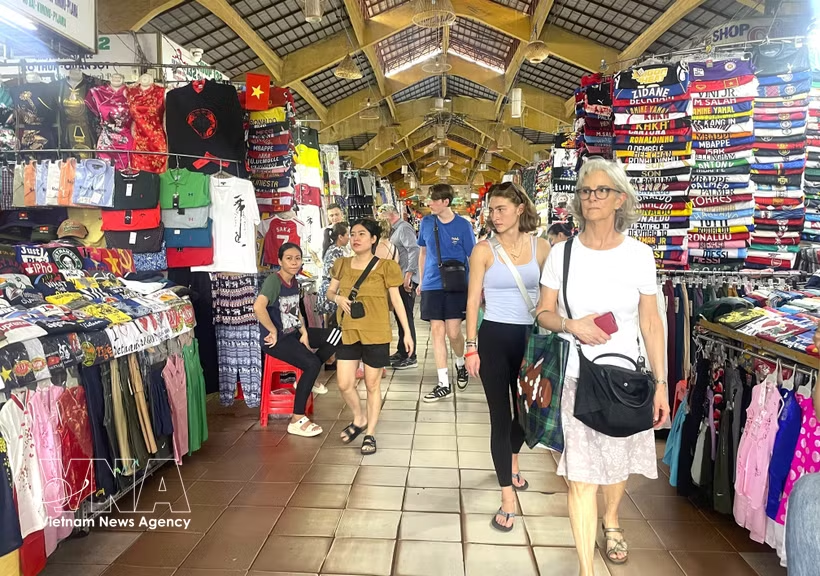
Ben Thanh Market in Ho Chi Minh City attracts a large numbers of domestic and international visitor.( Photo: VNA)

Hanoi (VNA) – Vietnam is targeting 45–50 million international tourist arrivals by 2030, but experts say reaching the ambitious goal will depend on stronger infrastructure, policies, tourism products and growth quality.

The Ministry of Culture, Sports and Tourism has outlined three scenarios for 2027–2030. Under the high-growth scenario, international arrivals would rise 15–18 percent annually to reach 45–50 million, while domestic tourism would reach around 160 million trips. Total tourism revenue is projected at 80–90 billion USD.

The sector aims to welcome 25–27 million international visitors in 2026, compared with nearly 21.2 million in 2025, up 20.4 percent year on year. Nearly 15.9 million arrived in the first eight months of 2026, up 14.4 percent year on year.

Dr. Tran Tuong Huy, Deputy Director of the Institute for Social Tourism Research, said reaching this year’s target would provide a strong foundation, but attracting up to 50 million visitors within four years would require a fundamental shift in development strategy.

Instead of focusing simply on visitor numbers, Vietnam should strengthen the competitiveness of its entire tourism ecosystem, from aviation and destinations to products, services, data and promotion, he suggested, noting that there remains significant potential in Northeast Asia, India, Europe, Australia, the Middle East and North America.

Huy also stressed the need to turn Vietnam’s cultural, culinary and natural assets into distinctive products capable of keeping visitors longer and increasing their spending.

Assoc. Prof. Dr. Pham Trung Luong, former Deputy Director of the Institute for Tourism Development Research, said the target is ambitious but could provide fresh momentum for the sector. He called for stronger and more coordinated policies on visas, aviation, tourism products, promotion and human resources.

Infrastructure is another major concern. Long Thanh International Airport is expected to add substantial capacity, but transport links connecting airports, cities and tourist destinations also need to be developed.

Many destinations still lack basic facilities such as parking areas, public toilets, information centres, piers and local transport. In the Mekong Delta, for instance, river tourism infrastructure remains below the region’s potential.

Luong said the 45–50 million target should be accompanied by quality indicators such as length of stay, visitor spending and tourism revenue.

The goal, he stressed, is not simply to attract more visitors, but to generate greater and more sustainable value from tourism. With improvements in infrastructure, products, policy, human resources and governance, Vietnam would be better positioned to reach the 2030 target./.


VNA

See more

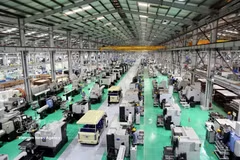
Factories and production facilities in the Chu Lai Open Economic Zone, Da Nang city, are equipped with modern production lines. (Photo: VNA)

Ready-built factories gain from new manufacturing FDI wave

Ready-built factories attracted 73% of new manufacturing FDI in northern Vietnam over the past two quarters, as foreign investment continued to surge at the region's industrial hubs during the first eight months of 2026. The trend points to growing demand for premises that can be put into operation quickly.

Vietnamese durian industry pivots from volume to value

Vietnamese durian industry pivots from volume to value

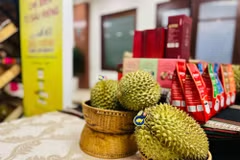
Durian has morphed from a high-value crop into a strategic Vietnamese export. But as output climbs and importing markets tighten rules on quality, food safety and traceability, the industry must pivot from volume growth to sustainable value chains, better quality and diversified markets.

A display area for Mid-Autumn Festival cakes at a supermarket (Photo: VNA)

Mid-Autumn Festival cake market heats up at affordable end

Industry insiders say competition is no longer just about the cake itself. Product quality, packaging, brand reputation, delivery services and personalisation are increasingly shaping consumer choices in a market crowded with both domestic and foreign players.

Minister of Foreign Affairs Le Hoai Trung (Photo published by VNA)

Vietnam, India set 25 billion USD trade goal

Vietnam and India agreed to make better use of complementary strengths, ease market access difficulties and facilitate business activities toward achieving the 25 billion USD bilateral trade target.

Delegates at the meeting between Vietnamese businesses operating in Cambodia and the Council for the Development of Cambodia (CDC) on September 14. (Photo: VNA)

Vietnamese businesses seek to expand investment in Cambodia

Vietnam currently has 223 investment projects in Cambodia with total registered capital of nearly 3.4 billion USD. Vietnamese companies operate in agriculture, particularly large-scale farming, finance and banking, telecommunications, aviation, processing, trade and services.

Octopus processing for export at Huy Nam Company in An Giang province. (Photo: VNA)

New opportunities for Vietnam’s seafood exports

The Vietnam-EFTA Free Trade Agreement brings together two groups of highly complementary economies. EFTA members Switzerland, Norway, Iceland and Liechtenstein have strengths in technology, innovation, finance, clean energy and sustainable development, while Vietnam is one of Asia’s most dynamic economies and is emerging as a major regional manufacturing, trade and investment hub.

The saponin content of Lai Chau ginseng can reach as high as 23.85% in its natural state, a remarkably high level compared to many other ginseng species. (Photo: baolaichau.vn)

Lai Chau ginseng development gains momentum

Blessed with rare and distinctive ecological values, the northern mountainous province of Lai Chau is stepping up efforts to conserve and develop its native ginseng, with the medicinal plant expected to play a growing role in the forest-based economy and local livelihoods.

The Vietnamese delegation poses for a group photo at the third meeting of the Vietnam-Canada Joint Economic Committee (Photo: VNA)

Vietnam, Canada broaden economic cooperation beyond trade

Vietnam is currently Canada’s largest trading partner in ASEAN. Building on the Comprehensive and Progressive Agreement for Trans-Pacific Partnership (CPTPP), the two countries are expanding bilateral economic ties into higher value-added areas such as clean energy, critical minerals, advanced technology, manufacturing and value-chain linkages.

The Index of Industrial Production (IIP) rises 14.4% in August and 11.9% in the first eight months compared to a year earlier. (Photo: VNA)

More momentum needed for economic growth in year-end race

To build momentum for the year-end race, one of the top priorities is to accelerate public investment disbursement, ensuring 100% of the allocated plan is disbursed without allowing funds to be concentrated in the final months of the year.