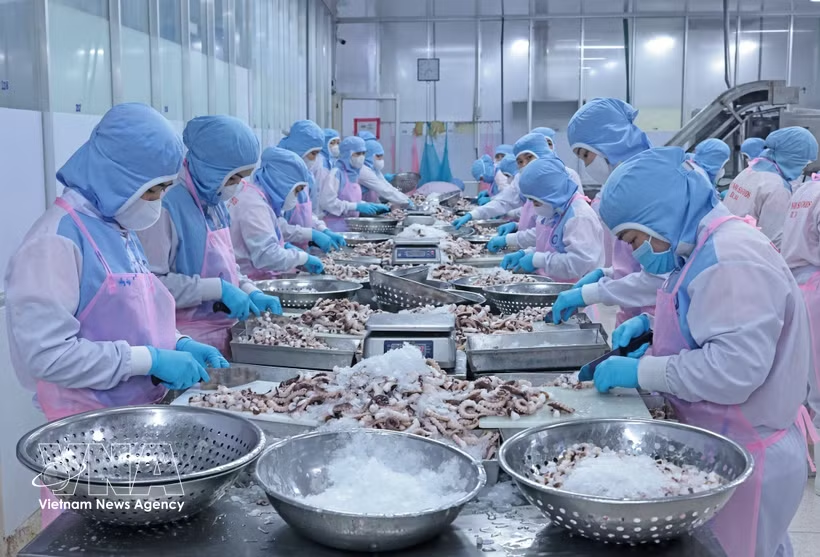
Hanoi (VNA) – The conclusion of negotiations on the Vietnam-European Free Trade Association (EFTA) Free Trade Agreement after 14 years of talks has opened new opportunities for Vietnam’s seafood export sector to access some of Europe’s most developed markets, which boast strong purchasing power and high standards.
However, turning tariff preferences into a competitive advantage will require businesses to meet stringent requirements on quality, traceability and sustainable development.
Expanding market opportunities
The Vietnam-EFTA Free Trade Agreement brings together two groups of highly complementary economies. EFTA members Switzerland, Norway, Iceland and Liechtenstein have strengths in technology, innovation, finance, clean energy and sustainable development, while Vietnam is one of Asia’s most dynamic economies and is emerging as a major regional manufacturing, trade and investment hub.
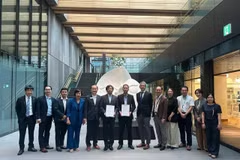
Deputy Minister of Industry and Trade Nguyen Sinh Nhat Tan said the agreement would provide a foundation for economic relations between Vietnam and EFTA countries to enter a new stage of development. With comprehensive, high-standard commitments, it will create a stable, transparent and predictable business environment, giving fresh impetus to trade, investment, technology and knowledge flows between the two sides.
The EFTA bloc has a population of around 15 million, making it relatively small in market size. Its appeal, however, lies in its strong purchasing power and stable demand for high-quality products. With GDP per capita exceeding 100,000 USD in 2025, several times higher than the EU average, EFTA is a promising import market for Vietnamese products in areas of strength, including seafood, agricultural products, wooden furniture and electronics.
In 2025, bilateral trade between Vietnam and EFTA reached 4.8 billion EUR, with Vietnam posting a trade surplus of 2.5 billion EUR, excluding Switzerland’s gold trade.
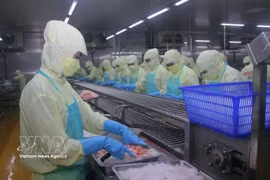
Vietnam’s seafood exports to the EFTA bloc remain modest, concentrated mainly in Switzerland and Norway. Despite the limited trade volume, EFTA markets offer considerable room for growth, particularly in the premium segment.
Economic experts said new-generation FTAs are shifting their focus from trade liberalisation towards improving institutional quality and business competitiveness. Once Vietnamese seafood businesses meet EFTA’s stringent standards, the door to other developed markets will also open wider.
Norway and Iceland, meanwhile, have strong seafood industries, particularly in marine aquaculture, fishing, deep processing and logistics. Norway is the world’s second-largest seafood exporter, ranking just ahead of Vietnam, which is third.
The deal therefore not only creates export opportunities but also prospects for cooperation in technology, supply chain management and new seafood product development. For Vietnamese businesses with strong processing capabilities, high-quality seafood raw materials from EFTA countries could support the development of products for modern retail markets or re-export.
Enhancing competitiveness
As with other new-generation FTAs, tariff preferences will only become a genuine competitive advantage when businesses meet stringent standards on quality, origin and sustainable development.
Nguyen Van Minh, Director of Nghi Son Food Joint Stock Group, said Switzerland, Norway and Iceland all have very high standards. As import tariffs fall, technical barriers and requirements on traceability, product quality and corporate social responsibility are likely to become more stringent.
The period from now until the agreement is signed, expected in the fourth quarter of this year, is a “golden period” for businesses to review their capabilities, complete compliance documentation and prepare market-entry strategies to maximise the FTA’s benefits.
Phung Thi Kim Thu, a market expert at the Vietnam Association of Seafood Exporters and Producers (VASEP), said businesses seeking to effectively tap the EFTA market need to make comprehensive preparations covering farming areas, fishing vessels, raw material supplies, processing plants, traceability and sustainable development certifications.
Many Vietnamese seafood products use imported materials or undergo multiple stages of processing. Businesses should therefore carefully study the agreement’s commitments and rules of origin for each product code, as well as cumulation mechanisms and origin certification procedures, to avoid missing out on its benefits.
Nguyen Thi Hoang Thuy, Vietnamese Trade Counsellor in Sweden concurrently accredited to Denmark, Norway, Iceland and Latvia, said the EFTA market’s high standards were in line with Vietnam’s new development orientation of increasing added value, improving the quality of growth and engaging more deeply in sustainable and responsible supply chains.
Businesses should start preparing now, she advised, adding that they should focus on investing in quality, innovation and green transformation, while establishing early links with import partners. In the new phase, businesses that move ahead on standards will move ahead in the market, Thuy said./.
See more
Ho Chi Minh City eyes municipal, project bonds to support infrastructure development
Great reliance on the state budget and conventional bank lending could put considerable pressure on the financial system, making it necessary to develop new and sustainable sources of funding from both domestic and international capital markets.
Explicit consent required for sharing customers’ credit information from November 1
The borrower’s consent must be given through a clear and specific method that can be printed or copied in writing, including in electronic form or another verifiable format.
Lai Chau ginseng development gains momentum
Blessed with rare and distinctive ecological values, the northern mountainous province of Lai Chau is stepping up efforts to conserve and develop its native ginseng, with the medicinal plant expected to play a growing role in the forest-based economy and local livelihoods.
Interbank market confidence index drops in September
Though the index remained just slightly above the neutral threshold of 50, banks were still relatively optimistic about economic growth and the management of the State Bank of Vietnam (SBV).
Vietnam, Canada broaden economic cooperation beyond trade
Vietnam is currently Canada’s largest trading partner in ASEAN. Building on the Comprehensive and Progressive Agreement for Trans-Pacific Partnership (CPTPP), the two countries are expanding bilateral economic ties into higher value-added areas such as clean energy, critical minerals, advanced technology, manufacturing and value-chain linkages.
More momentum needed for economic growth in year-end race
To build momentum for the year-end race, one of the top priorities is to accelerate public investment disbursement, ensuring 100% of the allocated plan is disbursed without allowing funds to be concentrated in the final months of the year.
Reference exchange rate up 11 VND at week’s beginning
The State Bank of Vietnam set the daily reference exchange rate at 25,607 VND/USD on September 14, up 11 VND from the last working day of the previous week.
Da Nang, Japanese partner sign deal on materials development
The central city and a Japanese partner have signed an agreement to boost scientific research cooperation on technological development of new materials, recycling materials and sustainable building material for green growth.
Arsenale enters Vietnam’s luxury tourist rail market
SJourney operates an eight-day, seven-night 1,726-km heritage journey connecting Hanoi and Ho Chi Minh City, offering passengers a distinctive experience combining scenic travel and cultural exploration.
Vietnam's footwear, bag exports to US top 8 billion USD in eight months
Exports from Vietnam's leather and footwear sector reached more than 2.45 billion USD in August, down 9% from July but up 3% from a year earlier, according to preliminary statistics.
Vietnamese goods gain export opportunities in Türkiye, Spain
Vietrade said the programme helped businesses gain practical market information, identify potential products and partners, and better understand requirements on quality, pricing and distribution. Such direct connections are expected to help companies adapt their products and develop more effective export strategies.
New drivers to power Vietnam’s next growth phase
As localities sharpen their competitive edges, whether in logistics, semiconductors, or advanced technology, the national economy gains a more resilient ecosystem built on regional synergies.
Vietnam moves from export orders to supply chain muscle in trade pivot
A major goal of the GoGlobal Programme for 2026-2030 is to promote Vietnamese products not just by boosting raw exports, but by building stronger brands, increasing competitiveness, and establishing a lasting presence in international markets.
Vietnam, RoK hold strong potential for smart agriculture cooperation: expert
Vietnam can draw valuable lessons from the RoK’s smart agriculture development model, said Vu Phong Lam, Research Professor at the Greenhouse Environment Laboratory, Department of Horticultural Science, College of Agriculture and Life Sciences, Chungnam National University.
French Group sees new opportunities for Vietnam-France industrial cooperation
French cheese maker Bel has operated in Vietnam since 2011 and now considers the country one of the pillars of its development strategy in Asia. Over the past 15 years, the group has gradually established a long-term production base serving both the Vietnamese market and regional demand.
PM Le Minh Hung calls on WTO to continue support for Vietnam
Vietnam actively and responsibly participates in the WTO’s agenda and supports its coordinating role in promoting inclusive and balanced global trade for peace, cooperation and development, while effectively responding to global challenges, said Prime Minister Le Minh Hung.
PM urges Indian groups to invest in clean energy, infrastructure in Vietnam
Prime Minister Le Minh Hung on September 12 called on India's ACME Group and GMR Group to expand investment and cooperation in Vietnam, particularly in clean energy, green industry, high technology and infrastructure, as Hanoi seeks to attract investment in strategic sectors.
Vietnam sees opportunities to deepen engagement with BRICS: Trade Counsellor
Vietnam could deepen cooperation with BRICS through four main areas: expanding trade and market access; attracting and promoting two-way investment; engaging deeper in global supply chains and logistics networks; and advancing cooperation in science-technology, innovation and digital transformation.
Vietnam, France step up financial, investment cooperation
Vietnam is committed to creating favourable conditions for French businesses to invest and operate in the country on a stable, long-term basis, said Minister of Finance Ngo Van Tuan.
Rail freight opens new logistics links between Vietnam, China, ASEAN
The Qinghai-Dong Nai route demonstrates a new direction for international intermodal rail transport, featuring deeper connectivity with hinterlands, shorter transit times and expanded two-way operations.