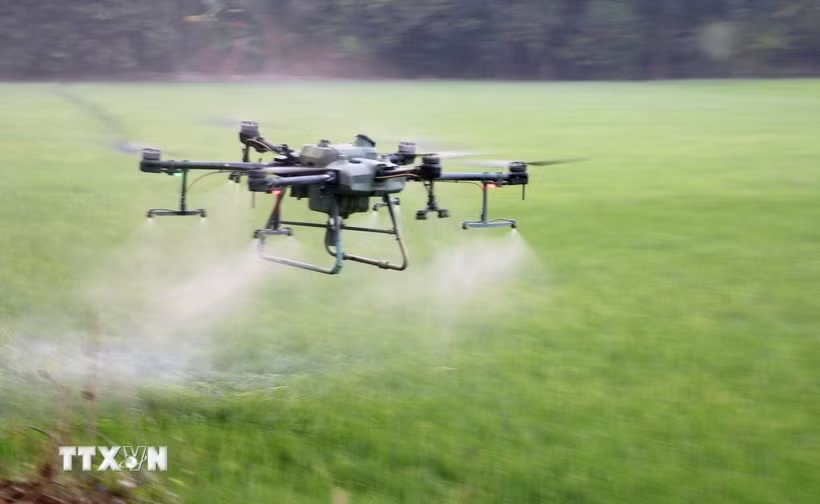
Seoul (VNA) – Combining the Republic of Korea (RoK)’s technological capabilities and management expertise with Vietnam’s production conditions, crop resources and market potential could enable the two countries to develop smart agriculture models that are both modern and practical, thereby increasing the value of agricultural products and delivering tangible benefits to farmers, an expert has said.
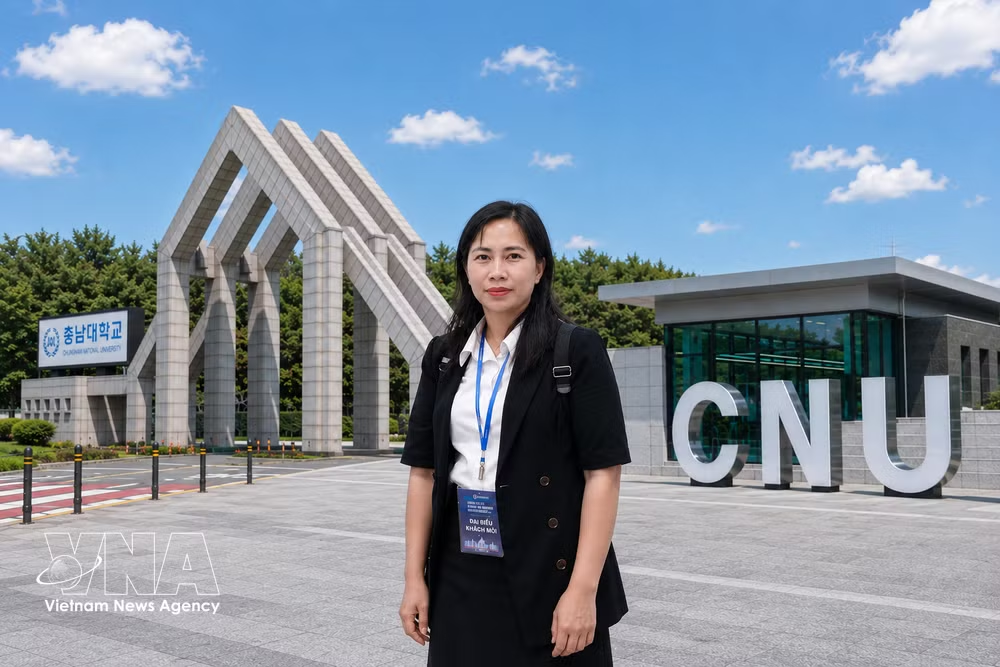
The RoK is making a strong shift toward high-tech agriculture, with smart agriculture identified as a new growth driver, Vu Phong Lam, Research Professor at the Greenhouse Environment Laboratory, Department of Horticultural Science, College of Agriculture and Life Sciences, Chungnam National University, told Vietnam News Agency.
Vietnam can draw valuable lessons from the RoK’s smart agriculture development model, she said.
Having spent 10 years conducting research and working in the RoK, she highlighted the ecosystem linking the Government, universities, research institutes, technology firms and farmers. New technologies are researched and tested through concrete models before being refined and transferred to production, helping bridge the gap between research and practical application.
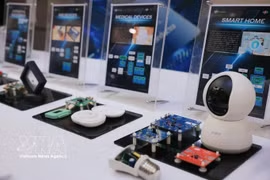
Another key feature is data-driven production management. At smart farms, sensors monitor temperature, humidity, light, CO₂ concentration, nutrients and crop growth. The data supports precise adjustment of growing conditions and AI applications for forecasting crop growth and yields, detecting pests and diseases early, and optimising production.
The RoK also focuses on human resources training and demonstration models, allowing farmers to experience technologies before investing.
Prof. Lam stressed that Vietnam should not replicate the Korean model wholesale. Technologies should be selected and adapted to the local climate, crops, production scale and farmers’ investment capacity. Initially, affordable, easy-to-operate and scalable solutions should be prioritised. Their effectiveness should be measured by lower costs, more efficient use of water and inputs, stable quality and higher farmer incomes.
Looking ahead, she said smart agriculture in the RoK has strong growth potential as the country faces limited farmland, labour shortage, an ageing rural population and climate change impacts. AI, big data, sensors, robots and computer vision are expected to be increasingly integrated into smart greenhouses, vertical farms and plant factories, moving beyond monitoring to forecasting crop conditions, detecting diseases and supporting production decisions.
The sector is also shifting from a sole focus on productivity toward efficient resource use and higher-quality products, including saving water and fertilisers, reducing pesticide use and environmental impacts. However, high initial investment and energy consumption remain challenges, particularly for indoor systems requiring intensive lighting and climate control.
On Vietnam-RoK cooperation, Lam said the two countries have complementary strengths. The RoK has advantages in sensors, automation, AI, greenhouse equipment, post-harvest technologies and production management, while Vietnam has diverse climate conditions, rich crop resources, an abundant workforce and an agricultural market with great development potential.
She suggested expanding joint research on smart greenhouse models suited to Vietnam’s climate, hydroponics, precision nutrient management, controlled-environment farming and post-harvest preservation. AI and computer vision could also support yield forecasting, pest detection and production decisions.
Lam stressed that cooperation should go beyond Vietnam importing Korean equipment, saying that the two sides should jointly research, test and adapt solutions to local conditions, while promoting exchanges among scientists, training young engineers and researchers, developing joint projects and connecting universities, research institutes, businesses and farmers./.