Vietnam sees opportunities to deepen engagement with BRICS: Trade Counsellor

Vietnam could deepen cooperation with BRICS through four main areas: expanding trade and market access; attracting and promoting two-way investment; engaging deeper in global supply chains and logistics networks; and advancing cooperation in science-technology, innovation and digital transformation.

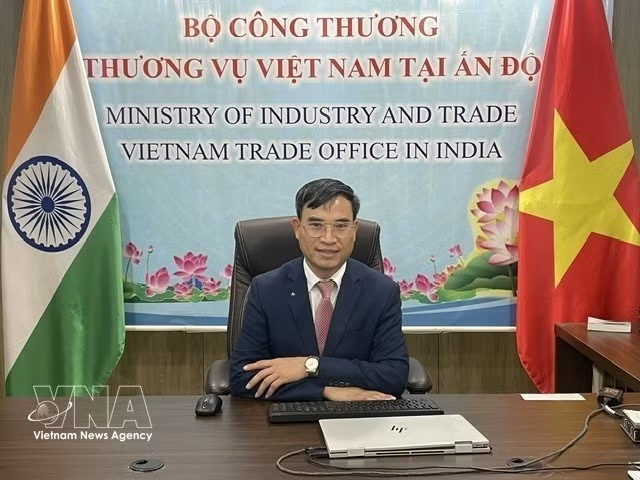
Vietnamese Trade Counsellor in India Bui Trung Thuong (Photo: VNA)

New Delhi (VNA) – Vietnam has significant opportunities to deepen its engagement with BRICS, particularly as India assumes the group’s chairmanship in 2026 and bilateral ties have been upgraded to an Enhanced Comprehensive Strategic Partnership, according to Vietnamese Trade Counsellor in India Bui Trung Thuong.

Talking to Vietnam News Agency correspondents in New Delhi, Thuong said BRICS is opening a special “window of opportunity” for Vietnam. The group now accounts for about 40% of global GDP at purchasing power parity and roughly one-fourth of international trade. According to UN Trade and Development (UNCTAD), intra-BRICS merchandise trade has increased more than 13-fold since 2003, reaching about 1.17 trillion USD in 2024.

​BRICS’ strength lies not only in its economic scale but also in the complementarity of its members. China and India are major manufacturing, consumption and technology centres; Russia and Gulf countries are strong in energy; Brazil has advantages in agriculture, while Indonesia, South Africa, Iran, Ethiopia and Egypt add resources, markets and logistics positions.

For Vietnam, becoming a BRICS partner provides deeper access to the group’s policy, business and expert networks, rather than viewing it merely as a diplomatic forum.

Thuong said India is particularly well positioned to connect Vietnam with BRICS as both a founding member and an influential voice among the Global South. Instead of approaching BRICS as a single market, Vietnam could adopt a “hub-and-spoke” model, with India as a connecting hub, other BRICS members serving as specialised markets and links, and Vietnam contributing goods, services, technology and ASEAN logistics capabilities.

He noted that India’s development priorities and the theme of its 2026 BRICS chairmanship align closely with Vietnam’s current needs, particularly supply chains, micro, small and medium-sized enterprises, sustainable finance and innovation.

China, another BRICS pillar, is Vietnam’s largest trading partner. Statistics from the Department of Customs show bilateral trade reached about 153 billion USD in the first half of this year. Vietnam imports large volumes of materials, components, machinery and equipment for production and export, reflecting its role in regional supply chains. However, Thuong said Vietnam should diversify input sources while increasing the export of higher value-added products to China.

He said infrastructure links with China, including railways, expressways and smart border gates, could help reduce logistics costs and improve the trade balance over the medium and long term.

Russia, another major BRICS member and an energy powerhouse, also offers considerable potential. Bilateral trade reached about 4.77 billion USD in 2025, up 4% year on year, and 3.24 billion USD in the first seven months of this year, equivalent to 68% of last year’s figure.

The official suggested that building on its relations with India, China and Russia, Vietnam could deepen cooperation with BRICS through four main areas: expanding trade and market access; attracting and promoting two-way investment; engaging deeper in global supply chains and logistics networks; and advancing cooperation in science-technology, innovation and digital transformation.

Thuong said India could serve as a key partner in human-resource training, startups and digital application; China in manufacturing and industrial technology; Russia in energy and basic science; and Gulf countries in capital and energy.

He stressed that cooperation should go beyond memoranda of understanding to concrete projects such as joint laboratories, engineer-training programmes, co-investment funds and AI applications in agriculture, logistics and trade, turning commitments into practical results./.

VNA

See more

Quang Tri province continues to mobilise resources to complete storm shelters and anchorage areas for fishermen. (Photo: VNA)

Quang Tri province mobilises resources for fisheries infrastructure

The provincial People's Committee assigned the Department of Agriculture and Environment to prepare an investment proposal for upgrading and expanding the Con Co storm shelter in Con Co special zone. The project has a total investment of 400 billion VND (15.4 million USD) and is scheduled to be implemented from 2026 to 2028.

A farmer in Tan Phuoc 3 commune, Dong Thap province, harvest pineapples. (Photo: VNA)

Digital transformation ushers Dong Thap agriculture into modern era

The province’s farmers are gradually embracing advances in science and technology and digital transformation, providing an important impetus for the agricultural sector to shift toward modern production in line with Politburo Resolution No. 19-NQ/TW dated June 16, 2022.

Customers shop for handicrafts at a trade fair in Hanoi (Photo: VNA)

Hanoi handicrafts reach 89 international markets

Major export products include rattan and bamboo products, sedge and wickerware, fine wooden furniture and handicrafts, ceramics, lacquerware and textiles. Many craft village products feature diverse designs and good quality, gradually enhancing their competitiveness in both domestic and international markets.

General Secretary of the Communist Party of Vietnam Central Committee and President To Lam and French President Emmanuel Macron witness the exchange of cooperation documents and agreements between the two countries. (Photo: VNA)

Finance Ministry, AFD exchange 48.6 million USD financial cooperation deals

An AFD-funded project in Dien Bien province aims to improve the management and efficient use of water resources and strengthen water regulation between river basins, helping secure water supplies for production and daily life while improving resilience to drought, erosion, flooding and climate change.

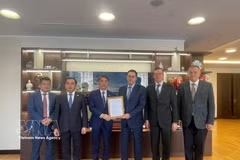
The working session between Vietnamese Minister of Industry and Trade Le Manh Hung and Andrey Slepnev, Minister in charge of Trade of the Eurasian Economic Commission (photo: moit.gov.vn)

Vietnamese minister proposes EAEU open market to Vietnamese goods

Minister of Industry and Trade Le Manh Hung asked the EAEU to consider removing several obstacles to bilateral trade, with a focus on eliminating the threshold safeguard measure on Vietnamese textile and garment products and opening the Russian market further to Vietnamese fishery products.

Vice Chairman of the Hanoi People’s Committee hands over investment policy approval for Moscow House project in Hanoi to the Moscow authorities. (Photo published by VNA)

Hanoi, Russian localities step up cooperation in urban railways, technology

Secretary of the Hanoi Party Committee Tran Duc Thang and the delegation held talks with Moscow authorities to review implementation of the 2025-2027 cooperation programme and discuss key priorities for the new period, including urban transport, science and technology, digital transformation, trade and investment, and cultural exchanges.

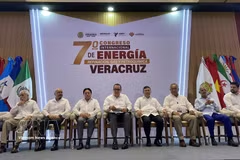
Vietnamese Ambassador to Mexico Nguyen Van Hai (fourth from right) and others attend the seventh Veracruz International Energy Congress. (Photo: VNA)

Vietnam, Mexico strengthen energy, port cooperation

A number of Mexican state Veracruz businesses expressed their wish to organise a delegation to Vietnam to gain first-hand insights into the market, seek partners and explore investment and business opportunities, initially focusing on trade, energy, agriculture and tourism.