Vietnam, India deepen Comprehensive Strategic Partnership after decade of growth

Taking place on September 3, 2016 during Indian Prime Minister Narendra Modi’s official visit to Vietnam, the upgrade of bilateral ties to a comprehensive strategic partnership marked an important milestone, ushering in a new chapter in the ties between the two countries.

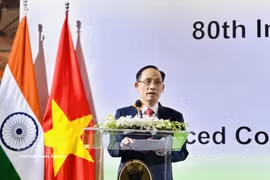
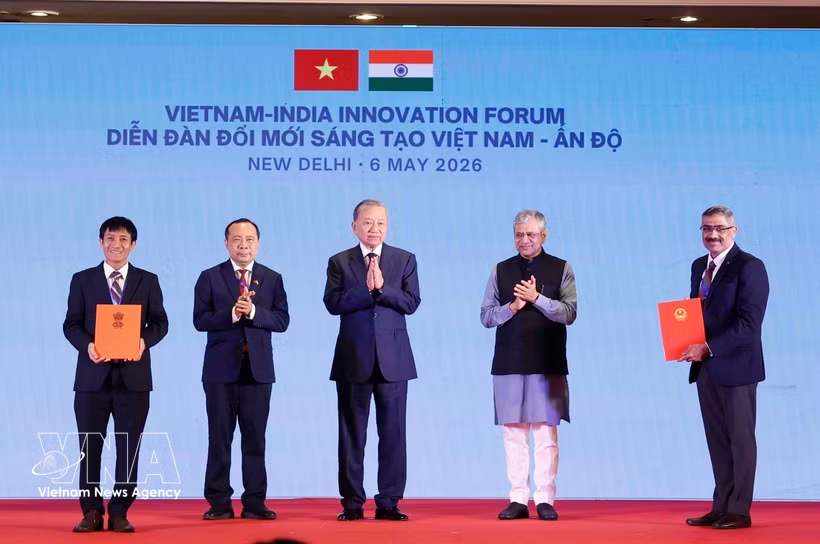
General Secretary of the Communist Party of Vietnam Central Committee and President To Lam (centre) and officials at the Vietnam-India Innovation Forum in New Delhi on May 6, 2026. (Photo: VNA)

Hanoi (VNA) – Ten years after elevating their ties to a comprehensive strategic partnership, relations between Vietnam and India have flourish across a wide range of areas.

Taking place on September 3, 2016 during Indian Prime Minister Narendra Modi’s official visit to Vietnam, the upgrade marked an important milestone, ushering in a new chapter in the ties between the two countries.

Vietnam and India established diplomatic relations on January 7, 1972, during Vietnam’s resistance war for national reunification. Their ties have been nurtured by successive generations of leaders and strengthened by shared values and close people-to-people connections.

The friendship between President Ho Chi Minh and Indian Prime Minister Jawaharlal Nehru laid an important foundation for bilateral relations. The two countries supported each other during their respective struggles for national independence and have continued to cooperate in national reconstruction and socio-economic development.

The two sides first established a comprehensive cooperation framework in May, 2003, upgraded relations to a strategic partnership in July, 2007 and then to a comprehensive strategic partnership in September, 2016.

Over the past decade, political trust has continued to deepen, while defence and security cooperation has become a strategic pillar. Economic, trade and investment ties have also expanded.

India is now Vietnam’s eighth-largest trading partner, while Vietnam ranks 21st among India’s trading partners and fourth in ASEAN. Bilateral trade rose to 16.46 billion USD in 2025 from 5.43 billion USD in 2016, and reached 11.78 billion USD in the first seven months of 2026.

As of March, Indian investors had 503 valid projects in Vietnam with total registered capital of 1.117 billion USD, ranking 26th among 154 countries and territories investing in the country. Vietnam, meanwhile, had 30 investment projects in India worth nearly 150.5 million USD, including a VinGroup project to build an electric vehicle manufacturing plant in Tamil Nadu.

People-to-people exchanges remain a bright spot. Nearly 800,000 Indian tourists visited Vietnam in 2025, four times the 2019 figure. The two countries now have 80 direct flights a week, and have expanded cooperation in aviation and maritime connectivity. India has also supported the restoration of the Cham tower groups at the My Son UNESCO World Heritage Site in Da Nang.

Cooperation in science and technology is gaining new momentum, particularly in innovation, robotics, startups, biotechnology, information technology, artificial intelligence and semiconductors. The two sides are also working together in peaceful nuclear energy and critical minerals.

At multilateral forums, Vietnam and India continue to coordinate closely and support each other, particularly at the United Nations and in ASEAN-led regional mechanisms.

New momentum for upgraded partnership

The state visit to India by General Secretary and President To Lam in May gave fresh momentum to bilateral relations. During the visit, the two countries issued a 52-point Joint Statement on an Enhanced Comprehensive Strategic Partnership, under the theme of “Shared vision, strategic convergence, substantive cooperation.”

The two sides agreed to strive for bilateral trade of 25 billion USD by 2030 in a balanced and sustainable manner and work to remove market-access barriers.

They also identified science and technology, innovation and digital transformation as key drivers for the new phase of relations, with greater cooperation in semiconductors, AI, information technology, 6G, healthcare, critical minerals and peaceful nuclear energy.

Vietnamese Deputy Minister of Foreign Affairs Nguyen Manh Cuong said Vietnam and India share ambitions for national development, and a vision for a peaceful, equitable and rules-based international order.

He highlighted three important “transformations," namely turning political trust into capacity for joint action; translating the upgraded partnership into substantive cooperation that strengthens each country’s autonomy and resilience; and turning strategic proximity into a space for peace and prosperity linking Southeast Asia with South Asia and the Pacific with the Indian Ocean.

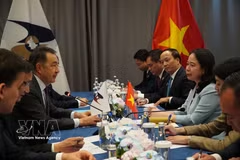
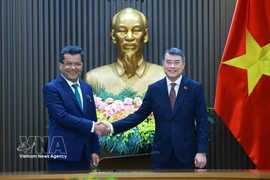
On August 26, Prime Minister Le Minh Hung received Indian Minister of State for External Affairs Pabitra Margherita, who was visiting Vietnam for activities marking the 10th anniversary of the Comprehensive Strategic Partnership.

At the meeting, PM Hung affirmed that Vietnam always supports India in playing an increasingly important role in the international arena, including as the host of the BRICS in 2026. Meanwhile, Margherita stressed that Vietnam is one of the most important partners in India’s “Act East” policy and its Indo-Pacific vision, as well as a key partner in ASEAN.

They agreed that Vietnam and India share many similarities in their visions and development aspirations. Vietnam aims to become a developed country by 2045, while India has set a target of achieving developed-country status by 2047. The elevation of bilateral ties to an “Enhanced Comprehensive Strategic Partnership” has opened up many opportunities for the two countries to accompany, cooperate with and support each other.

The two sides agreed to remove market-access bottlenecks, work toward the 25 billion USD trade target, double two-way investment, strengthen science-technology cooperation and develop high-quality human resources.

Vietnam also encouraged major Indian technology groups to invest in the country, particularly in technology, infrastructure, energy and pharmaceuticals, while the two sides will study increasing direct flight frequencies to meet growing travel, trade and tourism demand./.

VNA
See more

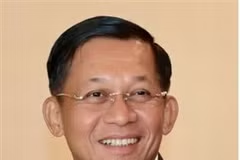
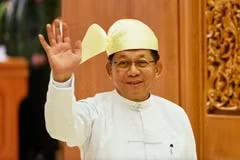
Myanmar President Min Aung Hlaing (Photo published by VNA)

Myanmar President’s Vietnam visit to give fresh impetus to bilateral ties

Vietnam consistently attaches importance to cooperation with Myanmar and supports its socio-economic development and national reconciliation. Myanmar, for its part, values Vietnam’s development achievements and prioritises strengthening the Comprehensive Cooperation Partnership, while facilitating Vietnamese businesses’ investment and operations in the country.

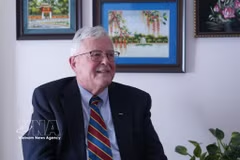
Professor Carl Thayer, a Vietnam specialist at the Australian Defence Force Academy, the University of New South Wales. (Photo: VNA)

Vietnam’s position: from vision to action

From an economy that has made strong use of integration opportunities, Vietnam is increasingly seen as a country capable of proactively creating development space, establishing its position in regional and global networks and making more substantive contributions to common issues.

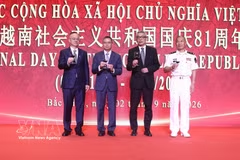
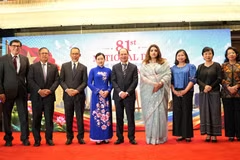
Vietnamese Ambassador to China Pham Thanh Binh (second from left) and representatives of Chinese ministries and agencies toast the 81st anniversary of Vietnam’s National Day at the ceremony in Beijing on September 2. (Photo: VNA)

Vietnamese communities in China, Japan celebrate National Day

The Vietnamese communities in China and Japan are increasingly serving as important links between Vietnam and their host societies, contributing not only to stronger people-to-people ties but also to broader economic, cultural and technological collaboration.

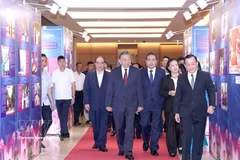
General Secretary of the Communist Party of Vietnam Central Committee and President To Lam, and other Party and State leaders visit an exhibition themed “Simple yet noble examples” on September 3. (Photo: VNA)

Party, State leaders visit exhibition honouring exemplary people

The exhibition comprises two sections, focusing on preserving President Ho Chi Minh’s teachings in the hearts of the people and honouring those who have followed his example, highlighting his thought, morality and style, as well as outstanding individuals and collectives inspired by his teachings.

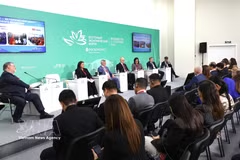
The discussion “Eurasian Connectivity: Challenges and Directions for Promoting Cooperation” is held on September 2 as part of the 11th Eastern Economic Forum in Russia. (Photo: VNA)

EEF 2026: Vietnam calls for action to deepen Eurasian connectivity

Drawing on Vietnam’s and ASEAN’s experience, Consul General Nguyen Viet Kien called for an open, inclusive and mutually beneficial model of Eurasian connectivity, building a peaceful, stable, open, and well-connected Eurasian space that brings benefits to all nations.

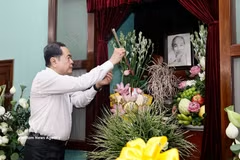
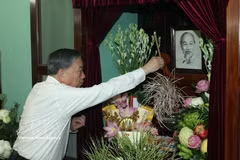
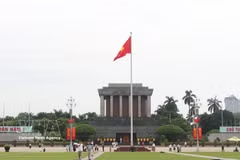
President of the National Assembly Tran Thanh Man offers incense in tribute to President Ho Chi Minh at House 67 in the Ho Chi Minh Relic Site within the Presidential Palace complex in Hanoi on the afternoon of September 2. (Photo: VNA)

NA President pays tribute to President Ho Chi Minh

Speaking with staff at the relic site, NA President Tran Thanh Man urged them to continue their efforts in preserving and protecting artifacts and documents associated with President Ho Chi Minh for future generations, while doing more to introduce his life and great legacy to Vietnamese people and international visitors.

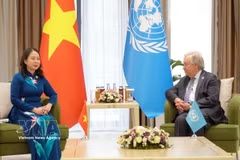
Vice State President Vo Thi Anh Xuan meets with UN Secretary-General Antonio Guterres. (Photo: VNA)

Vice State President meets UN chief, CICA, Togo leaders

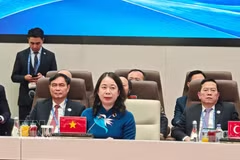
On the sidelines of the expanded Shanghai Cooperation Organisation (SCO Plus) Summit in Bishkek, Kyrgyzstan, Vice State President Vo Thi Anh Xuan held meetings with the UN Secretary-General, the Secretary General of the Conference on Interaction and Confidence Building Measures in Asia (CICA), and the President of the Council of Ministers of Togo.

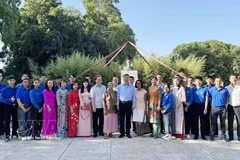
Representatives of the Vietnamese community in Cuba lay flowers at the statue of beloved President Ho Chi Minh (Photo: VNA)

Vietnam, Cuba reaffirm enduring friendship, solidarity

Vietnam attaches great importance to its special solidarity, friendship and comprehensive cooperation with Cuba, and believes the Cuban Party, State and people will achieve new successes in national development, said Vietnamese Ambassador to Cuba Le Quang Long.

Vice President Vo Thi Anh Xuan attended and delivered an important speech at the 2026 Shanghai Cooperation Organisation Plus (SCO Plus) Summit in Bishkek, Kyrgyzstan on September 1. Photo: VNA

Vice President attends Shanghai Cooperation Organisation Plus Summit in Kyrgyzstan

Vietnam stands ready to serve as a bridge to promote cooperation between ASEAN and the Shanghai Cooperation Organisation, strengthen connectivity between Southeast Asia and Central Asia and the broader Eurasian region, thereby expanding areas of cooperation, enhancing strategic autonomy and delivering tangible benefits to people.

Eighty-one years on: Vietnam advances toward a strong and prosperous future

Eighty-one years on: Vietnam advances toward a strong and prosperous future

Eighty-one years since the August Revolution (August 19) and the founding of the Democratic Republic of Vietnam (now the Socialist Republic of Vietnam) on September 2, 1945, the country has made incredible progress in building the nation, transforming itself from a poor, underdeveloped nation into a dynamic economy with an increasingly prominent presence on the global stage.

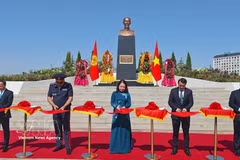
Vice President Vo Thi Anh Xuan and delegates cut the ribbon to inaugurate President Ho Chi MInh statue (Photo: VNA)

President Ho Chi Minh statue inaugurated in Bishkek

Ho Chi Minh Square and the statue of President Ho Chi Minh in Bishkek further demonstrate the affection and respect for President Ho Chi Minh while adding to the symbols of friendship between Vietnam and Kyrgyzstan.

Vietnamese Ambassador to Bangladesh Nguyen Manh Cuong (centre) and Bangladeshi State Minister for Foreign Affairs Shama Obaed Islam (fourth from right) pose for a group photo with ambassadors of several ASEAN member states to Bangladesh. (Photo published by VNA)

Vietnam’s National Day celebrated in Bangladesh

The Ambassador noted that after four decades of Doi moi (Renewal), Vietnam has made significant achievements, becoming a dynamic economy with a GDP of 514 billion USD in 2025, economic growth of 8.02%, total trade turnover of 930 billion USD and more than 38.4 billion USD in registered foreign direct investment (FDI).