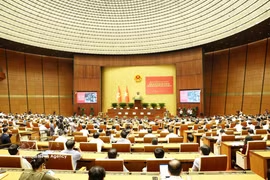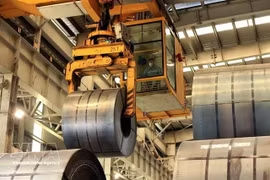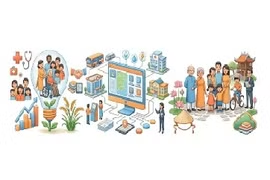
Hanoi (VNA) - Transformations in development and governance models, science and technology, human resources and the ability to respond proactively to external changes are emerging as key factors shaping Vietnam’s new position, commented scholars and overseas Vietnamese experts who highlighted an increasingly clear link between Vietnam’s development vision and its capacity to act following the 14th National Party Congress.
From an economy that has made strong use of integration opportunities, Vietnam is increasingly seen as a country capable of proactively creating development space, establishing its position in regional and global networks and making more substantive contributions to common issues, they noted.
From strategic vision to new growth drivers
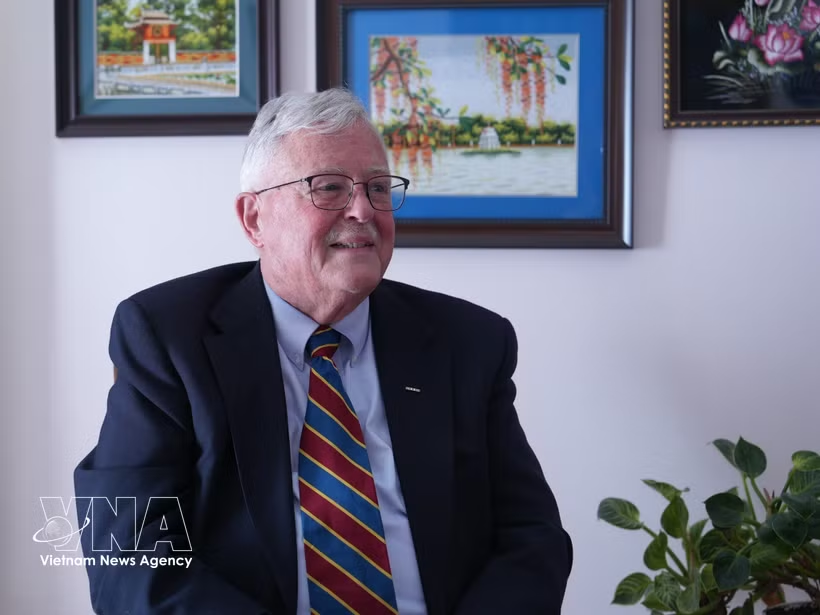
Regarding the implementation of development goals set at the 14th National Party Congress, Professor Carl Thayer, a Vietnam specialist at the Australian Defence Force Academy, the University of New South Wales, said Vietnam’s development orientations need to be viewed against the backdrop of intensifying strategic competition among major powers, prolonged conflicts and a more fragmented international order. This requires Vietnam to pursue its development goals in a coordinated manner while making effective use of its international relations to expand its room for manoeuvre.
Dr. Valeria Vershinina, Deputy Director of the ASEAN Centre at the Moscow State Institute of International Relations (MGIMO), said the Doi moi (Renewal) policy has gradually turned Vietnam into a respected member of the international community, an attractive investment destination and an increasingly important regional manufacturing hub. Vietnam, she said, is now viewed as an emerging middle power capable of playing an active role in regional and international cooperation.
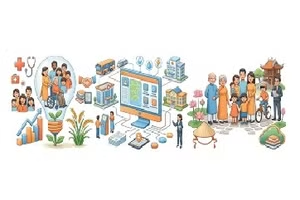
These assessments highlight a reality that Vietnam’s current position has been built on 40 years of Doi moi, but consolidating it requires new drivers of development. This means moving from leveraging existing advantages to creating new ones, and from growth relying heavily on external resources towards higher-quality growth and stronger endogenous capacity. Against this backdrop, four strategic shifts have emerged as an important focus in translating the development orientations of the 14th National Party Congress into action.
Professor Toshiro Nishizawa, a senior research fellow at the University of Tokyo and the Asian Development Bank Institute, said the four shifts not only highlight Vietnam’s development potential but also strengthen its economic and political position and self-reliance amid growing geopolitical uncertainty. The shifts, he said, should be viewed as mutually reinforcing elements aimed at fundamentally transforming the development model. Productivity, knowledge, science and technology, and human capital will increasingly take centre stage, replacing an approach based largely on labour and cost advantages.
Science, technology and innovation have been particularly highlighted among these new drivers. Professor Vu Minh Khuong of the Lee Kuan Yew School of Public Policy in Singapore said Resolution No. 57-NQ/TW on breakthroughs in science and technology, innovation and national digital transformation provides an important framework for strengthening endogenous capacity, technological self-reliance and knowledge, while treating data and artificial intelligence as new strategic infrastructure. The priority, he said, should not be to expand too many programmes, but to concentrate resources on core capabilities and measure them by their actual impact.
Strengthening endogenous capacity also provides a new foundation for international integration. Professor Thayer described Resolution No. 59-NQ/TW on international integration in the new situation as a breakthrough policy that places integration among the key drivers of the new development phase. Whereas integration was previously viewed largely as a gateway for Vietnam to access capital, technology, markets and international experience, the requirement today is higher: Vietnam must have sufficient capacity to contribute to these networks and create value together with others.
From this perspective, endogenous capacity and international integration are not separate processes. The stronger Vietnam’s internal capacity, the more proactively it can integrate; the deeper its integration, the greater its access to resources that can further strengthen that capacity. This forms the link between domestic transformation and Vietnam’s external position: development capacity not only generates growth, but also expands the country’s strategic choices and ability to act.
From participation to shaping
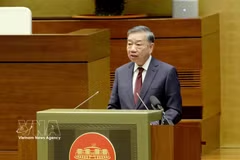
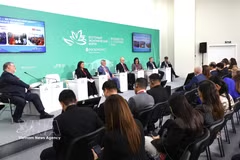
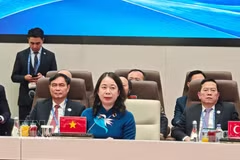
The shift in Vietnam’s position is also reflected in how the country is perceived on international forums. At the 23rd Shangri-La Dialogue in Singapore, the keynote address by General Secretary of the Communist Party of Vietnam Central Committee and President To Lam attracted attention from many scholars. What stood out was not only the content of the speech, but also how they viewed Vietnam’s role in a changing regional architecture.
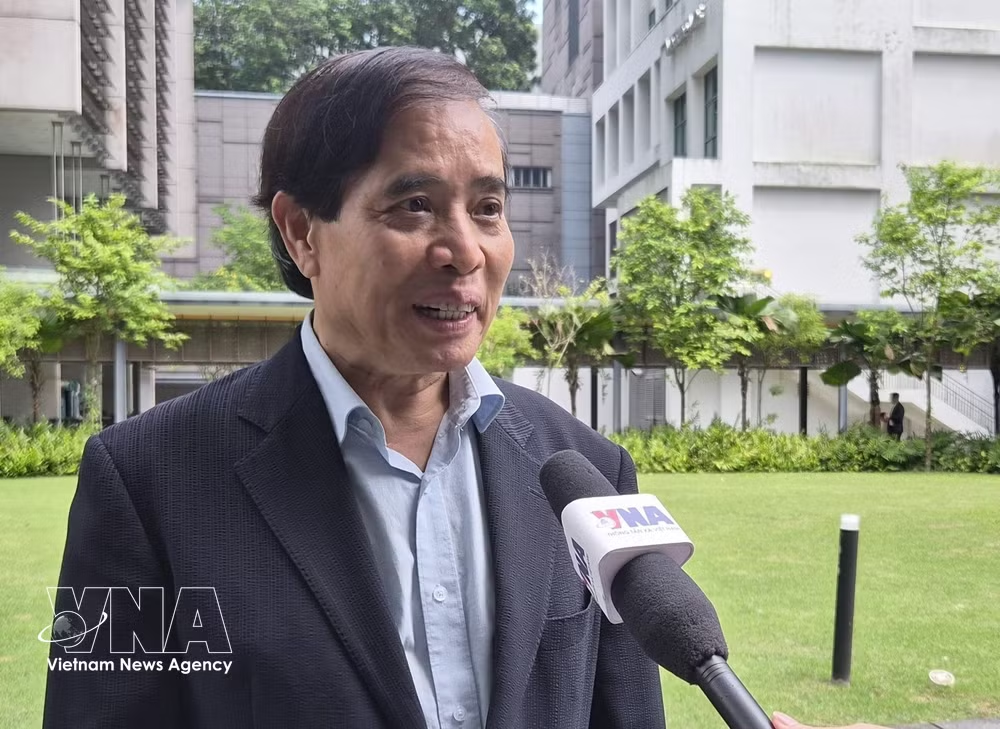
Dr. Ei Sun Oh, principal adviser at Malaysia’s Pacific Research Centre, said Vietnam has stepped onto the regional “stage” with a new mindset, demonstrating a constructive diplomatic role in promoting peace and stability.
From India, SD Pradhan, former Chairman of the Joint Intelligence Committee and former Deputy National Security Adviser, said Vietnam at the Shangri-La Dialogue was not merely participating, but also contributing to shaping regional and global agendas.
Assessments from research centres in different countries point to a common trend, with Vietnam’s role is increasingly measured not only by its achievements, but also by its capacity to contribute to common challenges.
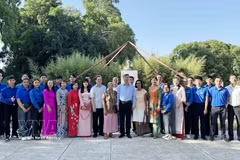
Moving from participation to shaping requires strong endogenous capacity to pursue strategic choices, economic and technological capabilities capable of creating value, and a broad network of relations to turn shared interests into opportunities for cooperation. In this context, overseas Vietnamese resources are also viewed as an important component of national strength.
Resolution No. 23-NQ/TW on overseas Vietnamese affairs in the new situation, issued on August 2, 2026, identifies overseas Vietnamese as “one of the important strategic resources” of the country. Dr. Phan Bich Thien, Chairwoman of the Vietnamese Women’s Forum in Europe, said the Vietnamese community abroad should be viewed as a strategic resource for integration and development, contributing not only economically but also through knowledge, experience, networks and soft power, thereby serving as a bridge between Vietnam and the world. This perspective broadens the concept of Vietnam’s endogenous strength at a time when knowledge, technology and cooperation networks increasingly transcend geographical boundaries.
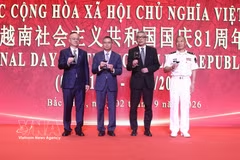
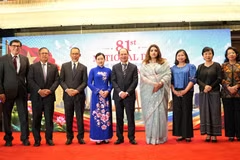
As Vietnam marks the 81st anniversary of National Day, the foundations of its development have undergone fundamental changes. Yet its new position is not a destination that has already been reached. The measure of the next phase will be the ability to turn vision into concrete capabilities and results. If the ongoing transformations generate substantive capacity, Vietnam will not only continue integrating with the world, but also gain greater ability to make choices, contribute and shape spaces for cooperation.
The story of Vietnam’s position will then be reflected not only in growth figures or international rankings, but also in stronger self-reliance, broader development space and a greater capacity to proactively participate, contribute and shape a rapidly changing world./.