Hanoi (VNA) – General Secretary of the Communist Party of Vietnam Central Committee and President To Lam has stressed that the value of the Party's resolutions and directives must be measured by their ability to address practical problems and bring about changes that people can see and feel.
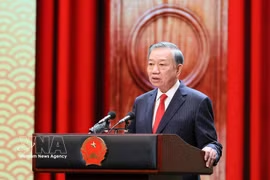
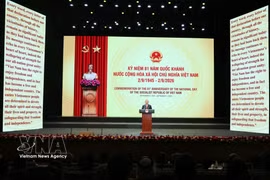
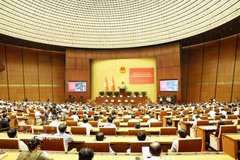
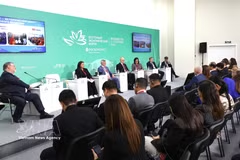
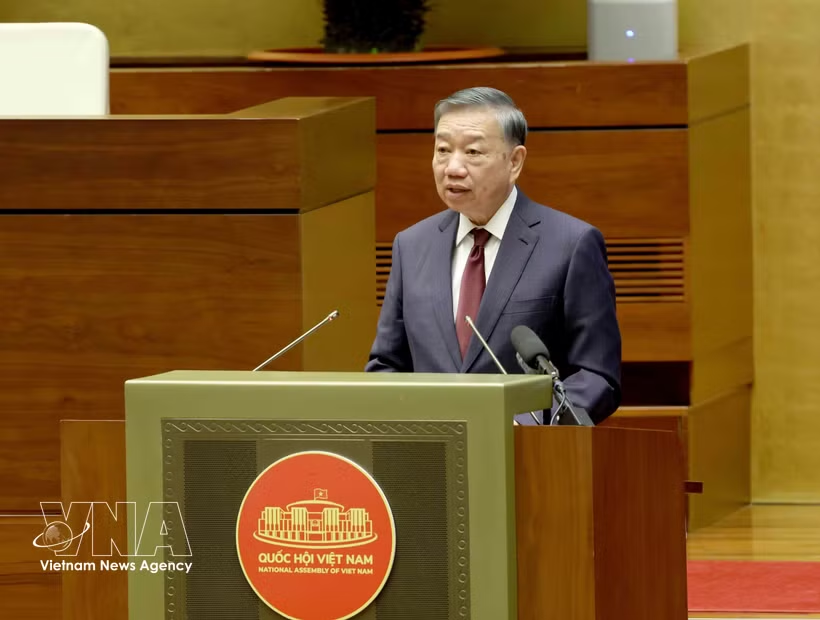
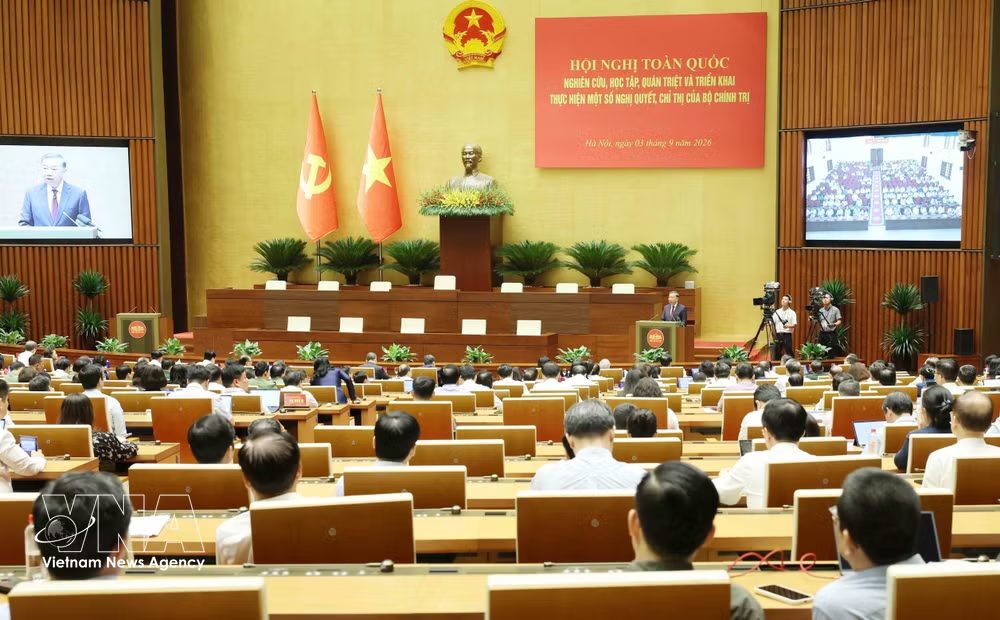
Speaking at a nationwide conference in Hanoi on September 3 to study, disseminate and implement a number of resolutions and directives of the Political Bureau, the top leader said the conference marked not only a period of studying and understanding the documents but also the beginning of a decisive stage: putting them into practice.
He asked every Party committee, agency, locality and Party member to have a clear understanding of what needs to be done, who is responsible, what authority and resources are available, what the deadline is, what product is expected and who will be accountable. The goal is to turn awareness into action and determination into results.
The top leader called on the entire political system to have a common understanding of the new points and the organic links among the six documents presented at the conference. Each document must be properly understood and implemented, while their related tasks should be connected to create combined strength.
The national interest and the legitimate interests of the people must remain the highest standards for evaluating the effectiveness of implementation, he said, calling for further improvements to institutions, clearer division of authority, adequate resources and better risk management.
Institutions must move ahead, maintaining discipline while also opening the way for development. The Party Committees of the National Assembly and the Government, together with relevant agencies, should promptly address overlapping regulations and fill legal gaps that hinder innovation, regional connectivity, tourism development and efforts to attract talents and mobilise resources, the General Secretary and President noted.
He also stressed that decentralisation and delegation of authority must go together with sufficient human resources, finance, data, technology and power control. The central authorities should focus on strategy, institutions, shared platforms and major resources, while provincial authorities should ensure necessary conditions, while commune-level administrations must have sufficient capacity to serve the people.
According to the leader, power control should ensure that innovation moves in the right direction rather than paralysing creativity. At the same time, those who act for personal gain, avoid responsibility or deliberately delay work must be dealt with strictly.
He described time as a non-renewable development resource, warning that delays in institutional reform, decision-making and removing bottlenecks increase costs and result in lost opportunities. “Things that are clear must be done immediately,” he said, calling for obstacles to be addressed at an early stage.
Officials are key to implementation
General Secretary and President Lam identified personnel work, the pioneering spirit, responsibility and exemplary conduct of officials, as well as a culture of implementation, as decisive factors in turning resolutions and directives into reality. Therefore, officials should be selected according to tasks, assigned challenging work and evaluated on the basis of actual results.
Every year, Party committees, agencies and localities should identify difficult tasks and bottlenecks and assign them to officials with sufficient courage, capacity, authority and resources. Those who dare to think and act and produce substantive results should be recognised, protected and entrusted with greater responsibilities. Those who avoid or shift responsibility and work half-heartedly should be screened out and replaced.
Promoting regional links and overseas Vietnamese resources
The top leader called for the organisation of development space and resources based on the overall national interest, linking regional development and tourism with the mobilisation of resources from Vietnamese people living abroad. Regional development should be viewed as a way to organise national growth, rather than simply adding together separate local development plans, he said.
He noted that each locality must clearly identify its role within the region, its key strengths, areas requiring coordination and infrastructure projects with spillover effects. Localities should not all seek to build the same facilities, such as seaports, airports, high-tech parks or financial centres, without considering their actual advantages and effectiveness.
According to the leader, for inter-regional projects, the situation in which each locality acts only within its own boundaries must end. Localities should jointly discuss, decide on, contribute resources to and take responsibility for projects while sharing their benefits.
Tourism development should be placed within the country’s broader development strategy and regional economic space. It should become a new growth driver and contribute to enhancing the country’s soft power.
At the same time, tourism should be developed as an integrated, cross-sectoral and inter-regional economic ecosystem, without sacrificing heritage, cultural identity or the environment for short-term growth.
Regarding more than 6.5 million Vietnamese people living abroad, General Secretary and President Lam affirmed that they are an inseparable part of the Vietnamese nation and a strategic resource. Policies should shift from simply mobilising and caring for the overseas Vietnamese community toward accompanying them, creating mechanisms for their participation and connecting their resources.
He demanded policies to be improved, administrative procedures simplified, and a database and global network of Vietnamese people established, while prejudice should be removed and the past left behind in order to look toward the future.
Overseas Vietnamese should be encouraged to serve as “cultural ambassadors” and “friendship ambassadors” and as participants in external communications, helping strengthen Vietnam’s soft power and contribute to protecting the country from an early stage and from afar.
Policy communication must win public trust
The top leader also called for stronger ideological work and policy communication, tighter discipline in implementation, and the use of data, products, actual changes and public satisfaction to evaluate performance.
He stressed that the ideological work should follow the principle of being proactive, sharp, persuasive and effective. It should remain firm while creatively applying and developing Marxism-Leninism, Ho Chi Minh Thought and the theory of the renewal process.
Policy communication must be timely, accurate and easy to understand, with greater emphasis on explanation, dialogue and listening, the leader noted, adding that public consensus should be built through facts, reason and practical results.
General Secretary and President Lam said cyberspace must be considered as a key area for the ideological work and a channel for listening to the people.
Data, digital technology and artificial intelligence should be used for forecasting and early warnings, but information generated with technological support must be verified and have a clearly responsible person. Technology cannot replace political mettle or the ability to engage in dialogue.
The effectiveness of the ideological work should not be measured by the number of news stories or articles, but by its ability to detect issues early, provide proper explanations, respond quickly and strengthen public trust, the leader said.
Quoting President Ho Chi Minh’s teaching, “One plan, ten measures, twenty determination,” General Secretary and President Lam asked Party committees, agencies, localities and their heads to immediately identify key tasks, assign them to the right people with sufficient authority and resources, and clearly define expected results, deadlines and responsibilities.
Ultimately, he stressed, the decisive factor is the implementation and the responsibility of leaders. Every document must be turned into concrete tasks with clearly identified people in charge and results that can be verified./.