Hanoi (VNA) – Vietnam and the Republic of Korea (RoK) have become major economic partners since they established diplomatic relations in 1992, with bilateral trade and investment continuing to grow.
Their relationship has also been upgraded from a Comprehensive Partnership in the 21st Century in 2001 to a Strategic Cooperative Partnership in 2009 and a Comprehensive Strategic Partnership in December 2022.
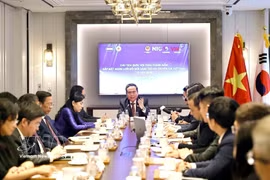
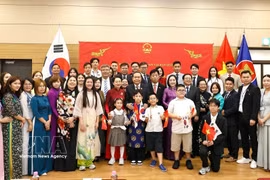
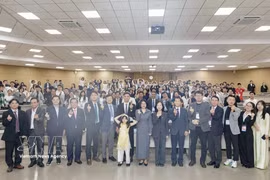
The ongoing official visit to the RoK by National Assembly President Tran Thanh Man is expected to open a new chapter in bilateral relations, including in trade and investment.
Complementary economies
The RoK is currently Vietnam’s second-largest foreign investor, second-largest source of tourists and provider of official development assistance, third-largest trading partner and third-largest market for Vietnamese workers.
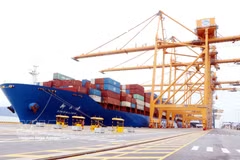
Bilateral trade reached 89.5 billion USD in 2025, up 9.6% from 2024. Vietnam’s exports to the RoK rose 12.7% to 28.9 billion USD, while imports increased 8.1% to 60.5 billion USD, leaving Vietnam with a trade deficit of 31.6 billion USD.
In the first seven months of 2026, two-way trade reached 70 billion USD, up 41% year-on-year. Vietnam’s exports rose 16% to 19 billion USD, while imports surged 52% to 51 billion USD, resulting in a trade deficit of 32 billion USD.
Vietnam mainly exports phones and components, computers and electronic products and components, much of which is produced by foreign-invested enterprises. Meanwhile, the RoK supplies machinery, equipment, components and production materials to Vietnam.
The two sides are working to implement an action plan aimed at raising bilateral trade to 150 billion USD by 2030 in a more balanced manner.
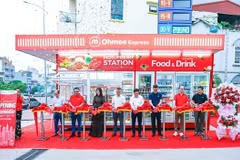
Investment ties have also remained strong. By the end of July 2026, Korean investors had registered 102.6 billion USD in Vietnam through 10,567 projects, making the country Vietnam’s largest foreign investor. Their projects are concentrated in manufacturing and processing, high technology, electronics, automobiles and auto parts, construction and real estate.
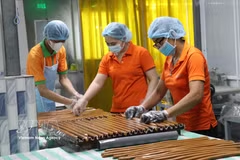
A recent milestone was the first export of processed chicken from CPV Food Binh Phuoc to the Korean market. Pawalit Ua-amornwanit, General Director of C.P. Vietnam, said the shipment would encourage the company to further invest in technology, strengthen deep processing capacity and increase product value.
More room for trade expansion
The Ministry of Industry and Trade’s Department of Foreign Markets said Korean companies showed strong interest in Vietnam International Sourcing (VIS 2026), covering food, logistics, digital technology, mechanics, shipbuilding, seafood and distribution.
Many came not only to source products but also to seek long-term partnerships with Vietnamese businesses, including through business-to-business connections, production partnerships, investment and sustainable supply chains.
Korean alcoholic beverage company HiteJinro, for example, used the event to promote its products and seek Vietnamese processed food products for its global distribution network, while also preparing for plans to expand production in Vietnam.
In logistics and supply chains, companies such as Zenith Union Partners and KCTC International sought Vietnamese partners in logistics, packaging, pallets, distribution and supply. Digital technology firm Megazone explored cooperation in digital infrastructure, data centers, cloud computing and digital transformation.
Shipbuilding and heavy industry also offer significant potential. Korean companies and the Korea Marine Equipment Association (KOMEA) sought Vietnamese suppliers of mechanical components, materials, flanges, pipe fittings and marine equipment for shipbuilding, energy and offshore industries.
At the 15th meeting of the Vietnam-RoK Joint Committee on Trade, Industry and Energy, Minister of Industry and Trade Le Manh Hung and Korean Minister of Trade, Industry and Resources Jung-Kwan Kim agreed to strengthen cooperation in strategic areas toward sustainable, balanced and mutually beneficial growth.
The two sides agreed to continue implementing the action plan targeting 150 billion USD in bilateral trade by 2030. They will also step up cooperation in distribution and logistics, intellectual property protection, commodity and derivatives markets, e-commerce, agricultural market access and competition management.
Energy cooperation was another focus, covering oil and gas, gas-fired power, power grids and renewable energy. Vietnam welcomed Korean companies’ participation in its energy sector and pledged to facilitate their investment in line with Vietnamese law.
The two sides also discussed cooperation in oil reserve facilities. Hung called on the Korea National Oil Corporation (KNOC) to share experience in planning, designing, building and operating oil storage facilities, particularly underground storage, and to help train Vietnamese officials.
To promote bilateral trade in the next period, the Vietnam Trade Office in the RoK said the focus should shift beyond simply increasing total trade. Priorities should include raising Vietnam’s market share in product groups where it remains low, increasing the added value of products where Vietnam already has a strong market share, and enabling more Vietnamese businesses to participate directly in Korean supply chains.
This approach is expected to help bilateral trade develop in a more balanced, substantive and sustainable manner./.
VNA