E-commerce reshapes rules of game

Once fixed fees, payment fees, infrastructure charges and service packages are included, sellers may have to spend around 24.5-27.6% of their revenue on platforms. The figure shows that the era of easy selling and low costs in e-commerce has officially come to an end.

A livestream session promotes green-skinned pomelos grown in Cho Lach commune, Vinh Long province. (Photo: VNA)

Hanoi (VNA) – Vietnam’s e-commerce sector is entering a new phase, with competitive advantages no longer resting primarily on low prices or increasing order volumes, but on operational efficiency, quality, transparency and trust.

Le Anh Tuan, Founder and CEO of Firstcom Digital, said the cost of selling on e-commerce platforms had moved to a new level. Based on a compilation of practical reports and seller communities, once fixed fees, payment fees, infrastructure charges and service packages are included, sellers may have to spend around 24.5-27.6% of their revenue on platforms. The figure shows that the era of easy selling and low costs in e-commerce has officially come to an end.

According to Tuan, platforms do not sell products; they sell access to buyers. After years of investing in users, data, logistics, payment systems and tools to stimulate purchases, platforms have become an important part of market infrastructure.

Experts also point out that when consumers have too many choices, low prices are no longer enough to provide a lasting competitive advantage. Surveys show that 70% of Vietnamese consumers are willing to spend more on trusted sellers that provide consistent service, while 49% will abandon a transaction if a seller has no reviews from previous buyers.

Nguyen Thi Thuy Linh, an office worker in Hanoi, said: “I used to compare prices first, but now my first criterion is whether the shop is an authorised retailer or a reputable seller. The price may be slightly higher, but I feel more confident about the quality, warranty and after-sales service.”

Moreover, requirements concerning taxation, seller identification and information transparency will force businesses to standardise their operations, improve product controls and enhance after-sales services. This is an essential step towards curbing counterfeit goods, imitation products and goods of unknown origin in the digital environment.

In particular, from July 1, 2026, the 2025 Law on E-Commerce and Decree No. 248/2026/ND-CP, detailing a number of provisions of the law, have established a new legal framework aimed at increasing transparency and the accountability of market participants.

Kieu Tien Anh, CEO of the Hi1 e-commerce platform, said the new regulations would steer the market towards greater transparency, safety and sustainable development. They would also increase responsibilities relating to seller verification, product information, consumer protection, data management, traceability and the handling of transactions in the digital environment.

The new phase of e-commerce, however, extends beyond national borders. Artificial intelligence (AI), data and cross-border e-commerce are creating new ways for Vietnamese businesses to reach international customers.

According to Roger Luo, Head of South & Southeast Asia at Alibaba.com, Vietnam remains one of the platform’s positively growing markets, with the number of new exporters joining the platform between April 2025 and March 2026 increasing by around 10% year on year.

Le Hoang Oanh, Director of the Vietnam E-Commerce and Digital Economy Agency under the Ministry of Industry and Trade, affirmed that e-commerce exports are one of the key pillars of the national e-commerce development master plan for 2026-2030. They enable businesses to reach international consumers directly, reduce costs and enhance the standing of Vietnamese brands.

The Ministry of Industry and Trade is implementing the e-commerce law and Decree No. 248 with a focus on stronger verification and traceability, consumer protection and closer coordination among relevant agencies.

For businesses, meanwhile, the key priorities are to accurately calculate costs, take control of data, standardise operations, improve service quality and gradually reduce dependence on any single platform.

For e-commerce platforms, having become part of market infrastructure means their responsibility can no longer stop at facilitating transactions. They must also contribute to building a fair and safe business environment.

Green e-commerce, in particular, needs to be considered across the entire process, from packaging, warehousing and logistics to last-mile delivery, returns, reverse logistics and recycling. Every online transaction has a lifecycle behind it.

Growth, therefore, should not be measured solely by the volume of goods sold, but also by the economic, social and environmental value generated by each transaction./.


VNA

See more

Ho Chi Minh City targets third-quarter growth of over 11% (Photo: VNA)

Ho Chi Minh City targets third-quarter growth of over 11%

Ho Chi Minh City will continue to implement drastic measures to achieve double-digit growth, targeting GRDP growth of at least 11.07% in the third quarter of 2026, 9.43% in the first nine months and 12.3% in the fourth quarter, with a view to completing the full-year goal of 10% or more.

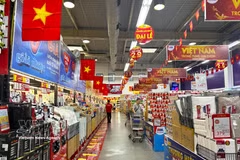
MM Mega Market An Phu supermarket in Ho Chi Minh City is brightly decorated for the National Day holiday. (Photo: VNA)

Domestic consumption up over 13%, tourism continues strong growth

The total retail sales of goods and consumer service revenues in August were estimated at 679.8 trillion VND (26 billion USD), up 1.6% from the previous month and 14.9% year-on-year. In the January-August period, the figure reached 5.24 quadrillion VND, representing a 13.3% increase year-on-year.

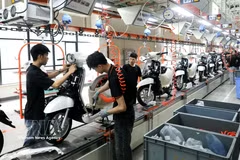
A production line of Onaga Co., Ltd. (Japan) at HANSSIP (Photo: nhandan.vn)

Hanoi moves to maintain appeal to FDI inflows

In the first eight months of 2026, the capital city attracted more than 3.7 billion USD in FDI, equivalent to 83% of the plan set for the year. Newly registered FDI exceeded 572 million USD across 450 projects, up 175.78% in project numbers and 209.46% in capital compared to the same period last year. Additional registered capital topped 492 million USD, while capital contributions and share purchases exceeded 2.6 billion USD.

Saigon Marina IFC is the first private-sector project contributing to realising the goal of developing the Vietnam International Financial Centre in Ho Chi Minh City. (Photo: VNA)

VIFC offers various opportunities to attract forein investment

Turning the VIFC into an effective channel for international capital will require clear rules, quality projects and strong connections between investors and domestic businesses. Meeting these requirements will be key to transforming investor interest into concrete capital flows and investment projects in Vietnam.

Production line at Yadea Vietnam’s smart manufacturing plant, which has an investment of more than 100 million USD, in Tan Hung Industrial Park, Bac Ninh province. (Photo: VNA)

Development model for new era – An inevitable trend

International organisations broadly agree that shifting the growth model from reliance on traditional factors toward technology and innovation is no longer an option for Vietnam, but an imperative of the times.

At a commune administrative service centre in Hung Yen province (Photo: VNA)

Government determined to cut administrative procedures to drive double-digit growth

Resolution No. 258/NQ-CP, dated August 31, 2026, calls for substantive and comprehensive reform, with a focus on maximum cuts and simplification of administrative procedures and business conditions. It also seeks to shift management from pre-licence inspection to post-licence inspection based on risk management, while strengthening real-time, data-driven oversight and putting people and businesses at the centre of public services.

(Illustrative photo: VNA)

Vietnam eyes entry into 40-billion-USD Southeast Asian CCS market: experts

A clear, transparent and stable legal framework would not only enable Petrovietnam to play a leading role in new energy development but also strengthen investor confidence, encouraging both domestic and foreign enterprises to invest, transfer technology and cooperate in developing large-scale CCS projects.

Durian is stockpiled at a company warehouse in Dong Gia Nghia ward, Lam Dong province, for sorting and distribution to the market. (Photo: VNA)

Vietnam targets durian exports of around 4 billion USD in 2026

In the first eight months, Vietnam's durian export revenue was estimated at 1.95 billion USD, of which exports to China alone fetched 1.85 billion USD or 95%. The country is working very hard to earn 4 billion USD from durian exports this year.

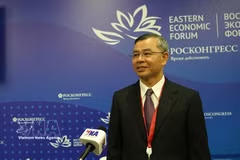
Minister of Finance Ngo Van Tuan grants an interview to Vietnam News Agency correspondents in Russia. (Photo: VNA)

Vietnam businesses poised to tap opportunities in Russia’s Far East: minister

Following the elevation of bilateral ties to a comprehensive strategic partnership and the entry into force of the Vietnam-Eurasian Economic Union Free Trade Agreement, Vietnam-Russia trade increased by an average of 10.8% annually during 2016-2025. However, it reached only about 4.7 billion USD in 2025, remaining modest compared to the two countries' potential and strong political ties.