Vietnam–Russia ties' strategic nature remains resilient: Russian expert

The core message of the top Vietnamese leader’s visit will be the reaffirmation of the partnership’s unwavering strategic nature, according to Dr Valeria Vershinina.

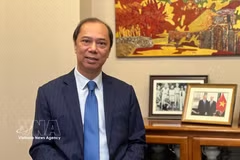
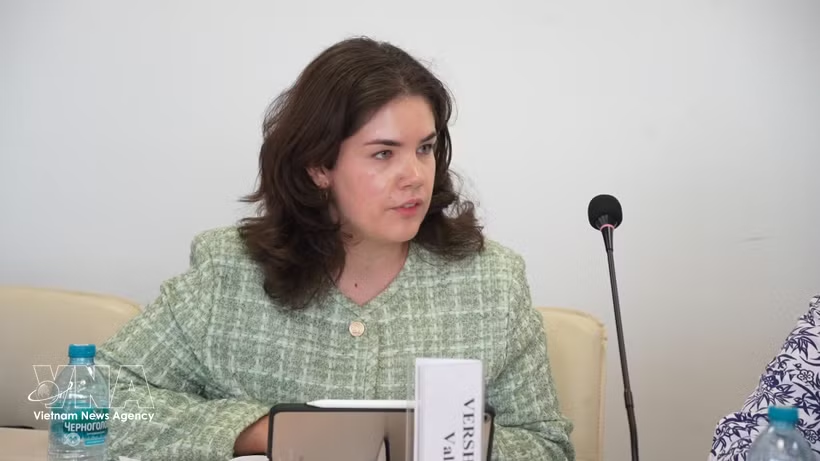
Dr Valeria Vershinina, Deputy Director of the ASEAN Centre at the Moscow State Institute of International Relations (MGIMO) under Russia’s Ministry of Foreign Affairs (Photo: VNA)

Hanoi (VNA) – The upcoming state visit to Russia by General Secretary of the Communist Party of Vietnam Central Committee and President To Lam is expected to reaffirm the unwavering strategic nature of Vietnam–Russia relations despite external upheavals, said Dr Valeria Vershinina, Deputy Director of the ASEAN Centre at the Moscow State Institute of International Relations (MGIMO) under Russia’s Ministry of Foreign Affairs.

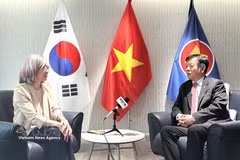
In an interview granted to the Vietnam News Agency, Vershinina said high-level meetings demonstrate the maturity of Russia–Vietnam dialogue, with substantive cooperation continuously advanced at the expert level.

She highlighted Vietnam’s growing role as a “strategic link” in the region, noting it is a completely equal member of regional structures and has proactively promoted many important security initiatives, including the establishment of the ASEAN Defence Ministers’ Meeting Plus (ADMM+).

Vietnam’s role as the country coordinator of the Russia–ASEAN dialogue partnership provides a good opportunity for Moscow to strengthen ties with ASEAN, she said, elaborating that Vietnam clearly understands both Russia’s position and ASEAN’s interests and priorities.

As the first country to sign a free trade agreement with the Eurasian Economic Union (EAEU), Vietnam is well placed to help connect and harmonise integration projects across the broader Eurasian and Asia-Pacific spaces. Russia sees Vietnam as capable of conveying the concept of a Eurasian architecture to the ASEAN public in a natural and non-prescriptive manner while still respecting ASEAN centrality, the expert added.

Against risks of instability in the Asia-Pacific, Vershinina said both Russia and Vietnam support ASEAN centrality. They also share the view that there are risks capable of undermining the principle of indivisible security and running counter to ASEAN’s core principles of non-interference in internal affairs and respect for territorial integrity.

To maintain an open and inclusive regional architecture, she proposed that the two countries work together to enhance existing ASEAN-led mechanisms such as the ASEAN Regional Forum (ARF), East Asia Summit (EAS) and ADMM+, while promoting practical cooperation roadmaps, including in maritime security and cybersecurity.

To translate high-level political trust into concrete results, Vershinina identified the resumption of construction of Vietnam’s first nuclear power plant as a “core symbolic” project. In the long term, this project could create jobs, develop high-quality human resources, strengthen energy security and support Vietnam’s modernisation.

To optimise the bilateral partnership, Russia should focus on targeted projects aligned with Vietnam’s priorities in innovation and technology, she suggested, stressing that implementation quality and progress matter more than the number of projects.

She also called for modernising the Vietnam–EAEU Free Trade Agreement after a decade of enforcement by updating goods lists, simplifying customs procedures and expanding local-currency payments to reduce reliance on third-country currencies and lower business costs.

In digital transformation, the expert highlighted cooperation potential in AI application to agriculture, smart healthcare and training in machine learning. In cybersecurity, she proposed sharing experience in protecting critical infrastructure such as energy, financial and public services facilities and conducting joint exercises.

Vershinina also noted the rapid expansion of Vietnamese studies in Russia, with Vietnamese-language teaching now offered at major universities including the Higher School of Economics, Moscow State Linguistic University, Russian Foreign Trade Academy and Kazan Federal University. Russian businesses' demand for Vietnamese-speaking specialists is also growing.

She suggested joint Vietnamese-language contests, mutual recognition of certificates and research internships to further encourage young Russians’ interest in Vietnam.

For the next generation of experts, leading universities like MGIMO and Vietnamese partners should combine AI and digital platforms with traditional teaching methods, she said, adding that online learning cannot replace the value of direct exchanges.

Vershinina said the core message of the top Vietnamese leader’s visit will be the reaffirmation of the partnership’s unwavering strategic nature.

The strength of bilateral ties over the next decade, she went on, will depend not on the number of documents signed, but on the consistency and determination of both sides in turning the agreed projects into concrete results./.

VNA
See more

British researcher Kyril Whittaker (Photo publish by VNA)

Vietnam has three key factors to turn policies into reality: British scholar

Vietnam is well known for its beautiful natural scenery, and the closeness with which many people live side by side with nature. Even in big cities, one can see cafes which build themselves around fish habitats, or create a green oasis in the middle of an urban area, said British researcher of Vietnamese politics and history Kyril Whittaker.

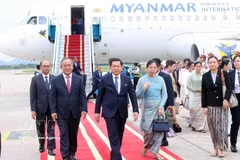
President of the Republic of the Union of Myanmar Min Aung Hlaing and his spouse are welcomed at the Noi Bai International Airport in Hanoi (Photo: VNA)

Myanmar President arrives in Hanoi, beginning official visit to Vietnam

President of the Republic of the Union of Myanmar Min Aung Hlaing and his spouse arrived in Hanoi on September 4, beginning their three-day official visit to Vietnam. The visit holds great importance, contributing to consolidating the traditional friendship and comprehensive cooperative partnership between Vietnam and Myanmar, strengthening political trust, and expanding bilateral and multilateral cooperation.

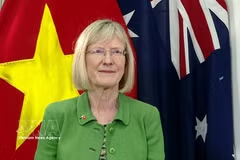
Australian Ambassador highlights Vietnam’s growing regional and global role

Australian Ambassador highlights Vietnam’s growing regional and global role

Australian Ambassador to Vietnam Gillian Bird stressed the importance of translating the Comprehensive Strategic Partnership into tangible results for both countries. She cited General Secretary and President To Lam’s state visit to Australia earlier in August as the perfect example of a substantive and outcomes-focused high-level visit.

Representatives of the Communist Party of Belarus attend the reception in Minsk on September 2 to mark the 81st anniversary of the August Revolution and National Day (September 2, 1945-2026). (Photo: Published by VNA)

Vietnam's National Day celebrated in Belarus

The reception featured Vietnamese songs and dances performed by children from Vietnamese-language classes and Vietnamese students. Members of the Vietnamese community also introduced traditional Vietnamese cuisine to international guests.

Ambassador Nguyen Quoc Dung in an interview with the 5WH platform (Photo: VNA)

Vietnam promotes economic diplomacy, seeks deeper cooperation with US

Vietnam is accelerating its green transition through renewable energy development, efficient energy use, greener production and supply chains, green transport, sustainable agriculture and a circular economy. Vietnam hopes US partners will contribute not only investment but also technology, management expertise, human resource training and support in enhancing implementation capacity.

Foreign leaders send congratulations to Vietnam on 81st National Day

Foreign leaders send congratulations to Vietnam on 81st National Day

On the occasion of the 81st anniversary of Vietnam’s National Day (September 2, 1945–2026), leaders of India, the Republic of Korea, Indonesia, Singapore, Thailand, Malaysia, New Zealand, Australia, Canada, Brunei and Myanmar, as well as the United Nations, have sent messages and letters of congratulations to Vietnamese Party and State leaders.

Politburo Member and Minister of Foreign Affairs Le Hoai Trung (R) receives outgoing French Ambassador to Vietnam Olivier Brochet on September 3. (Photo: Ministry of Foreign Affairs)

Outgoing ambassador pledges continued contributions to France-Vietnam relations

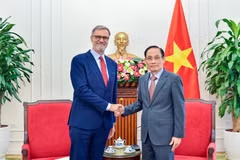
Minister of Foreign Affairs Le Hoai Trung called on Vietnam and France to maintain delegation exchanges and contacts at all levels, and make economic, trade and investment cooperation on par with their potential. He also urged the two countries to seek breakthroughs in science and technology, innovation, energy, aerospace, transport and railways; and deepen defence-security, healthcare, education-training, cultural and local-level collaboration.

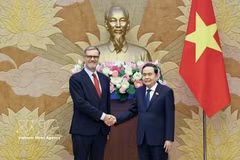
National Assembly President Tran Thanh Man (R) receives French Ambassador to Vietnam Olivier Brochet in Hanoi on September 3. (Photo: VNA)

NA President receives outgoing French Ambassador

France attaches importance to Vietnam’s increasingly prominent role and position in the region and the international arena, and wishes to accompany Vietnam in its new era of development, said outgoing French Ambassador to Vietnam Olivier Brochet.

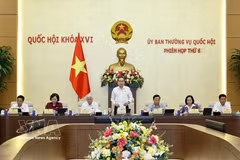
NA President Tran Thanh Man speaks at the sixth session of the National Assembly Standing Committee. (Photo: VNA)

NA Standing Committee's sixth session opens

Preparations for the National Assembly's second session must begin early, with close coordination from the outset. Issues that qualify for the session should be included, while documents must be submitted on time so that deputies have sufficient information and time to make high-quality decisions on important issues with long-term impacts, said top legislator Tran Thanh Man.

Head of the Party Central Committee’s Commission for Policy and Strategy Nguyen Thanh Nghi speaks at the national conference on September 3. (Photo: VNA)

Party official presents resolution on regional development

The resolution directs Vietnam to effectively restructure, manage and use regional development space in line with national planning, leveraging the strongest advantages, competitive strengths and cultural identity of each region and locality, said Head of the Party Central Committee’s Commission for Policy and Strategy Nguyen Thanh Nghi.

Minister of Foreign Affairs Le Hoai Trung speaks at the national conference on September 3 on studying, disseminating and implementing a number of Politburo resolutions and directives. (Photo: VNA)

Clear step forward in Party’s thinking on overseas Vietnamese affairs

The first is to elevate awareness of the position and role of the Vietnamese community abroad, he said. The resolution reaffirms that overseas Vietnamese are an inseparable part of the Vietnamese nation, while identifying them as one of the country’s important strategic resources, a bridge connecting Vietnam with the world, and partners directly contributing to national construction, development and defence.