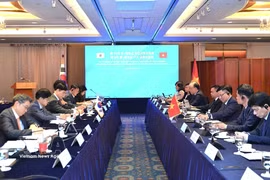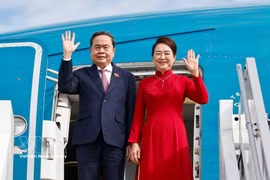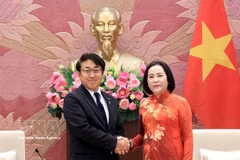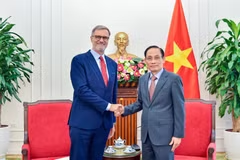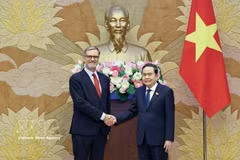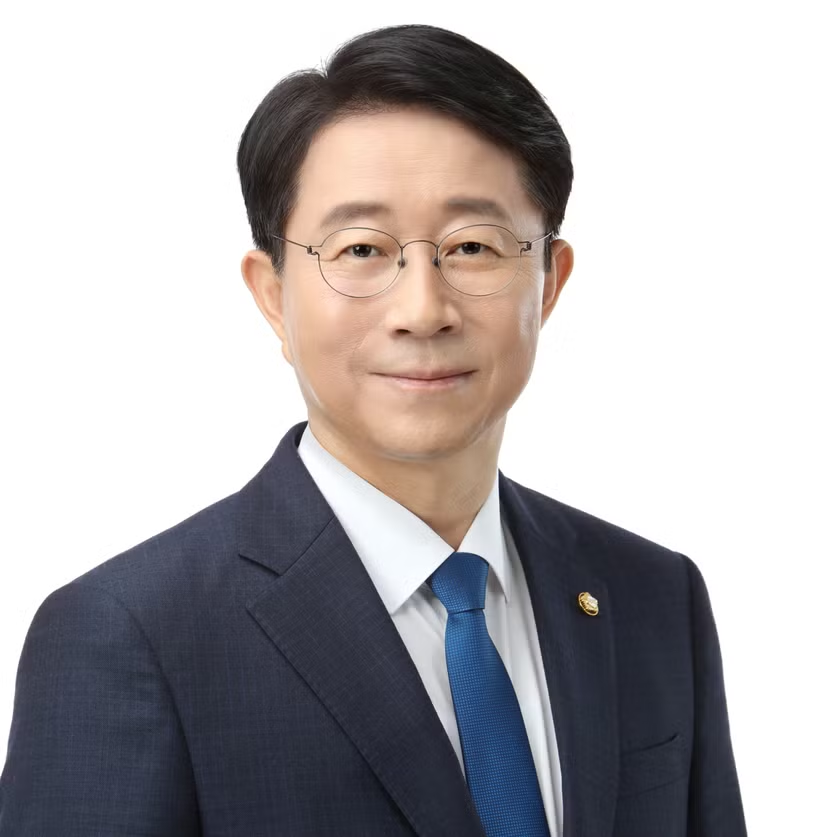
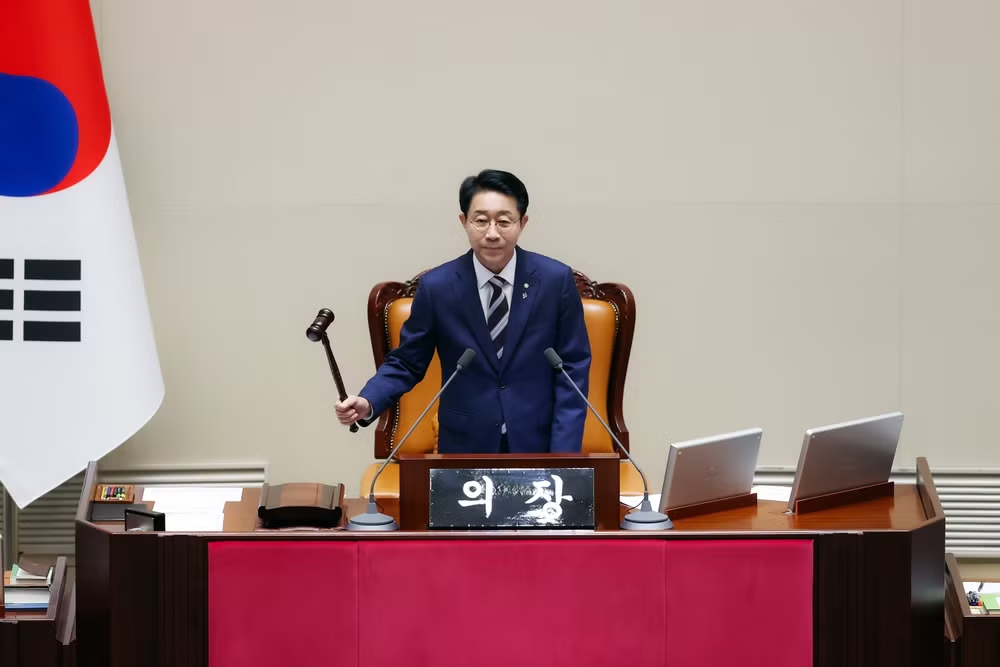
Hanoi (VNA) – At the invitation of Speaker of the National Assembly of the Republic of Korea Cho Jeong-sik, National Assembly President Tran Thanh Man, his spouse and a high-ranking Vietnamese delegation will pay an official visit to the RoK from September 6–9. On this occasion, the Vietnam News Agency (VNA) correspondents in Seoul had an intensive interview with Speaker Cho on the purpose of the visit, prospects for cooperation between the two parliaments, and the strategic areas of cooperation that the two countries are working towards in the future.
The following is the full text of the interview:
Vietnam and the Republic of Korea are looking ahead to the 35th anniversary of the establishment of diplomatic relations. In your view, what prospects does Vietnamese National Assembly Chairman Tran Thanh Man’s upcoming visit to the Republic of Korea open up for cooperation between the National Assembly of Vietnam and the National Assembly of the Republic of Korea, and how will it contribute to the Comprehensive Strategic Partnership between the two countries?
On behalf of the National Assembly of the Republic of Korea, I sincerely welcome the visit by H.E. Tran Thanh Man, Chairman of the National Assembly of the Socialist Republic of Vietnam.
Since the inauguration of the Lee Jae-myung administration last June, our two countries have held three high-level exchanges in just six months. This is a testament to the close cooperation between Korea and Vietnam.
Chairman Tran’s visit follows the visit to Vietnam by former National Assembly Speaker Woo Won-shik last November, marking an exchange of visits by the parliamentary leaders of our two countries within less than a year. Chairman Tran is a particularly special guest, as he is the first foreign parliamentary speaker whom I will have the honor of welcoming since taking office.
As we celebrate the 35th anniversary of the establishment of diplomatic relations next year, I believe it will be a turning point in our relations in which to set up new milestones for the development of our friendship and cooperation. Chairman Tran’s visit at this important juncture will contribute to the continued development of inter-parliamentary exchanges and serve as important momentum for further elevating the level of bilateral cooperation.
In November 2025, we signed a memorandum of understanding (MOU) to vitalize and institutionalize cooperation between our two parliaments. I believe this visit will be an opportunity to facilitate the implementation of the MOU, and I look forward to discussing ways to further enhance our parliamentary exchanges and cooperation. I also hope to exchange views on ways to further advance our bilateral relationship, which was elevated to a Comprehensive Strategic Partnership in 2022.
Parliaments are an important pillar of state governance and play a vital role in facilitating and supporting bilateral cooperation. I believe we can further develop bilateral relations through active exchange and cooperation between our governments, including reciprocal visits by leaders of our two countries, as well as through the faithful implementation of bilateral agreements. I hope to have an in-depth discussion with Chairman Tran on how our parliaments can facilitate and provide the necessary legislative support in this process.
In your view, which areas of strategic cooperation should the two countries prioritize in this new phase of development?
Korea and Vietnam are each other’s third-largest trading partner, while Korea is Vietnam’s largest foreign investor. Against this backdrop, our two countries have continued to build a strong partnership. Our countries have set a goal of increasing bilateral trade to USD 150 billion by 2030, and are exploring ways to expand cooperation in infrastructure projects in Vietnam, including new city development, high-speed railways, nuclear energy, and power grids.
Advanced fields, such as artificial intelligence, semiconductors, and biotechnology are also promising areas for the future development of our bilateral relations. Our two countries have agreed to expand cooperation in advanced fields in accordance with the Framework for a Master Plan on Science, technology and Innovation Cooperation. The Vietnam-Korea Institute of Science and Technology (VKIST), established in Vietnam with Korea’s support, is a symbol of our shared commitment to building a promising future through cooperation in science and technology. I am also pleased that our two countries are cooperating in critical minerals, and hope that this cooperation will produce tangible and meaningful results.
Strengthening security cooperation commensurate with our comprehensive strategic partnership is also important. I believe we should maintain regular high-level exchanges in the area of security and further deepen cooperation in national defense and the defense industry. Furthermore, I hope that our two parliaments can strengthen cooperation in combating increasingly serious transnational crimes and jointly address non-traditional security challenges, including cybersecurity.
With some five million people traveling between our two countries every year, ensuring the safety and protecting the rights and interests of both our peoples are becoming increasingly important. The Korean National Assembly will provide support so that more than 100,000 Korean and Vietnamese multi-cultural families can settle effectively in both societies and become fully integrated into their local communities.
How do you assess the coordination between the two countries’ National Assemblies in strengthening and completing the legal framework to create new momentum for bilateral cooperation?
Cooperation between our two National Assemblies plays a pivotal role in institutionalizing bilateral agreements and building a solid legal foundation for stable cooperation. While summit meetings and MOUs at the government level provide the general framework that guides the direction of bilateral relations, legislative and institutional improvements led by the parliaments become the practical driving force to move our shared initiatives forward and actually implement them.
In particular, legal predictability is essential for businesses, which play a key role in advancing the shared prosperity of our two nations, to invest with confidence and operate actively. In this regard, the Korean National Assembly is committed to laying the foundation for broader bilateral economic cooperation by refining laws and institutions in such areas as taxation and investment protection in close alignment with the needs of the business community.
In addition, as various agreements are reached to further advance our Comprehensive Strategic Partnership, we hope that the two parliaments will expedite legislative follow-up measures and budgetary deliberations.
We also should contribute to improving laws and institutions which directly affect the lives of our peoples.
I hope that the two parliaments will work together to strengthen an effective legal safety net to ensure the safety of people visiting or living in each other’s countries and to support multicultural families.
It is my firm belief that active communication and exchanges will not only strengthen the friendly ties between our two parliaments, but also provide a strong legal and institutional foundation for the sustainable shared prosperity of Korea and Vietnam.
Vietnam and the Republic of Korea are home to communities of more than 350,000 Vietnamese people in the Republic of Korea, and nearly 190,000 Korean people in Vietnam. In your view, what policies and initiatives are needed to further promote the role of these two communities in strengthening people-to-people exchanges and expanding cooperation in the cultural and social spheres?
The 350,000 Vietnamese nationals residing in Korea and the 190,000 Korean nationals residing in Vietnam serve as invaluable bridges connecting our peoples’ hearts and key players in advancing our Comprehensive Strategic Partnership.
We are “in-law nations” bound by 100,000 multicultural families with mutual visits approaching five million each year. Against this backdrop, we look forward to close inter-parliamentary cooperation to safeguard the rights and interests of our two peoples.
The most important starting point is creating an environment where our peoples can settle in each other's country with confidence.
The Korean National Assembly will remain committed to providing continued support for Korean-Vietnamese multicultural families, Vietnamese workers and students, so that they can enjoy the respect and legal rights in Korean society.
I hope that the Vietnamese National Assembly will also offer active support in improving the living and investment environment for Korean nationals and entrepreneurs in Vietnam.
We will continue our efforts for more active people-to-people exchanges between our two nations.
Vietnam is already the second most-visited country for Koreans. Therefore, greater attention should be given to promoting more active two-way exchanges.
It is also essential for our youths, who will lead the future of our two nations, to interact more actively through scholarships and mutual exchange programs.
We should continue to support Korean-Vietnamese multicultural families as they bind us together as “in-laws.”
In this regard, we will strengthen support for Vietnamese women who have migrated to Korea through marriage to ensure their successful settlement in Korean society. The Korean National Assembly will also pay close attention to supporting the children of these multicultural families so that they can grow into future leaders of our bilateral partnership, with a deep understanding of the languages and cultures of both countries.
We hope that our two National Assemblies will further deepen friendship and mutual trust by providing strong support for the safety and happiness of these 540,000 people.
Against the backdrop of numerous challenges facing the region and the world, how do you assess the prospects for cooperation between the National Assembly of Vietnam and the National Assembly of the Republic of Korea at multilateral parliamentary forums, particularly in contributing to peace, stability, and sustainable development, as well as addressing common regional and global challenges?
In the face of unprecedented challenges—such as complex geopolitical crises, supply chain instability, and climate change—cooperation between our parliaments is crucial for Korea-ASEAN cooperation and stability in the Asia-Pacific region.
In particular, the Korean government upgraded ROK-ASEAN relations to a Comprehensive Strategic Partnership (CSP) in 2024, and at last year’s ASEAN Summit, the President proposed the ROK-ASEAN CSP, which is aligned with the ASEAN Community Vision, pledging all-around cooperation with ASEAN. Vietnam is a core ASEAN member and Korea’s key regional partner. The Korean National Assembly will therefore cooperate closely with Vietnam to develop relations not only on a bilateral level, but also through multilateral inter-parliamentary fora such as the Inter-Parliamentary Union (IPU) and the Asia-Pacific Parliamentary Forum (APPF)./.