Vietnam, RoK step up cooperation in key economic sectors

Regarding key minerals, they agreed to speed up necessary procedures to begin construction of the Vietnam-RoK key minerals supply chain technology centre. Vietnam will also work with relevant agencies to address difficulties that Korean businesses are facing when investing in the sector.

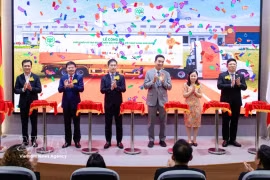
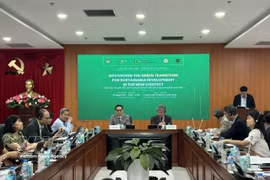
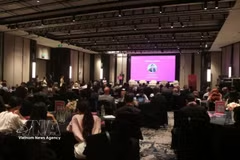
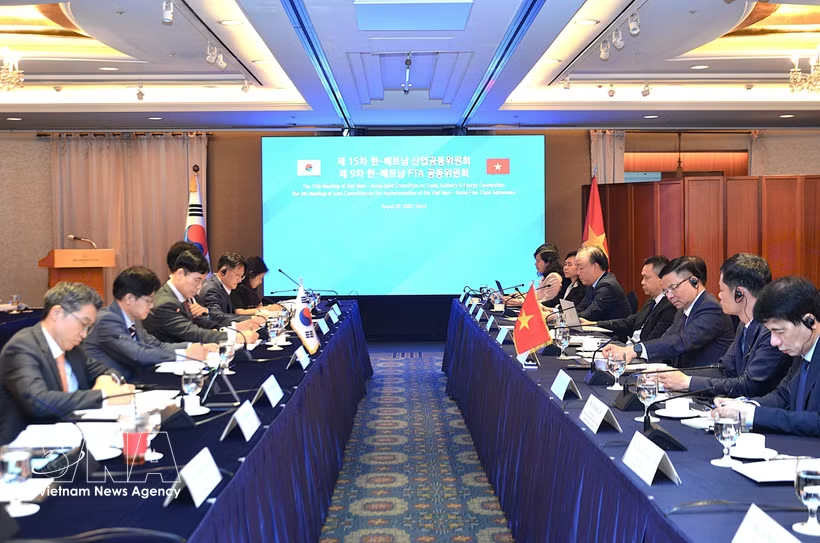
The 15th meeting of the Vietnam-RoK Joint Committee on Trade, Industry and Energy Cooperation and the ninth meeting of the Vietnam-RoK Free Trade Agreement (FTA) Committee are held in Seoul on August 26. (Photo: VNA)

Seoul (VNA) – Vietnam and the Republic of Korea (RoK) have agreed to expand cooperation in key minerals, energy security, industrial technology and other promising sectors, with the RoK set to support Vietnam in building its first underground oil storage facility.

The agreement was reached at the 15th meeting of the Vietnam-RoK Joint Committee on Trade, Industry and Energy Cooperation and the ninth meeting of the Vietnam-RoK Free Trade Agreement (FTA) Committee, held in Seoul on August 26.

The meetings were co-chaired by Vietnamese Minister of Industry and Trade Le Manh Hung and RoK Minister of Trade, Industry and Energy Kim Jung Kwan.

The two sides discussed measures to strengthen economic and trade ties and put into practice cooperation outcomes from high-level meetings between the two countries in August 2025 and April 2026.

Regarding key minerals, they agreed to speed up necessary procedures to begin construction of the Vietnam-RoK key minerals supply chain technology centre. Vietnam will also work with relevant agencies to address difficulties that Korean businesses are facing when investing in the sector.

In energy and resources, the two countries will promote long-term cooperation in supply chains, including joint crude oil storage and emergency response mechanisms. They also agreed to facilitate liquefied natural gas (LNG) power projects and power grid infrastructure, while continuing policy cooperation in nuclear and renewable energy.

During the meetings, Petrovietnam Oil Stockpile Company Limited (PVOS) and the Korea National Oil Corporation (KNOC) signed a memorandum of understanding on cooperation in building an oil storage facility in Vietnam.

Vietnam is working to develop its first underground oil storage facility to help respond to possible disruptions in oil supplies. Based on its experience in building and operating oil storage facilities, KNOC will provide consulting and technical support throughout the design, construction and operation of the facility. The two sides will also cooperate in operation, maintenance and professional training.

A Korean representative said the cooperation would help improve Vietnam's oil storage capacity while creating a basis for broader cooperation to strengthen oil supply chains in the Asia-Pacific region.

In trade, the two countries aim to raise bilateral trade to 150 billion USD by 2030. Two-way trade increased from 79.4 billion USD in 2023 to 86.7 billion USD in 2024 and 94.6 billion USD in 2025. The figure reached 62.4 billion USD in the first half of 2026. The Korean Government forecasts that full-year trade could exceed 100 billion USD for the first time.

The two sides will also step up negotiations on sanitary and phytosanitary measures for agricultural products, aiming to complete talks on Vietnamese lychee and passion fruit, as well as Korean Unshu mandarins and kiwifruit.

They also agreed to strengthen cooperation in digital transformation in distribution and logistics, intellectual property protection, and the detection and handling of counterfeit goods, while promoting cooperation between the two countries' competition authorities./.


VNA
See more

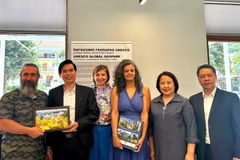
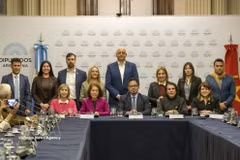
Lang Son's delegation works with the management board of the Chelmos-Vouraikos Global Geopark to exchange experiences regarding the management, conservation, and promotion of the global geopark's values. (Photo: Embassy of Vietnam in Greece)

Vietnam, Greece step up subnational cooperation

Addressing the event, Vietnamese Ambassador to Greece Pham Thi Thu Huong stressed that as a bridge between Vietnamese localities and partners in host countries, the embassy’s organisation of the dialogue was among its key economic diplomacy activities in 2026. The initiative aims to support localities in strengthening ties with Greek partners, particularly businesses, thereby contributing to their socio-economic development and that of the country as a whole.

The Ben Thanh–Can Gio metro line will run alongside Rung Sac road, helping lay the foundation for the green transition of Can Gio. (Photo: VNA)

Vietnam seeks to unlock 700 billion USD for green transition

To fulfil its commitment to achieve net-zero emissions by 2050, Vietnam needs to mobilise around 700 billion USD over the course of its long-term transition. The scale of the funding requirement highlights the need to expand sources beyond the State budget, particularly private and international capital.

Cast of the 2026 edition of “Anh trai vuot ngan chong gai”. (Photo: Yeah1)

Efforts needed to unlock copyright to drive cultural industry development

As Vietnam’s economy grows and living standards improve, demand for cultural products such as publications, music and films has increased strongly. Domestic products are also becoming increasingly competitive with foreign counterparts, with a number of Vietnamese films and music programmes achieving impressive commercial success.

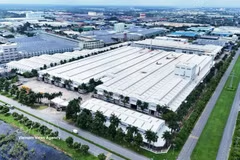
A view of Vinh Loc 2 Industrial Park in My Yen commune, Tay Ninh province (Photo: VNA)

FDI surge fuels new real estate demand

According to Savills experts, FDI continues to flow into manufacturing, logistics, technology and digital infrastructure, changing property requirements for investors.

Lien Chieu Port is under construction in central Da Nang city. (Photo: VNA)

Energy infrastructure underpins marine economy development

The integrated investment in energy infrastructure will provide a vital infrastructure foundation for effectively harnessing the marine potential, helping realise the goal of making Vietnam a strong maritime nation and achieving sustainable and prosperous development from the sea./.

The Australia-Vietnam Policy Institute Forum in Ho Chi Minh City on August 25, 2026 discusses how Australian expertise, partnerships and capital can support Vietnam's growth, and how to build stronger connections between the two countries' business communities. (Photo: VNA)

Vietnam, Australia seek new space for economic cooperation

The Australia–Vietnam Policy Institute Forum was held in Ho Chi Minh City on August 25, bringing together policymakers, businesses, and organisations for discussing how the business communities of Australia and Vietnam can build stronger connections.

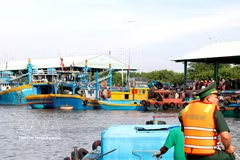
Officers from Thanh Hai Border Guard Station (Phu Thuy ward, Lam Dong province) patrol and monitor fishing vessels entering and leaving the port. (Photo: VNA)

Lam Dong province deploys 10 key measures to combat IUU fishing

The measures target key gaps, including ineligible fishing vessels, port controls, electronic fishing-trip data, seafood traceability and vessel monitoring system (VMS) violations. Authorities will also act against vessels detained by foreign authorities, submit weekly progress reports and draw up specific action plans.

Speakers at the seminar (Photo: VNA)

Legal transparency key to making VIFC more attractive: experts

Dominic Scriven, Chairman and Founder of Dragon Capital, said legal clarity, consistency and predictability are essential to strengthening investor confidence, enabling long-term business planning and encouraging firm capital commitments to Vietnam.

Illustrative photo (Photo: VNA)

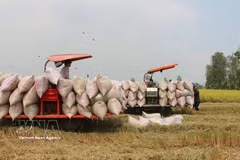
Vietnam promotes cooperation to remove barriers to rice trade with Philippines

Vietnam proposed studying a higher-level cooperation framework on rice trade to provide a more stable and long-term foundation for Vietnam-Philippine rice trade while balancing the interests of farmers, businesses and consumers, and providing sustainable livelihoods for rice growers and stable living conditions for Philippine consumers.