Vietnam, Malaysia explore potential for Halal supply chain cooperation

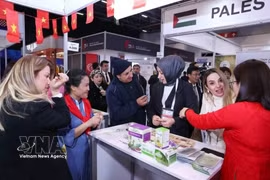
Matrade has set up a representative office in Ho Chi Minh City to support Vietnamese businesses in exploring Halal partnerships and supplying products to the Malaysian market.

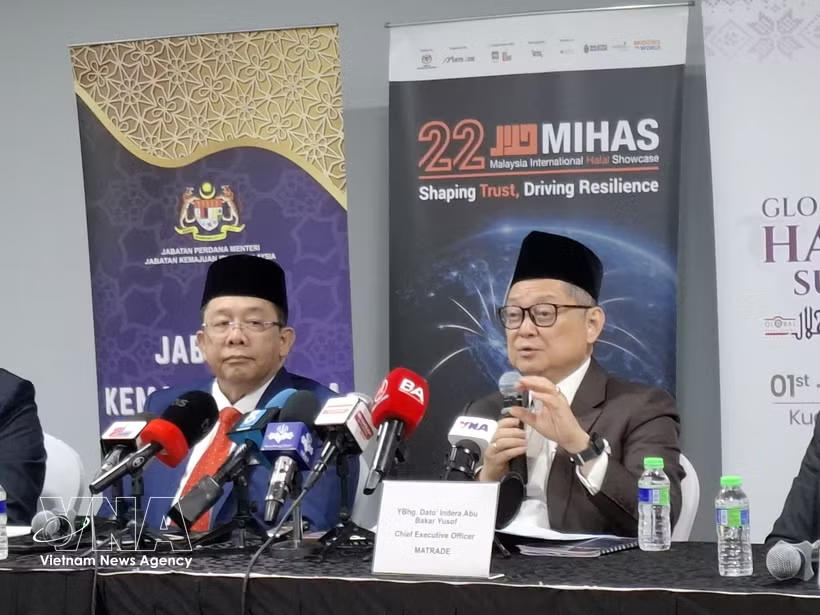
Abu Bakar Yusof (left), Chief Executive Officer of the Malaysia External Trade Development Corporation (Matrade), and Dr. Sirajuddin bin Suhaimee, Director General of the Department of Islamic Development (JAKIM), Malaysia’s Halal certification authority (Photo: VNA)

Kuala Lumpur (VNA) – Malaysia sees significant potential for Vietnam to integrate into the global Halal supply chain and is committed to strengthening trade cooperation and providing technical support to help Vietnamese businesses meet stringent Halal requirements.

The assessment was shared by Abu Bakar Yusof, Chief Executive Officer of the Malaysia External Trade Development Corporation (Matrade), and Dr. Sirajuddin bin Suhaimee, Director General of the Department of Islamic Development (JAKIM), Malaysia’s Halal certification authority, in interviews with Vietnam News Agency (VNA) correspondents in Kuala Lumpur.

Yusof noted that Vietnam has actively engaged in the Halal market over the past five years. Although the number of local businesses directly involved remains modest, at around 17, the country is actively developing its Halal industry while importing a range of Halal products from Malaysia to address domestic supply shortages.

Matrade has set up a representative office in Ho Chi Minh City to support Vietnamese businesses in exploring Halal partnerships and supplying products to the Malaysian market. It also hosts an annual “Buyer Connection” programme to connect Vietnamese businesses with local importers. Yusof shared hope that more Vietnamese companies will join in, helping to grow bilateral Halal trade.

Sirajuddin said JAKIM has maintained close cooperation with Vietnamese companies since 2000. Currently, five Halal certification bodies in Vietnam are recognised by JAKIM, enabling local businesses to obtain certification for exports to Malaysia and other international markets.

He said Malaysia’s Halal certification enjoys global recognition for its emphasis on hygiene, quality and traceability. The certification process involves rigorous scrutiny of product ingredients, quarterly audits for medium-risk products and standards updates every five years to keep pace with new technologies.

JAKIM is also developing an AI-powered system, expected to be launched next year, to automate document verification and provide access to an ingredient database, helping streamline certification procedures and eliminating the need to repeatedly certify individual ingredients.

With the global Halal market projected to reach 5 trillion USD by 2030, Vietnam’s efforts to strengthen production capacity and comply with stringent standards will be key to deeper integration into global Halal value chains.

Malaysia is preparing a series of international Halal events, including the Global Halal Summit (GHaS) and the Malaysia International Halal Showcase (MIHAS), offering expanded opportunities for regional partners, including Vietnam.

At MIHAS 2026, Malaysia aims to increase expected sales from 1.1 billion USD to 1.25 billion USD. The 22nd edition is expected to feature 2,400 booths from at least 45 countries and facilitate around 4,000 B2B meetings between 600 Malaysian companies and 300 international buyers./.


VNA
See more

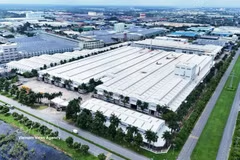
A view of Vinh Loc 2 Industrial Park in My Yen commune, Tay Ninh province (Photo: VNA)

FDI surge fuels new real estate demand

According to Savills experts, FDI continues to flow into manufacturing, logistics, technology and digital infrastructure, changing property requirements for investors.

Lien Chieu Port is under construction in central Da Nang city. (Photo: VNA)

Energy infrastructure underpins marine economy development

The integrated investment in energy infrastructure will provide a vital infrastructure foundation for effectively harnessing the marine potential, helping realise the goal of making Vietnam a strong maritime nation and achieving sustainable and prosperous development from the sea./.

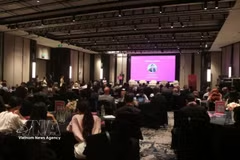
The Australia-Vietnam Policy Institute Forum in Ho Chi Minh City on August 25, 2026 discusses how Australian expertise, partnerships and capital can support Vietnam's growth, and how to build stronger connections between the two countries' business communities. (Photo: VNA)

Vietnam, Australia seek new space for economic cooperation

The Australia–Vietnam Policy Institute Forum was held in Ho Chi Minh City on August 25, bringing together policymakers, businesses, and organisations for discussing how the business communities of Australia and Vietnam can build stronger connections.

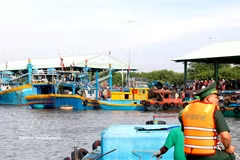
Officers from Thanh Hai Border Guard Station (Phu Thuy ward, Lam Dong province) patrol and monitor fishing vessels entering and leaving the port. (Photo: VNA)

Lam Dong province deploys 10 key measures to combat IUU fishing

The measures target key gaps, including ineligible fishing vessels, port controls, electronic fishing-trip data, seafood traceability and vessel monitoring system (VMS) violations. Authorities will also act against vessels detained by foreign authorities, submit weekly progress reports and draw up specific action plans.

Speakers at the seminar (Photo: VNA)

Legal transparency key to making VIFC more attractive: experts

Dominic Scriven, Chairman and Founder of Dragon Capital, said legal clarity, consistency and predictability are essential to strengthening investor confidence, enabling long-term business planning and encouraging firm capital commitments to Vietnam.

Illustrative photo (Photo: VNA)

Vietnam promotes cooperation to remove barriers to rice trade with Philippines

Vietnam proposed studying a higher-level cooperation framework on rice trade to provide a more stable and long-term foundation for Vietnam-Philippine rice trade while balancing the interests of farmers, businesses and consumers, and providing sustainable livelihoods for rice growers and stable living conditions for Philippine consumers.

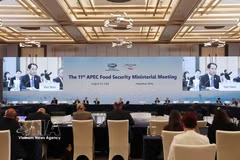
An overview of the 11th APEC Food Security Ministerial Meeting in Hangzhou on August 25. (Photo: VNA)

Vietnam proposes four strategic cooperation directions at APEC Food Security Ministerial Meeting

Vietnam’s proposals at the 11th APEC Food Security Ministerial Meeting, which took place in Hangzhou, China received broad support and consensus from participating economies. Several members expressed their desire to work with Vietnam to further build consensus, with a view to ensuring that the APEC Food Security Ministerial Meeting in Vietnam in 2027 will produce a shared vision and a substantive action programme.

Vietnam Post accelerates the adoption of modern technology, elevates logistics capabilities, and boosts the digital economy. (Photo: VNA)

Breakthrough opportunities for businesses in digital economy

Only when businesses view digital transformation as a fundamental change in their business models, while the State provides an enabling framework, data infrastructure and sufficiently broad markets for innovation, can the digital economy become a substantive growth driver.

A lecturer guides students on how to diagnose diseases in aquatic animals. (Photo: VNA)

Vietnam leans on digital workforce to unlock productivity boom

Vietnam needs a cohesive national strategy linking the State, enterprises, and training establishments. The strategy must prioritise standardising training to international norms and investing in technological infrastructure to boost national productivity.

A factory in Bac Ninh province (Photo: VNA)

Vietnam directs more credit to SMEs

With deposit rates still relatively high, banks’ room to cut lending rates sharply is limited. Lenders must stay efficient and cannot fund at high cost while lending at very low rates.

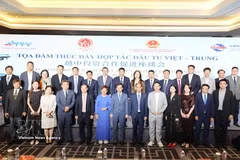
Delegates at the Vietnam-China investment cooperation promotion seminar jointly organised in Beijing on August 24 pose for a photo. (Photo: VNA)

Chinese firms praise Vietnam’s investment environment

Vietnam’s political stability, fast-growing economy, and increasing focus on science and technology, with many policies that promote the sector’s growth, create ideal conditions for Chinese tech firms looking to invest and expand in the country.