Vietnam leans on digital workforce to unlock productivity boom

Vietnam needs a cohesive national strategy linking the State, enterprises, and training establishments. The strategy must prioritise standardising training to international norms and investing in technological infrastructure to boost national productivity.

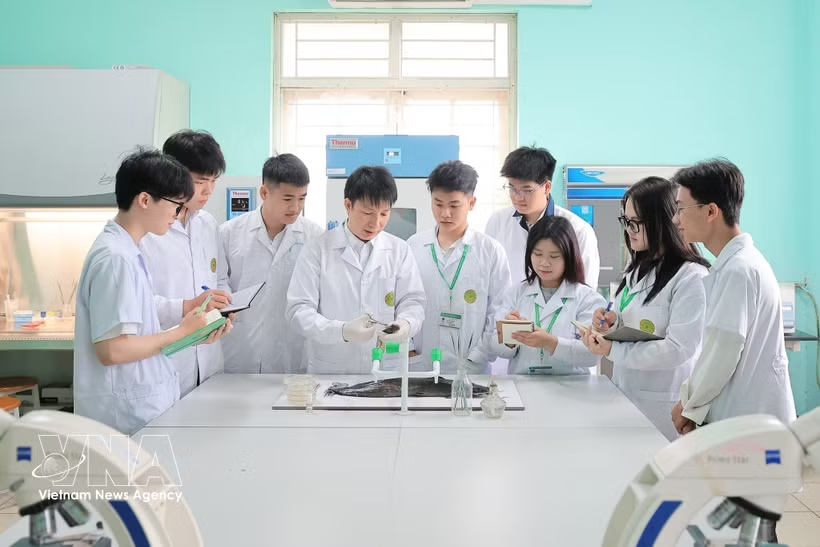
A lecturer guides students on how to diagnose diseases in aquatic animals. (Photo: VNA)

Hanoi (VNA) – Amid the Fourth Industrial Revolution, driven by digital technologies and with a digital workforce emerging as a key driver of productivity and business competitiveness, the Prime Minister's approval of a project on training and developing human resources in the field of standards, metrology and quality is expected to create a breakthrough in the coming period.

Developing an adaptive digital workforce

Vietnam possesses a solid foundation for a digital workforce, marked by high internet penetration and rapid infrastructure build-out. The Ministry of Education and Training’s circular on digital competency establishes a clear legal framework to equip workers with the technological skills and adaptability required for modern production.

Le Minh Tam, Director of the Training Centre for Standards, Metrology and Quality, said the project aims to train roughly 20,000 officials, civil servants, public employees and workers in the sector by 2030, while developing a specialised cohort of 1,500 experts in national quality infrastructure.

It seeks to modernise course delivery, deploy digital platforms, and strengthen post-training assessment to build a genuine digital workforce. This capacity is viewed as critical for firms navigating digital transformation, green transition, circular economy and tightening technical barriers to global trade.

According to Tam, future experts will require deep technical expertise combined with foreign-language proficiency and digital fluency to shape standards at the regional and global levels. The Commission for the Standards, Metrology and Quality of Vietnam (STAMEQ) plans to expand international cooperation to facilitate expert exchange and align knowledge with advanced benchmarks.

Developing this workforce is meant to upgrade national quality infrastructure, drive innovation, improve productivity and sharpen Vietnam’s competitive edge in its next growth phase.

Hoang Huu Hanh, Deputy Director of the National Digital Transformation Agency, said following the Politburo’s Resolution 52-NQ/TW on the orientations and policies for Vietnam to proactively participate in the Fourth Industrial Revolution and the national digital transformation programme through 2025, Vietnam has identified digital transformation as a key strategy.
vnanet-k.jpg
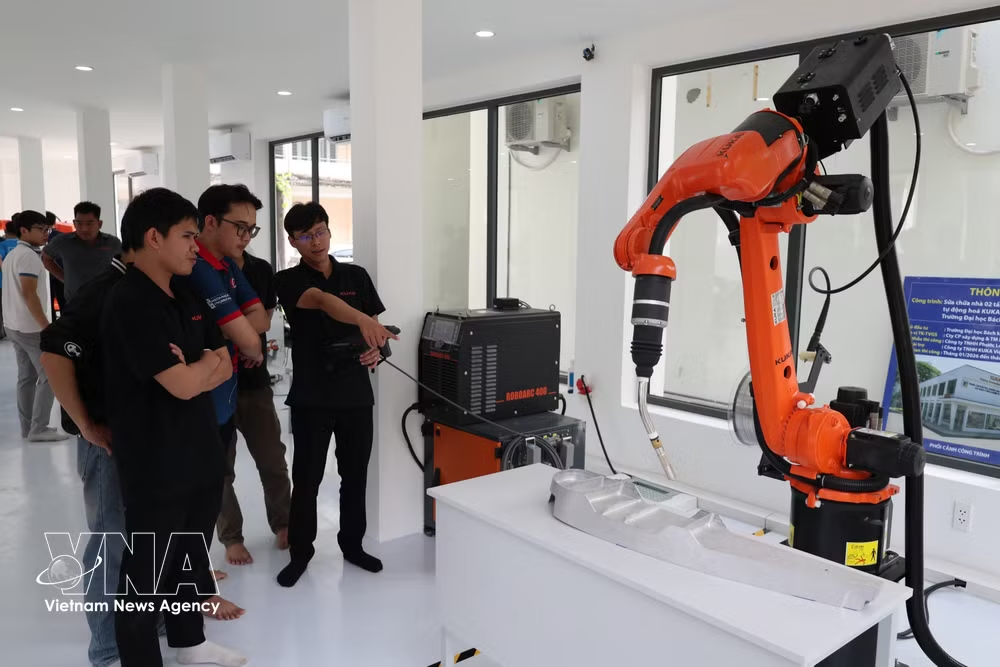
An industrial robot is tested at the University of Da Nang. (Photo: VNA)

Accordingly, digital infrastructure, artificial intelligence, and digital human capital are the pillars of rapid, sustainable development.

Digital workforce – a strategic asset for higher productivity

The Politburo’s Resolution 57-NQ/TW on breakthroughs in science, technology, innovation and national digital transformation underscores the imperative to overhaul education and training to supply a workforce capable of meeting the demands of scientific and technology development, innovation and national digital transformation.

Yet, reality reveals a critical gap: many firms possess technology but lack personnel with the digital skills and adaptive mindsets to leverage it. Consequently, investment fails to translate into productivity gains.

Le Thi Hoai Thuong, Director of External Affairs at Nestlé Vietnam Co., Ltd., said the company has adopted the “Connected Factory” model, under which its digital workforce has digitised all production data and processes, cutting around 60% of non-value-adding activities while improving operational efficiency and maintaining quality, safety and sustainability.

Tam stressed that Vietnam needs a cohesive national strategy linking the State, enterprises, and training establishments. The strategy must prioritise standardising training to international norms and investing in technological infrastructure to boost national productivity./.

VNA

See more

Speakers at the seminar (Photo: VNA)

Legal transparency key to making VIFC more attractive: experts

Dominic Scriven, Chairman and Founder of Dragon Capital, said legal clarity, consistency and predictability are essential to strengthening investor confidence, enabling long-term business planning and encouraging firm capital commitments to Vietnam.

Illustrative photo (Photo: VNA)

Vietnam promotes cooperation to remove barriers to rice trade with Philippines

Vietnam proposed studying a higher-level cooperation framework on rice trade to provide a more stable and long-term foundation for Vietnam-Philippine rice trade while balancing the interests of farmers, businesses and consumers, and providing sustainable livelihoods for rice growers and stable living conditions for Philippine consumers.

An overview of the 11th APEC Food Security Ministerial Meeting in Hangzhou on August 25. (Photo: VNA)

Vietnam proposes four strategic cooperation directions at APEC Food Security Ministerial Meeting

Vietnam’s proposals at the 11th APEC Food Security Ministerial Meeting, which took place in Hangzhou, China received broad support and consensus from participating economies. Several members expressed their desire to work with Vietnam to further build consensus, with a view to ensuring that the APEC Food Security Ministerial Meeting in Vietnam in 2027 will produce a shared vision and a substantive action programme.

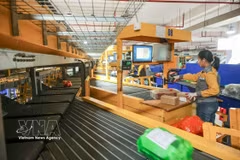
Vietnam Post accelerates the adoption of modern technology, elevates logistics capabilities, and boosts the digital economy. (Photo: VNA)

Breakthrough opportunities for businesses in digital economy

Only when businesses view digital transformation as a fundamental change in their business models, while the State provides an enabling framework, data infrastructure and sufficiently broad markets for innovation, can the digital economy become a substantive growth driver.

A factory in Bac Ninh province (Photo: VNA)

Vietnam directs more credit to SMEs

With deposit rates still relatively high, banks’ room to cut lending rates sharply is limited. Lenders must stay efficient and cannot fund at high cost while lending at very low rates.

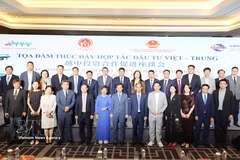
Delegates at the Vietnam-China investment cooperation promotion seminar jointly organised in Beijing on August 24 pose for a photo. (Photo: VNA)

Chinese firms praise Vietnam’s investment environment

Vietnam’s political stability, fast-growing economy, and increasing focus on science and technology, with many policies that promote the sector’s growth, create ideal conditions for Chinese tech firms looking to invest and expand in the country.

Illustrative photo (Photo: VNA)

FDI businesses look for deeper administrative reforms

While appreciating the progress, FDI firms said the next stage of reforms should go beyond putting procedures online. They want administrative processes to be simplified on digital platforms, data systems to be better connected, information to be provided only once and regulations to be applied consistently.

A view of the Vietnam–Singapore Industrial Park in Ho Chi Minh City (Photo: VNA)

Vietnam witnesses surge in Singapore investment inflows

The strong investment flow reflects not only the potential of the Vietnamese market but also the close bilateral relationship, particularly since the two countries upgraded ties to a Comprehensive Strategic Partnership in March 2025.

Mariculture – new growth driver for Vietnam’s ocean economy (Photo: VNA)

Mariculture – new growth driver for Vietnam’s ocean economy

Resolution No 20-NQ/TW on building and developing Vietnam into a strong maritime nation identifies marine farming as a new pillar of the marine economy. It targets mariculture production value growing by an average of around 8% annually and accounting for 15% of the total fisheries sector value.