Singapore’s experience suggests solutions to Vietnam’s human resources challenge in AI era

As Vietnam accelerates digital transformation and high-tech development, Singapore’s experience and the engagement of global technology companies demonstrate that human resources preparation must stay ahead of the curve. The ability to filter knowledge, collaborate, innovate and effectively use AI will increasingly become essential to helping workers adapt to a changing labour market and strengthening the competitiveness of Vietnam’s economy in the new era.

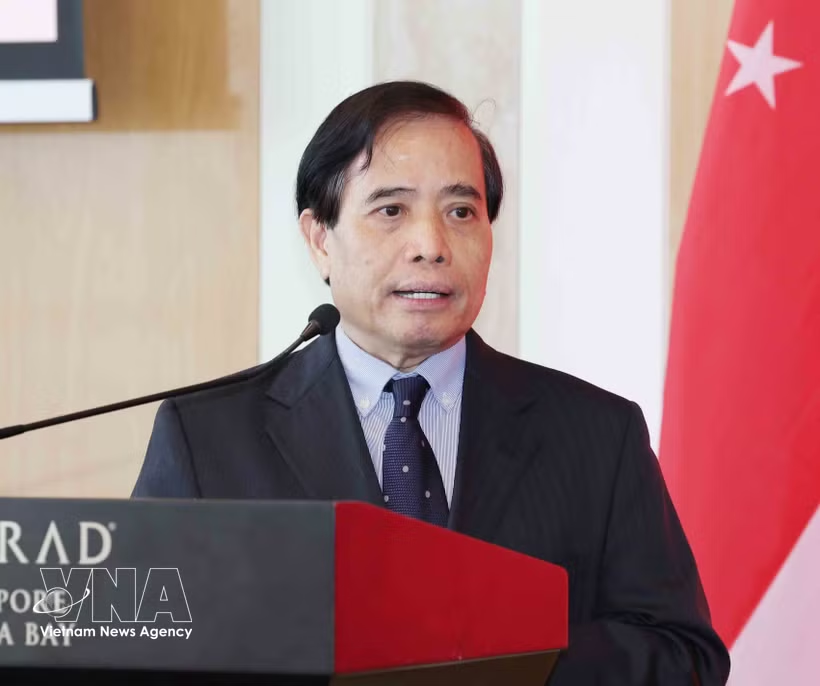
Professor Vu Minh Khuong of the National University of Singapore. (Photo: VNA)

Singapore (VNA) – Vietnam is facing the dual task of accelerating high-tech workforce training while preparing for labour shifts in labour-intensive sectors, and can learn from Singapore’s experience in solving this problem, according to Singapore-based experts.

Professor Vu Minh Khuong of the National University of Singapore (NUS) said Singapore’s experience shows that education and human resources development must be given top priority as they are decisive to a country’s competitiveness and future.

According to the expert, education in the AI era should focus on three core capabilities. The first is the ability to filter and process knowledge as people are increasingly exposed to vast amounts of information. The key is no longer simply how much knowledge one can remember, but how to find, assess and use information to solve problems. This approach also calls for changes in teaching, learning and assessment. Rather than restricting students’ use of AI or the Internet, education should allow them to use such tools and assess their ability to apply technology to specific problems.

The second is the ability to listen to, absorb different perspectives and collaborate with others. Khuong said future workers will need not only professional expertise but also the capacity to synthesise diverse views and work effectively with others. The third is creativity – the ability to generate new ideas, solutions and values. This is also one of the key factors that distinguish high-quality human resources in the age of AI.

Technology companies are also playing a growing role in equipping workers with new skills. Shanti Alexander, Meta’s Director of Policy Programmes and Campaigns for Asia-Pacific, said the company is committed to supporting the comprehensive, useful and accessible development and application of AI in Vietnam. Meta is working with STEAM for Vietnam, Hocmai and Vietnet-ITC Centre to help businesses apply AI in production and business activities, while partnering with the National Innovation Centre (NIC) to support the technology developer community.

Meta and the NIC recently held an AI hackathon that attracted more than 1,000 developers to build AI solutions to real-world problems within 48 hours. The two sides are also implementing the ViGen project to develop high-quality open datasets for Vietnam, providing a foundation for AI models and solutions better suited to the country’s language, needs and conditions.

Education is another key focus. Meta is working with Vietnamese partners on AI skills programmes for teachers, aiming to train nearly 1,000 educators this year. AI is thus becoming not only a field requiring specialised human resources but also a tool for renovating teaching and learning methods. Meanwhile, the economic restructuring process is creating new challenges for labour-intensive sectors. Ernie Koh, Vice Chairman of the Singapore Business Federation (SBF)’s South-East Asia Business Group, noted that Vietnam’s labour market is changing as economic growth accelerates in localities beyond Hanoi and Ho Chi Minh City, creating more local job opportunities and reducing workers’ need to move to major economic hubs.

Drawing on his experience in a labour-intensive manufacturing sector, Koh said such industries in Vietnam will face increasing pressure to transform as the economy moves further towards high technology and more young, skilled workers shift to higher-value sectors. He also highlighted the potential role of labour mobility within ASEAN in addressing shortages in specific markets while supporting regional workforce restructuring.

These assessments show that Vietnam’s human resources challenge in the AI era goes beyond training more engineers or technology specialists. It requires a broader approach encompassing education reform, AI skills development for the existing workforce, stronger cooperation among the State, educational institutions and technology companies, and policies to facilitate labour mobility across sectors.

As Vietnam accelerates digital transformation and high-tech development, Singapore’s experience and the engagement of global technology companies demonstrate that human resources preparation must stay ahead of the curve. The ability to filter knowledge, collaborate, innovate and effectively use AI will increasingly become essential to helping workers adapt to a changing labour market and strengthening the competitiveness of Vietnam’s economy in the new era./.

VNA

See more

Online public services in Thanh Khe ward, Da Nang city, help residents protect personal data. (Photo: nhandan.vn)

Vietnam moves to strengthen digital shield amid rise of AI, deepfakes

An effective “digital shield” should have three key capabilities: early warning to identify unusual topics, sources and dissemination patterns, as well as signs of fabrication or coordinated activity; rapid verification through coordination among authorities, databases, experts and the press; and proactive communications, providing accurate, accessible and multimedia content to the right audiences once information is verified.

The product exhibition area at the AI Day 2026, organised by Hanoi University of Science and Technology and STEAM for Vietnam in collaboration with the US Embassy in Vietnam and the National Innovation Centre (Photo: VNA)

Building AI capabilities tailored to Vietnam’s needs

Vietnam is entering a new phase of AI development, moving beyond the adoption of existing technologies to building its own capabilities by advancing models, computing infrastructure, data, and talent in parallel to create an ecosystem capable of developing technologies tailored to the country’s needs.

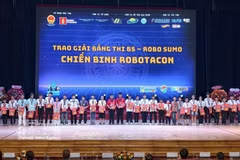
Top-performing teams at ROBOTACON WRO 2026 national finals are honoured at a ceremony on August 23 (Photo: VNA)

Top-performing teams at ROBOTACON WRO 2026 national finals honoured

The national finals of the ROBOTACON WRO 2026 robot talent competition concluded in the central province of Gia Lai on August 23, providing students with a valuable learning and experiential environment where they could develop STEM skills, learn to work together, think creatively and solve complex problems.

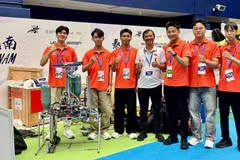
The LH-FOF team from Vietnam's Lac Hong University represents the country at ABU Robocon 2026. (Photo: VTV)

Vietnam team wins three awards at ABU Robocon 2026

The LH-FOF team from Vietnam's Lac Hong University won three awards the 2026 Asia-Pacific Broadcasting Union Robot Contest (ABU Robocon): third place overall, the best design award and a sponsor’s award.

Panoramic view of the site designated for the Ninh Thuan 1 nuclear power plant in Phuoc Dinh commune, Khanh Hoa province. (Photo published by VNA)

Skilled workforce vital to Vietnam’s nuclear power programme

The long-term challenge Vietnam must proactively address is building a pool of personnel in management, regulation, research and development, and technical support. These are areas in which the country must take the initiative in training and building up its own capabilities so that it can independently conduct assessments, evaluate safety, verify technical calculations, carry out research, and provide support for the sustainable development of the nuclear programme.

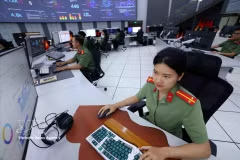
Officers and soldiers of the Department of Cybersecurity and High-Tech Crime Prevention under the Ministry of Public Security monitor malware trend charts and directly assess potential threats in cyberspace. - Illustrative image (Photo: VNA)

Vietnam issues new cybersecurity rules for domestic, foreign businesses

Issued on August 19, the decree comprises six chapters and 32 articles, covering cybersecurity protection measures, information security assurance, specialised cybersecurity training, and management of IP address identification for telecommunications and Internet service providers.

Students compete in the national finals of the ROBOTACON WRO (World Robot Olympiad) 2026. (Photo: VNA)

Nearly 500 contestants compete at ROBOTACON WRO 2026 national finals

Held under the theme “Robots Meet Culture”, this year’s competition aims to connect technology with cultural values, encouraging students to apply their knowledge of science, engineering and programming to real-world problems while promoting cultural values through creative solutions.

Ang Wee Seng, Executive Director of the Singapore Semiconductor Industry Association (Photo published by VNA)

Expert suggests Vietnam, Singapore combine complementary strengths in semiconductors

Singapore, Vietnam and other ASEAN economies have different but complementary strengths. By linking these strengths through infrastructure, talent mobility, research partnerships, reliable supply chains and joint industry development, ASEAN can become an integrated, sustainable and globally significant semiconductor ecosystem rather than merely a collection of separate semiconductor manufacturing locations.

Israeli experts introduce several areas with potential for cooperation, including AI, cybersecurity, quantum technology, data, health technology and the application of artificial intelligence in businesses. (Photo: VNA)

Vietnam, Israel explore stronger cooperation in technology, innovation

During the meeting, Ambassador Nguyen Ky Son said science, technology, innovation and artificial intelligence (AI) are becoming key drivers of Vietnam’s development, stressing that the application of AI and emerging technologies must go hand in hand with data security and safety.

The report “Vietnam’s Technological Leap: Sources of Success and Limitations” (Photo: screenshot)

Vietnam makes significant technological progress thanks to open-door policy: Russian expert

Dezhina, a senior researcher at the Institute of Sociology under the Federal Research Center of the Russian Academy of Sciences, said the rapid development of Vietnam’s services sector and knowledge-based industries represents a technological leap driven largely by foreign investment and government policies aimed at developing infrastructure, boosting exports and attracting FDI.

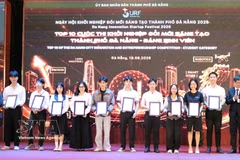
The Da Nang People’s Committee presents awards to the Top 10 projects in the Student Category of the Da Nang Innovation and Startup Competition at SURF 2026. (Photo: VNA)

Da Nang runs biggest annual startup event

Themed “A New Era of Growth – Pioneering Innovation”, the festival focused on expanding international connectivity, promoting cross-border investment cooperation and highlighting strategic technology sectors such as artificial intelligence (AI), semiconductors, digital technology, blockchain, green technology and digital transformation.

Personnel responsible for safeguarding national digital sovereignty in cyberspace maintain a serious and focused working spirit at all times (Photo: VNA)

Protecting national security amid digital transformation, cyberspace

Cybersecurity, information security and data security risks must be identified and addressed early and from afar, with appropriate defensive measures ready to neutralise threats and protect national interests in cyberspace, said Lieutenant General Le Xuan Minh, Director of the Ministry of Public Security’s Department of Cybersecurity and Hi-tech Crime Prevention (A05).

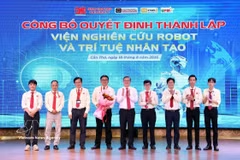
The leadership of the Institute of Robotics and Artificial Intelligence is introduced. (Photo:VNA)

Mekong Delta launches first robotics, AI research institute

Dr. Nguyen Van Quang, Rector of Nam Can Tho University, said the university is developing a value chain covering training, research, technology development, testing, technology transfer and commercialisation. The model is designed to link research more closely with practical needs, ensuring that technologies generate products and products create value for society.