Vietnam makes significant technological progress thanks to open-door policy: Russian expert

Dezhina, a senior researcher at the Institute of Sociology under the Federal Research Center of the Russian Academy of Sciences, said the rapid development of Vietnam’s services sector and knowledge-based industries represents a technological leap driven largely by foreign investment and government policies aimed at developing infrastructure, boosting exports and attracting FDI.

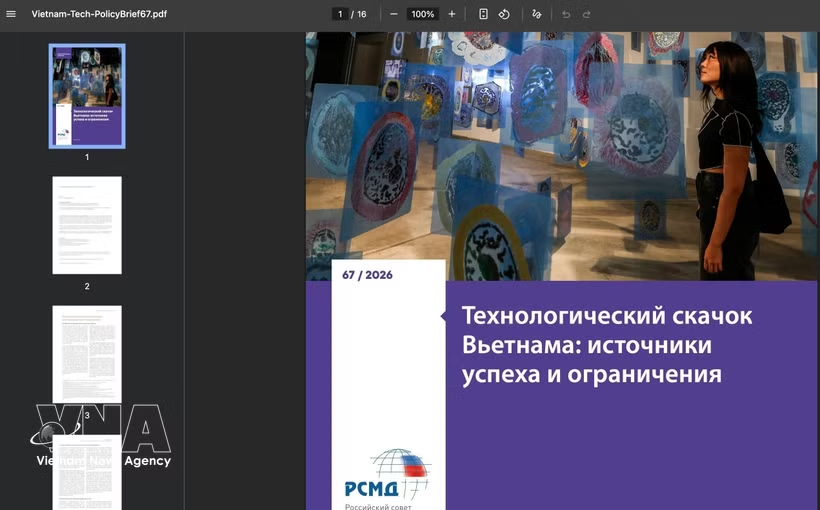
The report “Vietnam’s Technological Leap: Sources of Success and Limitations” (Photo: screenshot)

Moscow (VNA) - Vietnam has made significant technological progress thanks to its open-door policy, foreign investment and infrastructure development, according to Russian economist Irina Dezhina in a writing on the website of the Russian International Affairs Council (RIAC) on August 18.

Dezhina, a senior researcher at the Institute of Sociology under the Federal Research Center of the Russian Academy of Sciences, noted that Vietnam ranked 44th among 139 economies in the 2025 Global Innovation Index, ahead of Russia at 60th.

Vietnam ranked 37th in overall innovation performance, significantly higher than its 50th position in terms of innovation inputs, she said. The country also has well-developed telecommunications infrastructure, with nationwide 5G coverage.

According to the 2025 Digital Nations Index, Vietnam ranked 10th among 21 Asia-Pacific economies, behind Singapore, Australia, Japan, the Republic of Korea and New Zealand.

Dezhina said the rapid development of Vietnam’s services sector and knowledge-based industries represents a technological leap driven largely by foreign investment and government policies aimed at developing infrastructure, boosting exports and attracting FDI.

Attracting FDI into projects with strong potential for technology transfer has now become a strategic priority, she noted.

The turning point in Vietnam’s technological development dates back to the Doi Moi (Renewal) policy launched in 1986, according to Dezhina. She identified four major advantages underpinning the country’s progress: its proximity to major technology manufacturing hubs in Southeast Asia; its strategic location providing access to the Chinese and Indian markets; its reserves of rare earths, which are important for semiconductor production; and its rapid restoration of market-oriented economic mechanisms, facilitating technology-driven structural transformation.

However, Dezhina cautioned that technological progress does not necessarily mean technological self-reliance. While FDI has made a major contribution to GDP growth, technology transfer and management skills to domestic businesses remain limited. Vietnam continues to focus largely on lower value-added activities and final assembly.

She also noted that science spending has remained low, averaging around 0.42% of GDP over the past seven years. State funding is still allocated largely according to staffing levels rather than competitive mechanisms and research performance, while the country faces a shortage of highly qualified specialists, particularly in high-tech fields.

These shortcomings indicate that Vietnam has been successful in attracting and absorbing foreign technologies but has yet to develop an ecosystem capable of generating technologies domestically, she said. This presents a key challenge as Vietnam seeks to move from a manufacturing and assembly base toward a more innovation-driven economy.

Regarding Russia-Vietnam cooperation, Dezhina said the comprehensive strategic partnership provides a foundation for expanding cooperation in science and technology and human resource training, particularly in engineering. Potential areas include cybersecurity solutions, fintech, public-sector software and nuclear medicine.

She also suggested promoting cooperation between fast-growing Russian mid-sized technology companies and Vietnamese businesses, while establishing bilateral working groups to exchange experience and develop joint projects in science, technology and education.

Dezhina concluded that Vietnam’s technological leap has been driven by Doi Moi, international integration, FDI attraction and infrastructure investment. To build greater technological self-reliance, however, the country needs to address bottlenecks in high-quality human resources, science funding, university research capacity, linkages between FDI enterprises and domestic firms, and technology transfer./.

VNA
See more

Israeli experts introduce several areas with potential for cooperation, including AI, cybersecurity, quantum technology, data, health technology and the application of artificial intelligence in businesses. (Photo: VNA)

Vietnam, Israel explore stronger cooperation in technology, innovation

During the meeting, Ambassador Nguyen Ky Son said science, technology, innovation and artificial intelligence (AI) are becoming key drivers of Vietnam’s development, stressing that the application of AI and emerging technologies must go hand in hand with data security and safety.

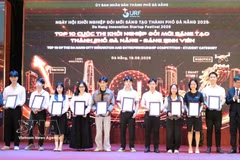
The Da Nang People’s Committee presents awards to the Top 10 projects in the Student Category of the Da Nang Innovation and Startup Competition at SURF 2026. (Photo: VNA)

Da Nang runs biggest annual startup event

Themed “A New Era of Growth – Pioneering Innovation”, the festival focused on expanding international connectivity, promoting cross-border investment cooperation and highlighting strategic technology sectors such as artificial intelligence (AI), semiconductors, digital technology, blockchain, green technology and digital transformation.

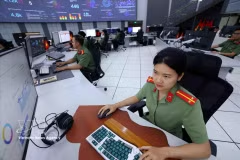
Personnel responsible for safeguarding national digital sovereignty in cyberspace maintain a serious and focused working spirit at all times (Photo: VNA)

Protecting national security amid digital transformation, cyberspace

Cybersecurity, information security and data security risks must be identified and addressed early and from afar, with appropriate defensive measures ready to neutralise threats and protect national interests in cyberspace, said Lieutenant General Le Xuan Minh, Director of the Ministry of Public Security’s Department of Cybersecurity and Hi-tech Crime Prevention (A05).

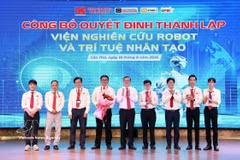
The leadership of the Institute of Robotics and Artificial Intelligence is introduced. (Photo:VNA)

Mekong Delta launches first robotics, AI research institute

Dr. Nguyen Van Quang, Rector of Nam Can Tho University, said the university is developing a value chain covering training, research, technology development, testing, technology transfer and commercialisation. The model is designed to link research more closely with practical needs, ensuring that technologies generate products and products create value for society.

Participants pose for a photo at the launch of the Daegu innovation space in Da Nang city. (Photo: VNA)

Daegu innovation space opens in Da Nang

The Daegu technology and innovation space in Da Nang will introduce Daegu’s outstanding technologies, innovative products and solutions while serving as a bridge connecting businesses, research institutes, universities and startup communities from the two cities.

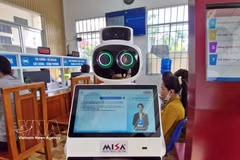
The virtual assistant interface on the reception robot in Lai Hoa commune. (Photo: VNA)

Can Tho builds smart, modern administration through AI application

Amid efforts to accelerate national digital transformation, localities in Can Tho city are integrating modern technologies into State administration. Beyond conventional software and online platforms, artificial intelligence (AI) is being incorporated into public administrative service processes, leading to tangible improvements in service of people and businesses.

Delegates at the opening ceremony of Conviction 2026 (Photo: VNA)

Ho Chi Minh City urged to lead in developing, testing new technology models: Deputy PM

Conviction 2026, a national-level forum on Digital Assets and Artificial Intelligence, which opened in Ho Chi Minh City on August 14, brings together representatives from State management agencies, technology companies, financial institutions, investment funds, experts, research institutes, universities and domestic and international partners, creating opportunities to connect policies, technology, resources and markets, according to Deputy Prime Minister Ho Quoc Dung.

Students at the Ho Chi Minh City University of Technology – Vietnam National University, Ho Chi Minh City, practice applying advanced technologies (Photo: VNA)

Vietnam taps global expertise to develop world-class AI workforce

The network aims to attract global Vietnamese AI talents, strengthen links among research institutions, businesses and experts to form strong research teams and promote commercialisation, while mobilising experts to advise on policies and key national AI programmes and projects.

Vietnam moves to build quantum workforce

Vietnam moves to build quantum workforce

As the country's science, technology and innovation hub, Ho Chi Minh City is now scrambling to build capacity for the quantum age, with workforce development at the centre of its push to seize future opportunities.

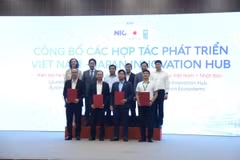
At the Vietnam – Japan Innovation Forum 2026 (Photo: tapchikinhtetaichinh.vn)

Vietnam – Japan Innovation Forum 2026 drives new models

NIC Deputy Director Hoang Trung Hieu shared that Vietnam is working to gradually make science, technology, and innovation its main growth drivers. Along the way, Japan stands out as one of its key partners, bringing strong capabilities in sci-tech, industry, and workforce, along with an extensive network of companies, research institutes, and universities.

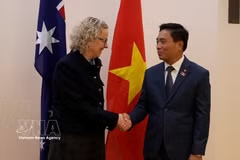
Vice President of the National Assembly Nguyen Doan Anh (R) and Deputy Speaker of the Australian House of Representatives Sharon Claydon (Photo: VNA)

Vietnam, Australia strengthen parliamentary cooperation

the Australian Parliament looks forward to close coordination with the Vietnamese NA at the Inter-Parliamentary Union (IPU) and other multilateral forums, said Deputy Speaker of the Australian House of Representatives Sharon Claydon.

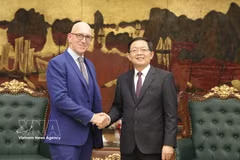
Deputy Prime Minister Ho Quoc Dung (R) receives Gianluca Pettiti, President and Chief Operating Officer of US-based Thermo Fisher Scientific, in Hanoi on August 12 (Photo: VNA)

Vietnam seeks stronger cooperation with US partner in semiconductors, biomedical technology

Vietnam welcomes leading global technology groups such as Thermo Fisher Scientific to engage more deeply in the country’s science and technology ecosystem through investment, research and development, technology transfer and human resources training, as well as cooperation with domestic research institutes, universities and businesses, Deputy Prime Minister Ho Quoc Dung said.

AI-powered robots help ease the workload of civil servants in providing initial consultations, while enabling citizens to become familiar with AI applications in accessing public services. (Photo: VNA)

National programme on AI human resources development approved

The programme aims to develop an AI workforce of sufficient scale, structure and quality to meet the requirements of strategic technology sectors, enhance national technological self-reliance, promote innovation and digital transformation, and foster the digital economy and digital society.