Vietnam issues new cybersecurity rules for domestic, foreign businesses

Issued on August 19, the decree comprises six chapters and 32 articles, covering cybersecurity protection measures, information security assurance, specialised cybersecurity training, and management of IP address identification for telecommunications and Internet service providers.

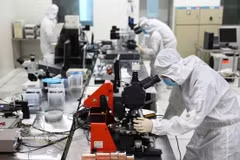
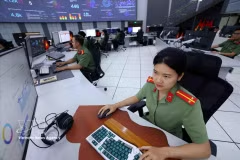
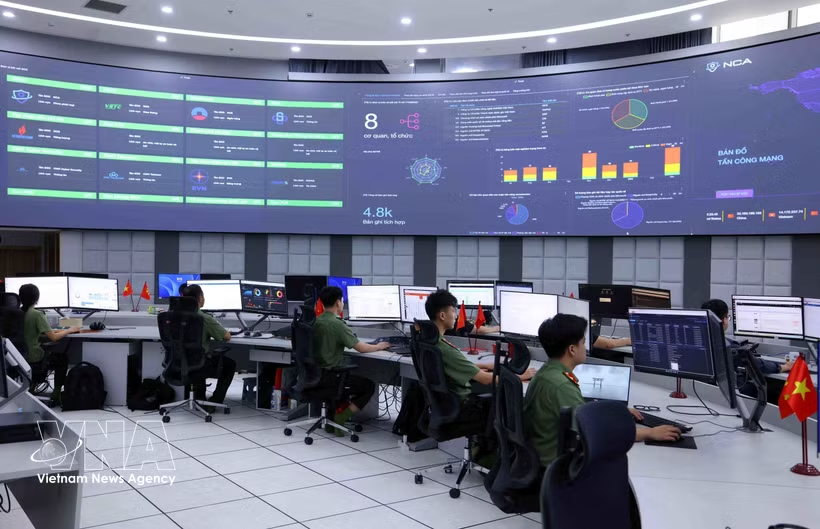
Officers and soldiers of the Department of Cybersecurity and High-Tech Crime Prevention under the Ministry of Public Security monitor malware trend charts and directly assess potential threats in cyberspace. - Illustrative image (Photo: VNA)

Hanoi (VNA) – The Government has issued Decree No. 333/2026/ND-CP detailing provisions and measures for implementing the Law on Cybersecurity, including notable requirements on information security assurance activities by domestic and foreign businesses operating in cyberspace in Vietnam.

Issued on August 19, the decree comprises six chapters and 32 articles, covering cybersecurity protection measures, information security assurance, specialised cybersecurity training, and management of IP address identification for telecommunications and Internet service providers.

According to Article 16, domestic and foreign businesses providing services on telecommunications networks, the Internet, and cyberspace-based value-added services in Vietnam must conduct information security assurance activities in accordance with the article and other relevant regulations of Vietnamese law.

Businesses must verify users’ information when digital accounts are registered and authenticate accounts using a mobile phone number in Vietnam. Users without such a number must use their personal identification number or another lawful electronic identification method.

Users conducting commercial livestreaming must authenticate their accounts using their personal identification number. Businesses must also apply necessary administrative and technical measures to protect users’ information and accounts and allow only verified accounts to post, share information, and use interactive functions.

Regarding information provision for cybersecurity protection, businesses must provide user information to specialised cybersecurity forces under the Ministry of Public Security upon valid requests made in accordance with Vietnamese law for verification, investigation, and handling of legal violations.

Such information must generally be provided within 24 hours of receiving a request. The deadline is reduced to three hours in emergencies involving threats to national security or human life.

Businesses must also restrict access to or remove illegal information, services and applications in Vietnam upon requests from specialised cybersecurity forces. Such requests must be fulfilled within 24 hours, or six hours in emergencies threatening national security.

For repeated violations, accounts, pages, community groups and content channels may face restrictions on visibility in Vietnam or temporary suspension. Accounts posting illegal information at least three times within 30 days may be restricted or suspended for up to 60 days, while those posting such information at least 10 times within 90 days may face restrictions or suspension for up to 180 days, depending on the nature and severity of violations.

Indefinite restrictions or account blocking may apply to accounts, pages, community groups, and content channels used to disseminate information infringing Vietnam’s national security, continue violations after being temporarily blocked at least three times, or otherwise serve as tools for cybersecurity violations where permanent blocking is deemed necessary.

An indefinitely blocked account may be restored if the grounds for the measure no longer exist, an error occurred during verification or handling, new circumstances emerge, or competent authorities determine that the account is not being used for cybersecurity violations.

The decree also provides for suspension or termination of services for organisations and individuals posting information covered by specified provisions of the Law on Cybersecurity upon requests from specialised cybersecurity forces.

Businesses must additionally store and manage system logs for State management, information security assurance, and handling of legal violations. Logs must include, at minimum, user account information, login and logout times, IP addresses, source ports and records of posted information processing, and must be retained in a retrievable form for at least 12 months.

The decree took effect on August 19, 2026./.

VNA
See more

Students compete in the national finals of the ROBOTACON WRO (World Robot Olympiad) 2026. (Photo: VNA)

Nearly 500 contestants compete at ROBOTACON WRO 2026 national finals

Held under the theme “Robots Meet Culture”, this year’s competition aims to connect technology with cultural values, encouraging students to apply their knowledge of science, engineering and programming to real-world problems while promoting cultural values through creative solutions.

Scientific and technological research and development in Vietnam - Illustrative image (Photo: VNA)

Singapore’s tech adaptation offers lessons for Vietnam: Insiders

Prof. Vu Minh Khuong from the Lee Kuan Yew School of Public Policy noted that Vietnam is also making positive progress in this area, with officials increasingly focused on updating knowledge, learning from new models and adapting to changes. The key, he stressed, is to quickly translate these efforts into concrete results, which can build trust, strengthen motivation and drive further development.

Ang Wee Seng, Executive Director of the Singapore Semiconductor Industry Association (Photo published by VNA)

Expert suggests Vietnam, Singapore combine complementary strengths in semiconductors

Singapore, Vietnam and other ASEAN economies have different but complementary strengths. By linking these strengths through infrastructure, talent mobility, research partnerships, reliable supply chains and joint industry development, ASEAN can become an integrated, sustainable and globally significant semiconductor ecosystem rather than merely a collection of separate semiconductor manufacturing locations.

Israeli experts introduce several areas with potential for cooperation, including AI, cybersecurity, quantum technology, data, health technology and the application of artificial intelligence in businesses. (Photo: VNA)

Vietnam, Israel explore stronger cooperation in technology, innovation

During the meeting, Ambassador Nguyen Ky Son said science, technology, innovation and artificial intelligence (AI) are becoming key drivers of Vietnam’s development, stressing that the application of AI and emerging technologies must go hand in hand with data security and safety.

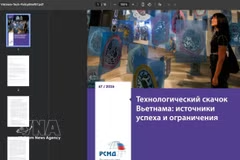
The report “Vietnam’s Technological Leap: Sources of Success and Limitations” (Photo: screenshot)

Vietnam makes significant technological progress thanks to open-door policy: Russian expert

Dezhina, a senior researcher at the Institute of Sociology under the Federal Research Center of the Russian Academy of Sciences, said the rapid development of Vietnam’s services sector and knowledge-based industries represents a technological leap driven largely by foreign investment and government policies aimed at developing infrastructure, boosting exports and attracting FDI.

The Da Nang People’s Committee presents awards to the Top 10 projects in the Student Category of the Da Nang Innovation and Startup Competition at SURF 2026. (Photo: VNA)

Da Nang runs biggest annual startup event

Themed “A New Era of Growth – Pioneering Innovation”, the festival focused on expanding international connectivity, promoting cross-border investment cooperation and highlighting strategic technology sectors such as artificial intelligence (AI), semiconductors, digital technology, blockchain, green technology and digital transformation.

Personnel responsible for safeguarding national digital sovereignty in cyberspace maintain a serious and focused working spirit at all times (Photo: VNA)

Protecting national security amid digital transformation, cyberspace

Cybersecurity, information security and data security risks must be identified and addressed early and from afar, with appropriate defensive measures ready to neutralise threats and protect national interests in cyberspace, said Lieutenant General Le Xuan Minh, Director of the Ministry of Public Security’s Department of Cybersecurity and Hi-tech Crime Prevention (A05).

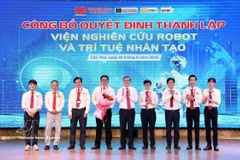
The leadership of the Institute of Robotics and Artificial Intelligence is introduced. (Photo:VNA)

Mekong Delta launches first robotics, AI research institute

Dr. Nguyen Van Quang, Rector of Nam Can Tho University, said the university is developing a value chain covering training, research, technology development, testing, technology transfer and commercialisation. The model is designed to link research more closely with practical needs, ensuring that technologies generate products and products create value for society.

Participants pose for a photo at the launch of the Daegu innovation space in Da Nang city. (Photo: VNA)

Daegu innovation space opens in Da Nang

The Daegu technology and innovation space in Da Nang will introduce Daegu’s outstanding technologies, innovative products and solutions while serving as a bridge connecting businesses, research institutes, universities and startup communities from the two cities.

The virtual assistant interface on the reception robot in Lai Hoa commune. (Photo: VNA)

Can Tho builds smart, modern administration through AI application

Amid efforts to accelerate national digital transformation, localities in Can Tho city are integrating modern technologies into State administration. Beyond conventional software and online platforms, artificial intelligence (AI) is being incorporated into public administrative service processes, leading to tangible improvements in service of people and businesses.

Delegates at the opening ceremony of Conviction 2026 (Photo: VNA)

Ho Chi Minh City urged to lead in developing, testing new technology models: Deputy PM

Conviction 2026, a national-level forum on Digital Assets and Artificial Intelligence, which opened in Ho Chi Minh City on August 14, brings together representatives from State management agencies, technology companies, financial institutions, investment funds, experts, research institutes, universities and domestic and international partners, creating opportunities to connect policies, technology, resources and markets, according to Deputy Prime Minister Ho Quoc Dung.