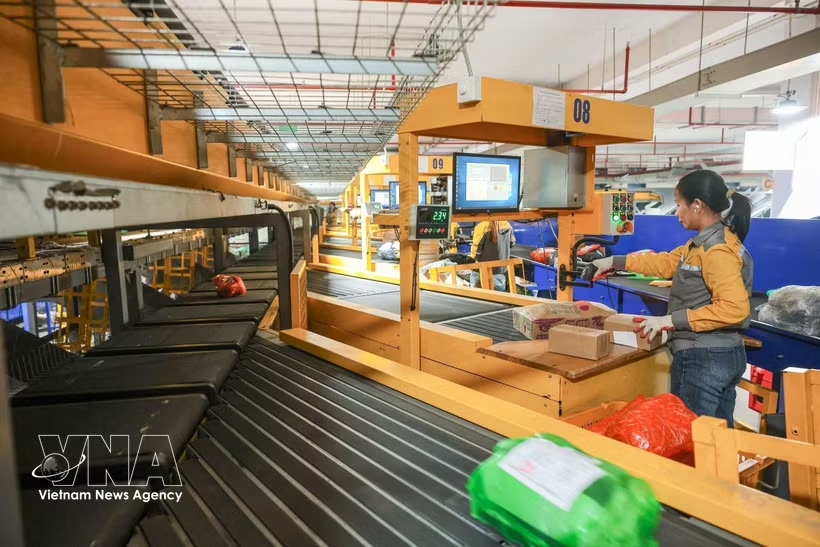
Hanoi (VNA) - Vietnam’s digital economy is emerging as an important growth driver, accounting for 14.02% of GDP in 2025, equivalent to 72.1 billion USD. This offers great opportunities for businesses to make breakthrough growth and clinch their position in the supply chain.
In the next stage of development, the challenge is not simply to digitalisation, but to turn technology, data and artificial intelligence (AI) into sources of productivity, added value and competitiveness for businesses.
A shift in business models
Politburo Resolution No. 57-NQ/TW, dated December 22, 2024, on breakthroughs in science and technology development, innovation and national digital transformation, sets a target for the digital economy to make up at least 30% of GDP by 2030.
Achieving this goal requires not only more businesses to participate in the digital economy, but, more importantly, the development of a business community capable of mastering technology, harnessing data and moving into higher-value segments of global production, supply, and distribution chains. Digital transformation should therefore be viewed as a fundamental shift in business models rather than simply an investment in technology.
Prof. Dr. Hoang Van Cuong, Vice Chairman of the Vietnam Economic Sciences Association, said the contribution of the digital economy should not be measured merely by its scale, but by the real value it creates for the domestic economy and Vietnamese businesses.
The timber industry is a case in point. Although Vietnam exports wood products to 167 countries and territories, most businesses still mainly operate as original equipment manufacturers (OEM), while higher value lies in original design manufacturing (ODM), product development and branding. Digital transformation is therefore crucial for wood businesses seeking to move from OEM to ODM and take greater control of product design and development.
The issue is no longer simply which technology to buy, but which business growth problem the technology can solve. National Assembly deputy Ho Duc Thang said businesses need to shift from choosing tools to identifying problems, from data storage to data governance as a strategic asset, and from training employees in performing tasks to developing their capacity to work alongside AI.
Technology only creates real value when it helps cut costs, shorten production times, improve quality or expand markets.
Bui Khanh Dung, General Director of Musa Pacta, held that for businesses to move faster, bottlenecks related to institutions, data, infrastructure, and technological absorption capacity need to be removed. In practice, superficial digitalisation remains common: applications are submitted online but additional paper documents are still required, while data already held by government agencies must still be re-entered by businesses.
According to Phan Duc Hieu, a member of the National Assembly’s Committee for Economic and Financial Affairs, management should shift from technology- or model-based approaches towards those based on objectives, outcomes and risks. Administrative procedures should also be redesigned with a digital mindset, alongside the use of regulatory sandboxes.
Data should be treated as infrastructure for the digital economy. If data remains fragmented, lacks interoperability standards and cannot be shared, businesses will struggle to harness AI and develop new business models.
Strengthening business proactiveness
Going forward, controlled data sharing and shared infrastructure should be promoted, while a data market should gradually be established so that data can become a resource for value creation. For small- and medium-sized enterprises, digital transformation support should focus less on the number of software packages or devices adopted and more on tangible outcomes such as lower costs, higher productivity, increased revenue and market expansion.
The State can help create an initial market for domestic technologies through ordering mechanisms, outcome-based public procurement, and the publication of real-world challenges for technology companies to solve
Ultimately, no policy can replace businesses’ own efforts to innovate. They must take the initiative in investing in technology, human resources and R&D, while strengthening management and technology absorption capacity.
Greater business-to-business linkages are also needed in line with Resolution No. 19-NQ/TW, adopted on July 28, 2026 by the 14th Party Central Committee’s third plenum on renewing Vietnam’s development model.
Large enterprises should play a leading role and bring smaller businesses deeper into their supply chains. SMEs need to invest in human resources and R&D, foster innovation, improve their ability to meet international standards and master technology rather than simply adopt existing solutions. Innovative startups, meanwhile, need space to experiment and grow.
Only when businesses view digital transformation as a fundamental change in their business models, while the State provides an enabling framework, data infrastructure and sufficiently broad markets for innovation, can the digital economy become a substantive growth driver./.