Hanoi (VNA) – Vietnam is stepping up coordination with the Philippines to address issues in bilateral rice trade, particularly an ongoing safeguard investigation into imported rice, while seeking to strengthen a stable and sustainable rice supply chain between the two countries.
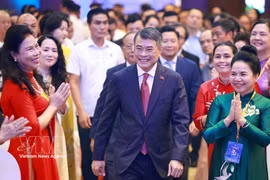
As part of these efforts, an inter-sectoral delegation led by Deputy Minister of Industry and Trade Nguyen Sinh Nhat Tan worked with Philippine authorities from August 19-21 to exchange views on the investigation, resolve trade-related difficulties and promote the implementation of bilateral cooperation agreements on rice.
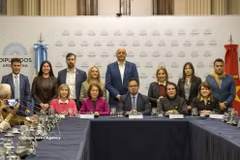
The delegation included representatives from the Ministry of Industry and Trade (MoIT), the Ministry of Agriculture and Environment, the Ministry of Foreign Affairs, the Vietnamese Embassy and Trade Office in the Philippines, and the Vietnam Food Association (VFA). They held working sessions with the Philippine Department of Trade and Industry (DTI), Department of Foreign Affairs (DFA), Tariff Commission (TC) and Department of Agriculture (DA).
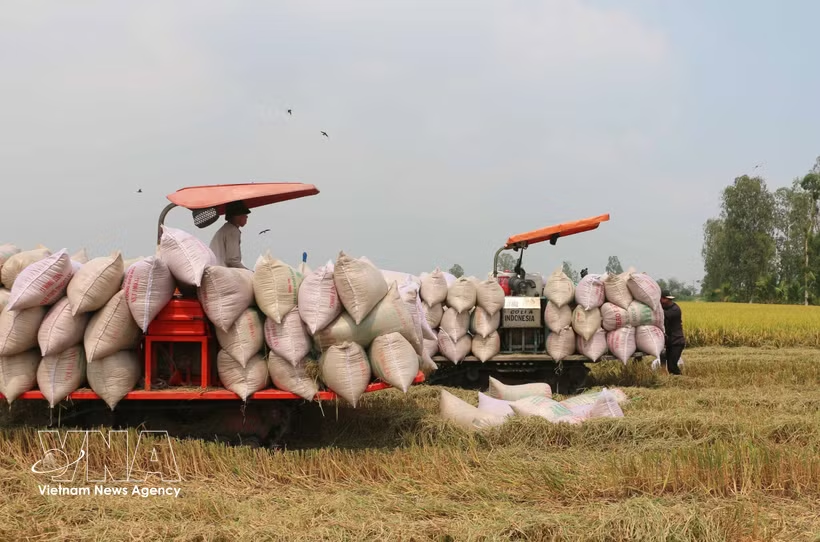
At the meeting with the DTI, both sides affirmed the importance of the Enhanced Strategic Partnership between Vietnam and the Philippines and the role of rice trade in bilateral economic ties. The Philippine side recognised Vietnam as a stable and reliable rice supplier that contributes significantly to food security and domestic market stability, according to the MoIT.
The two sides agreed to continue close coordination to effectively implement the Memorandum of Understanding (MoU) on rice trade cooperation, maintain stable supply chains and balance the interests of farmers, businesses and consumers in both countries.
Regarding the safeguard investigation, the DTI said the TC is conducting the investigation under a quasi-judicial mechanism. The DTI and relevant agencies will continue to monitor and coordinate the process to ensure that it is objective and transparent and complies with World Trade Organisation (WTO) rules and the ASEAN Trade in Goods Agreement (ATIGA). Both sides also agreed to maintain regular information exchanges to minimise any adverse impacts on bilateral rice trade. The Philippines took note of Vietnam’s proposal to upgrade the existing rice trade MoU or establish a more legally binding and stable cooperation framework to ensure smooth rice trade in line with international rules and market conditions.
The two sides also discussed cooperation in other economic areas, including energy investment and infrastructure development. The DTI expressed appreciation for Vietnam’s active support for the Philippines’ process of applying for joining the Comprehensive and Progressive Agreement for Trans-Pacific Partnership (CPTPP). Vietnam, meanwhile, said it would discuss with relevant ministries and agencies a Philippine proposal concerning market access for e-cigarettes and heated tobacco products.
At the meeting with the TC, the Vietnamese delegation presented key views, information and arguments contained in its comments submitted to the commission on the safeguard investigation.
Vietnam asked the TC to assess the case in the broader context of the Philippine rice market and the government’s import policies, including lower import tariffs and the issuance of sanitary and phytosanitary import clearance (SPS-IC). Vietnam also stressed the role of imported rice in ensuring supply, stabilising prices and safeguarding food security, as well as the potential impacts of safeguard measures on Philippine businesses and consumers.
The TC praised the Vietnamese Government, the VFA and relevant businesses for facilitating the investigation.
The Philippine side reaffirmed that the investigation would be conducted fairly, objectively and transparently in accordance with WTO and ATIGA rules. It also pledged to fully consider information, arguments and evidence submitted by relevant parties before making its final recommendation.
The TC asked Vietnamese ministries and agencies, the VFA and businesses to continue participating actively in a public hearing scheduled for September 2026.
At the meeting with the Philippine DA, the two sides discussed the implementation of the MoU on rice trade cooperation, measures to facilitate rice imports and exports, and orientations for future cooperation. The Philippine side again spoke highly of the important role of Vietnamese rice in ensuring supply and stabilising its domestic market. Despite its policy of diversifying import sources, it said Vietnam remains a stable major supplier, with Vietnamese rice valued by importers and consumers for its consistent quality and suitability to local preferences.
Vietnam proposed studying a higher-level cooperation framework on rice trade to provide a more stable and long-term foundation for bilateral rice trade while balancing the interests of farmers, businesses and consumers, and providing sustainable livelihoods for rice growers and stable living conditions for Philippine consumers. The Philippine side took note of the proposal and said it would study it.
On August 21, the VFA also met with the Philippine Rice Industry Association (PRIA) to discuss market developments, expected import demand and difficulties arising during the implementation of commercial contracts.
The two sides agreed to strengthen information sharing, support business-to-business connections and coordinate in addressing arising difficulties, contributing to stable, sustainable and mutually beneficial rice trade between Vietnam and the Philippines./.
VNA