Hanoi (VNA) – Singapore’s experience in governance, institution-building and engagement with the global technology ecosystem offers valuable lessons for Vietnam as its digital economy and AI adoption expand rapidly, while opening new opportunities for bilateral cooperation in science, technology and AI.
In an interview with Vietnam News Agency correspondents in Singapore, Prof. Vu Minh Khuong of the National University of Singapore said a notable feature of Singapore’s approach was its ability to quickly adjust legislation and government structure to keep pace with technological development.
The renaming of the Ministry of Communications and Information to the Ministry of Digital Development and Information reflects the growing role of digital transformation in the country’s development strategy, he noted.
Singapore has also strengthened resources for agencies implementing digital transformation policies and launched initiatives to help tens of thousands of businesses integrate AI into their operations, while promoting AI training among civil servants.
At the same time, the country considers both the benefits and risks of new technologies, including AI misuse, misinformation, personal data breaches and technology-enabled scams. These challenges are addressed through legal frameworks combined with greater public awareness.
Khuong said Singapore places particular emphasis on digital literacy, helping citizens identify and respond to risks in the digital environment. It also seeks to ensure vulnerable groups, particularly older people with limited access to technology, are not left behind. Such an approach enables society to benefit more from technological advances while strengthening public trust in digital transformation, he said.
Singapore simultaneously focuses on policy, legislation, infrastructure and human resources to prepare for emerging technologies, with particular attention to developing AI engineers and specialists.
The country also actively links national initiatives with multinational technology ecosystems. Khuong said Singapore identifies major challenges requiring solutions and then involves capable businesses in developing them.
In areas such as AI, data centres and digital infrastructure, the Singaporean Government works with businesses to address investment needs and obstacles related to regulations, finance, land and energy, helping facilitate large-scale projects.
This enables Singapore to tap the technology, capital and long-term vision of leading global corporations to address strategic challenges, while creating jobs and enhancing national competitiveness. Khuong said another strength of the model was its focus on developing the broader innovation ecosystem, with new policies and regulations subject to extensive consultation with affected stakeholders.
Vietnam’s digital potential
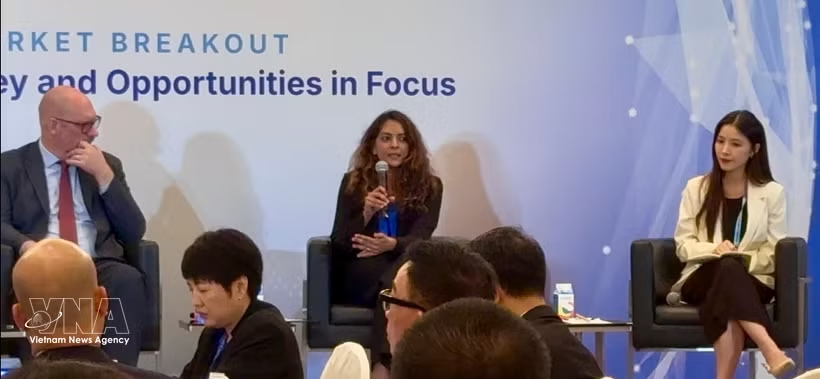
Vietnam has favourable conditions for accelerating the adoption of new technologies. Thao Dao, Country Strategy & Operations Lead at Google, said studies over the past decade have shown that Vietnam continously ranks among the fastest-growing digital markets in Southeast Asia.
Vietnam’s digital economy currently has a gross merchandise value of about 39 billion USD, including 25 billion USD from e-commerce. Video commerce grows about 60% annually, while around 650,000 sellers and shops increasingly use digital platforms as their main channels to reach customers and markets.
Vietnamese people’s interest in and use of AI is also among the highest in the region, she said, showing that AI is becoming a widely used tool in business, education and daily life.
Shanti Alexander, Meta’s Director of Policy Programmes and Campaigns for Asia-Pacific, also highlighted Vietnam’s potential in digital technology and AI. Vietnamese businesses are among regional leaders in conversational commerce and the use of business messaging platforms to reach domestic and international customers.
According to a Meta study, about nine in 10 people and businesses surveyed in Vietnam believe AI can improve productivity, communication and business operations. Alexander also praised Vietnamese businesses for their entrepreneurial spirit and willingness to experiment with new technologies.
Experts said Singapore’s experience and Vietnam’s rapidly growing digital market create opportunities for greater bilateral cooperation in AI, the digital economy, human-resource training and innovation ecosystems.
Singapore’s experience in linking policies with business needs, mobilising technology corporations to address national challenges and ensuring vulnerable groups are not left behind could provide valuable lessons for Vietnam, they added./.
See more
Deputy PM highlights overseas Vietnamese experts’ role in AI development
Deputy Prime Minister Ho Quoc Dung expressed his pleasure at meeting Prof. Dr. Nguyen Van Tam, a prominent Vietnamese scientist in France who has conducted outstanding research and holds key academic positions at IP Paris and Télécom Paris.
Building AI capabilities tailored to Vietnam’s needs
Vietnam is entering a new phase of AI development, moving beyond the adoption of existing technologies to building its own capabilities by advancing models, computing infrastructure, data, and talent in parallel to create an ecosystem capable of developing technologies tailored to the country’s needs.
Top-performing teams at ROBOTACON WRO 2026 national finals honoured
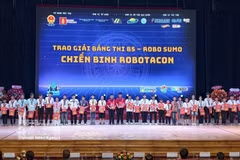
The national finals of the ROBOTACON WRO 2026 robot talent competition concluded in the central province of Gia Lai on August 23, providing students with a valuable learning and experiential environment where they could develop STEM skills, learn to work together, think creatively and solve complex problems.
Vietnam team wins three awards at ABU Robocon 2026
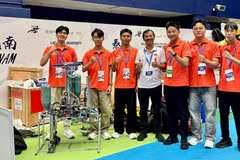
The LH-FOF team from Vietnam's Lac Hong University won three awards the 2026 Asia-Pacific Broadcasting Union Robot Contest (ABU Robocon): third place overall, the best design award and a sponsor’s award.
Skilled workforce vital to Vietnam’s nuclear power programme
The long-term challenge Vietnam must proactively address is building a pool of personnel in management, regulation, research and development, and technical support. These are areas in which the country must take the initiative in training and building up its own capabilities so that it can independently conduct assessments, evaluate safety, verify technical calculations, carry out research, and provide support for the sustainable development of the nuclear programme.
Vietnam issues new cybersecurity rules for domestic, foreign businesses
Issued on August 19, the decree comprises six chapters and 32 articles, covering cybersecurity protection measures, information security assurance, specialised cybersecurity training, and management of IP address identification for telecommunications and Internet service providers.
Nearly 500 contestants compete at ROBOTACON WRO 2026 national finals
Held under the theme “Robots Meet Culture”, this year’s competition aims to connect technology with cultural values, encouraging students to apply their knowledge of science, engineering and programming to real-world problems while promoting cultural values through creative solutions.
Singapore’s tech adaptation offers lessons for Vietnam: Insiders
Prof. Vu Minh Khuong from the Lee Kuan Yew School of Public Policy noted that Vietnam is also making positive progress in this area, with officials increasingly focused on updating knowledge, learning from new models and adapting to changes. The key, he stressed, is to quickly translate these efforts into concrete results, which can build trust, strengthen motivation and drive further development.
Nvidia proposes four strategic areas of cooperation with Vietnam
Nvidia described Vietnam as one of ASEAN's most dynamic start-up markets and expressed its interest in strengthening cooperation and supporting Vietnamese AI start-ups.
Vietnam opens digital transformation market to Russian tech firms
Ivan Gorkovenko, Regional Director for Southeast Asia at Softline Group, said Russian businesses should quickly seek local partners and prepare technology-transfer plans to compete effectively in the Vietnamese market.
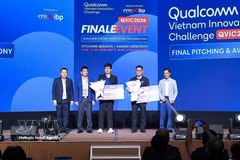
Vietnamese startups recognised for innovative AI solutions
Winning a total of 255,000 USD, the solutions are innovative AI applications developed by Vietnamese startups in areas including edge computing, the Internet of Things (IoT), robotics and healthcare.
Vietnam, Israel explore stronger cooperation in technology, innovation
During the meeting, Ambassador Nguyen Ky Son said science, technology, innovation and artificial intelligence (AI) are becoming key drivers of Vietnam’s development, stressing that the application of AI and emerging technologies must go hand in hand with data security and safety.
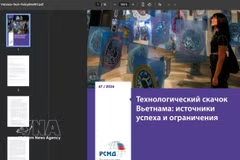
Vietnam makes significant technological progress thanks to open-door policy: Russian expert
Dezhina, a senior researcher at the Institute of Sociology under the Federal Research Center of the Russian Academy of Sciences, said the rapid development of Vietnam’s services sector and knowledge-based industries represents a technological leap driven largely by foreign investment and government policies aimed at developing infrastructure, boosting exports and attracting FDI.
Vietnam to award 1,500 full scholarships for strategic technology training abroad
By 2035, 1,500 Vietnamese citizens are expected to receive full scholarships for overseas study and research, including 100 undergraduate students, 400 master's students, 500 doctoral candidates and 500 postdoctoral researchers. The allocation may be adjusted in line with training needs and the state budget.
Da Nang runs biggest annual startup event
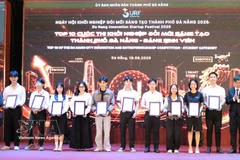
Themed “A New Era of Growth – Pioneering Innovation”, the festival focused on expanding international connectivity, promoting cross-border investment cooperation and highlighting strategic technology sectors such as artificial intelligence (AI), semiconductors, digital technology, blockchain, green technology and digital transformation.
Protecting national security amid digital transformation, cyberspace
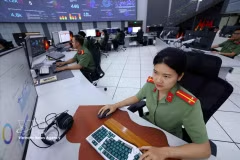
Cybersecurity, information security and data security risks must be identified and addressed early and from afar, with appropriate defensive measures ready to neutralise threats and protect national interests in cyberspace, said Lieutenant General Le Xuan Minh, Director of the Ministry of Public Security’s Department of Cybersecurity and Hi-tech Crime Prevention (A05).
Mekong Delta launches first robotics, AI research institute
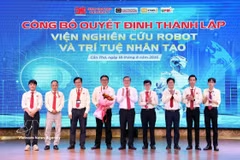
Dr. Nguyen Van Quang, Rector of Nam Can Tho University, said the university is developing a value chain covering training, research, technology development, testing, technology transfer and commercialisation. The model is designed to link research more closely with practical needs, ensuring that technologies generate products and products create value for society.
Daegu innovation space opens in Da Nang
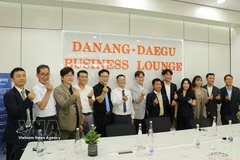
The Daegu technology and innovation space in Da Nang will introduce Daegu’s outstanding technologies, innovative products and solutions while serving as a bridge connecting businesses, research institutes, universities and startup communities from the two cities.
Vietnam steps up preparations for 6G as 5G network expands
A global technology, 6G requires cooperation between countries, businesses and international standards organisations to ensure the compatibility of telecommunications infrastructure worldwide.
Legal know-how essential for content creators in digital space
The workshop highlighted that the rapid development of e-commerce, social media and digital content creation is creating significant opportunities for KOCs and KOLs, while also requiring them to improve their legal knowledge and compliance.