Key Party leader's visit to lay foundation for Vietnam-Singapore new-generation strategic relationship

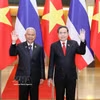
The official visit to Singapore by Member of the Political Bureau and Standing Member of the Secretariat of the Communist Party of Vietnam (CPV) Central Committee Tran Cam Tu will provide an important political foundation for turning the Comprehensive Strategic Partnership (CSP) into concrete collaboration programmes.

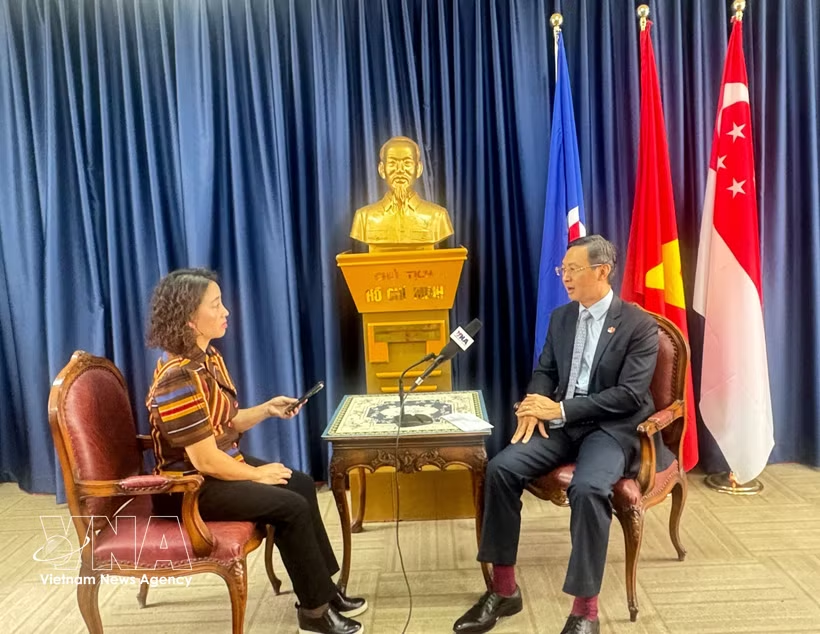
Vietnamese Ambassador to Singapore Tran Phuoc Anh in an interview with the Vietnam News Agency (Photo: VNA)

Singapore (VNA) – The official visit to Singapore by Member of the Political Bureau and Standing Member of the Secretariat of the Communist Party of Vietnam (CPV) Central Committee Tran Cam Tu and his co-chairing of the first Vietnam-Singapore Strategic Dialogue on August 24-25, carry landmark significance at the strategic, political and practical levels, said Vietnamese Ambassador to Singapore Tran Phuoc Anh.

First, the visit will open a new channel for strategic-level exchanges between the two countries - the Party-to-Party channel. This marks a shift from a “good relationship” towards a “strategic relationship”, enabling the two sides to engage in frank and in-depth discussions on long-term issues, including national development orientations, State building, economic development, social governance, personnel training, as well as regional and global developments, he told Vietnam News Agency correspondents in Singapore.

Second, the visit will provide an important political foundation for turning the Comprehensive Strategic Partnership (CSP) into concrete collaboration programmes. The first strategic dialogue will help the two sides identify new areas of cooperation beyond traditional fields such as trade, investment, education and defence-security. Particularly, Singapore has extensive experience in areas of interest to Vietnam, including artificial intelligence (AI), the digital economy, innovation, urban governance, human resource development, logistics, finance, and international connectivity.

Third, the visit offers an opportunity for the two sides to advance bilateral relations into practical areas aligned with Vietnam’s development priorities. Vietnam-Singapore cooperation in the coming period could move beyond the model of Singapore investing in Vietnam towards a deeper partnership model based on joint research, joint innovation, joint technology development, and joint participation in regional and global value chains.

Finally, Phuoc Anh said the most significant aspect of the visit is that it will create a new “architecture” for Vietnam-Singapore relations. Whereas bilateral ties have previously been driven mainly through Government-to-Government mechanisms and economic projects, a multi-layered structure could now emerge encompassing Party-to-Party, State-to-State, Government-to-Government, legislature-to-legislature, locality-to-locality and people-to-people ties, with the strategic dialogue serving as a bridge at the political-strategic level.

“I expect the dialogue to become not merely a high-level policy exchange mechanism, but a genuine new driving force for turning the major orientations of the two countries into concrete, breakthrough cooperation programmes and projects that create long-term value,” he said.

First, in the areas of green economy and energy transition, Vietnam wishes to draw on Singapore’s strengths in technology, green finance, governance and international connectivity to jointly promote clean energy, carbon credit and circular economy projects. A strategically significant avenue for cooperation will be to connect Vietnam’s energy production centres with Singapore’s financial, technological and market ecosystems, thereby developing cooperation models that could be replicated across the region.

Second, digital transformation, AI and innovation will form an important pillar. Singapore boasts extensive experience in developing digital government, data governance, AI and innovation ecosystems, while Vietnam has a large market, an increasingly strong technology workforce and substantial demand for digital transformation.

The two sides could go beyond experience-sharing towards jointly developing solutions, innovation centres, human resources training programmes and AI, data and digital technology projects serving public administration and businesses, the ambassador recommended.

Third, the dialogue could help remove bottlenecks in investment cooperation and business connectivity. Singapore is currently one of the largest investors in Vietnam, but there remains considerable room for further joint work, particularly in high technology, semiconductors, logistics, finance, smart cities, healthcare, education and emerging industries.

Finally, Phuoc Anh said the greatest value of the strategic dialogue lies in helping the sides anticipate new development trends in the region together, rather than simply addressing existing bilateral issues. With their CSP, high level of political trust and strong economic complementarity, the two countries are well placed to become ASEAN pioneers in green economy, digital transformation, AI, clean energy and innovation.

“If we can achieve this, the strategic dialogue will not only generate new projects, but, more importantly, create new models of cooperation, making a practical contribution to building a more dynamic, more creative, greener and more competitive ASEAN,” he said.

The ambassador noted that the visit and the dialogue carry significance beyond the bilateral framework, as they also represent a practical contribution to ASEAN solidarity, unity and centrality.

Vietnam and Singapore share core interests in building a united, self-reliant and adaptable ASEAN that plays a proactive role in the regional architecture. The dialogue will provide an additional channel for the two sides to discuss strategic issues, narrow differences, strengthen trust and coordinate more closely within ASEAN, he added./.

VNA
See more

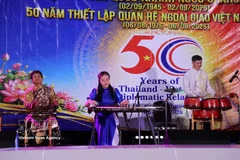
A performance at the programme (Photo: VNA)

NA President attends political-artistic programme celebrating national milestones

The programme contributed to educating younger generations about their responsibility to preserve and build on the achievements of the revolution, while fostering a spirit of enthusiasm and patriotic emulation and encouraging officials, Party members and people from all walks of life to harness the strength of great national unity to join hands in building and firmly safeguarding the nation.

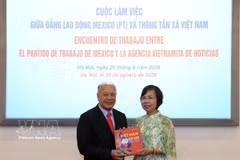
Deputy Secretary of the Quang Ninh provincial Party Committee Vu Quyet Tien (R) presents a painting of Ha Long Bay to Senator, PT General Secretary Alberto Anaya Gutiérrez. (Photo: VNA)

Quang Ninh pledges to facilitate Mexican investment

Quang Ninh hopes to further strengthen cooperation with Mexican localities, organisations and businesses, particularly by attracting investment in tourism, processing and manufacturing, science and technology, education and training, and healthcare.

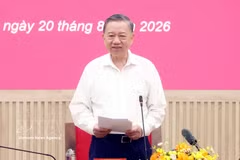
General Secretary of the Communist Party of Vietnam Central Committee and President To Lam speaks at the working session with the Ho Chi Minh National Academy of Politics' key leaders on August 20. (Photo: VNA)

Ho Chi Minh National Academy of Politics must serve as model of Party building: Top leader

The Ho Chi Minh National Academy of Politics must become a place where new issues are detected early, difficult problems are studied thoroughly, practical experience is elevated into theory, and theory is translated into action so that every cadre graduating from the academy is firmer in political mettle, clearer in theoretical thinking, more responsible and more effective in serving the Party, the country and the people, said top leader To Lam.

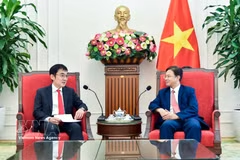
Deputy Foreign Minister Ngo Le Van (R) receives Watanabe Tetsuya, President of the Economic Research Institute for ASEAN and East Asia (ERIA), in Hanoi on August 20. (Photo: VNA)

Indonesia-based research institute ready to contribute ideas to APEC 2027 discussions

ERIA attaches great importance to collaboration with Vietnam and stands ready to further promote its strengths in research and policy advice to contribute to the country’s development goals through ASEAN and Mekong subregional cooperation, particularly in energy connectivity, infrastructure, digital connectivity, green transformation and high-quality human resources development.

Deputy Prime Minister Pham Thi Thanh Tra (R) receives Chinese Ambassador to Vietnam He Wei on August 20. (Photo: chinhphu.vn)

Tightening ties with China remains top priority in Vietnam’s foreign policy: Deputy PM

Amid complex, rapid and unpredictable developments in the regional and international situation, Vietnam and China should effectively implement important common perceptions reached by their top leaders, and continuously consolidate and develop bilateral ties, especially in areas of substantive cooperation, said Deputy Prime Minister Pham Thi Thanh Tra.

☕ Afternoon briefing on August 20

☕ Afternoon briefing on August 20

A meeting to discuss a project reviewing the five-year implementation of Resolution No. 28-NQ/TW, Vietnam's plan to award 1,500 full scholarships for strategic technology training abroad, and Dak Lak province seeking the UNESCO Global Geopark recognition for Phu Yen Geopark are among news highlights on August 20.

General Secretary of the Communist Party of Vietnam Central Committee and President To Lam speaks at the working session with the Party Central Committee’s Commission for Organisation on August 20. (Photo: VNA)

Party leadership must closely link with targets, outcomes, accountability: Top leader

General Secretary and President To Lam said the review of the Resolution No. 28-NQ/TW implementation is an important political task in the building of the Party and the political system. It should examine how the Party exercises its leadership and ruling role and how the entire political system translates the Party’s guidelines and policies into action and concrete results.

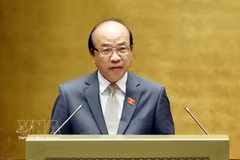
Chairman of the National Assembly's Committee for Legal and Judicial Affairs Phan Chi Hieu delivers a verification report on three draft laws - the revised Penal Code, the revised Criminal Procedure Code, and the revised Law on Organisation of Criminal Investigation Agencies on August 20. (Photo: VNA)

Bill seeks to narrow application scope of death penalty for six offences

Lawmakers on August 20 discussed the Government's proposal and a verification report on the draft revised Penal Code, which narrows the application scope of the death penalty for six offences, retaining it for only four, namely treason, murder, terrorism and illegal drug production.

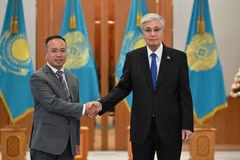
Vietnamese Ambassador to Kazakhstan Nguyen Thanh Le (L) and Kazakh President Kassym-Jomart Tokayev at their meeting on August 19. (Photo published by VNA)

Vietnam seeks to deepen strategic partnership with Kazakhstan

Ambassador Nguyen Thanh Le affirmed that he will work closely with Kazakhstan’s Ministry of Foreign Affairs, ministries, agencies and localities to effectively implement high-level agreements, strengthen political trust and promote cooperation in trade, investment, transport and logistics, tourism, culture, education and people-to-people exchanges.

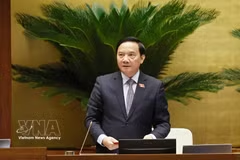
National Assembly Vice President Nguyen Khac Dinh precides over the discussion (Photo: VNA)

Amendments to bills aim to close loopholes in criminal laws

The amendments to the Penal Code focus on four major areas - revising and supplementing provisions on offences and penalties; revising provisions on grounds for exclusion, postponement and exemption from criminal liability and the statute of limitations for criminal prosecution; and ensuring consistency, feasibility and sound legislative drafting.