Ho Chi Minh National Academy of Politics must serve as model of Party building: Top leader

The Ho Chi Minh National Academy of Politics must become a place where new issues are detected early, difficult problems are studied thoroughly, practical experience is elevated into theory, and theory is translated into action so that every cadre graduating from the academy is firmer in political mettle, clearer in theoretical thinking, more responsible and more effective in serving the Party, the country and the people, said top leader To Lam.

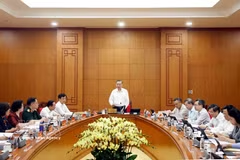
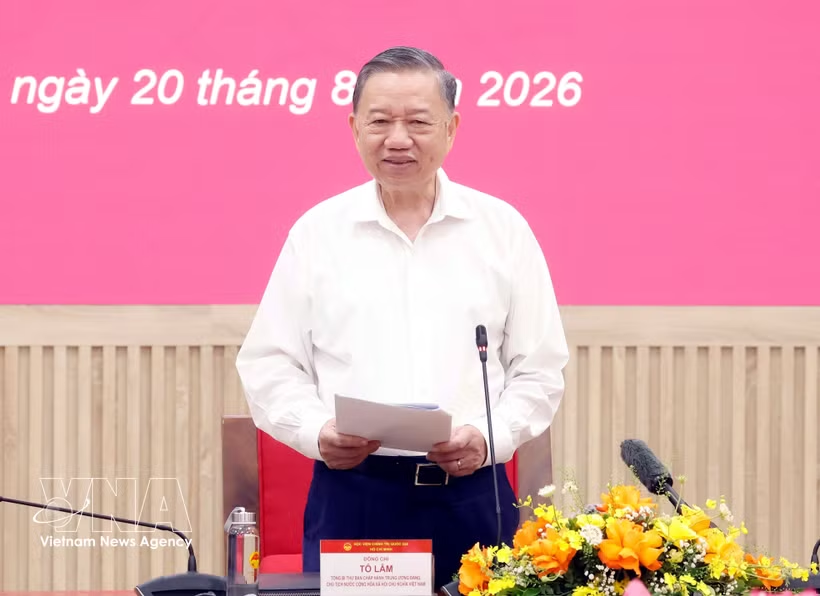
General Secretary of the Communist Party of Vietnam Central Committee and President To Lam speaks at the working session with the Ho Chi Minh National Academy of Politics' key leaders on August 20. (Photo: VNA)

Hanoi (VNA) – General Secretary of the Communist Party of Vietnam Central Committee and President To Lam on August 20 called on the Ho Chi Minh National Academy of Politics (HCMA) to become a model of Party building, discipline, academic integrity, public resource use, and accountability.

Speaking at a working session with the academy’s key leaders in Hanoi, General Secretary and President Lam praised the academy, the Central Council for Theoretical Studies, the academy’s affiliated institutes and the nationwide system of politics schools for their important contributions to Party building and the country’s development over the past time. He stressed that the academy must accurately assess its achievements and shortcomings, and clearly define its position, mission and development requirements in the new period.

According to the top leader, the academy must fully and effectively perform its assigned functions, commensurate with its role as the Party Central Committee’s school for Party building and a national centre for training leaders and managers, as well as conducting research into political theory, leadership science, administrative management, State management and public governance.

Each field must produce valuable theoretical and practical outputs that directly serve Party and political system building and personnel development, General Secretary and President Lam said, urging the HCMA to substantially enhance its capacity for research, forecasting and strategic policy advice, proactively review major issues, identify emerging trends and detect at an early stage unprecedented challenges and changes affecting the country, thereby providing timely and reliable scientific, theoretical and practical foundations for the formulation and improvement of Party guidelines and State policies and laws.

The academy must also contribute to developing a contingent of officials with firm political mettle, theoretical and strategic thinking, and strong leadership, management and implementation capabilities. Such officials must be capable of translating Party guidelines into concrete results, safeguarding the Party’s ideological foundation and proactively fighting and rejecting wrong and hostile allegations.

The Party and State leader called for comprehensive reform of the academy’s operating methods to deliver clear improvements in quality and effectiveness. He emphasised the need to elevate theoretical research, practical reviews, strategic advice and the protection of the Party’s ideological foundation.

He asked the academy to organise scientific reviews of 100 years of the Party’s leadership of the Vietnamese revolution, 40 years of implementing the 1991 Political Platform, and a special programme for 2026-2030.

In addition, training and retraining must shift from simply knowing theory to understanding correctly, applying creatively and acting responsibly. Theory should serve as the foundation, political mettle as the core, implementation capacity as the direct requirement, ethics and integrity as the standard, and the interests of the people as the ultimate measure.

He highlighted the need for breakthroughs in data, digital transformation, artificial intelligence (AI) and implementation governance. Digital transformation, he said, must redesign governance, research and learning on an integrated data architecture, with data being accurate, complete, clean, up-to-date, traceable, properly managed and protected.

The top leader stressed that investing in the academy means investing in the Party’s fundamental work, its thinking and governing capacities, and the quality of its cadres. The academy must become a place where new issues are detected early, difficult problems are studied thoroughly, practical experience is elevated into theory, and theory is translated into action so that every cadre graduating from the academy is firmer in political mettle, clearer in theoretical thinking, more responsible and more effective in serving the Party, the country and the people, he added./.
VNA

See more

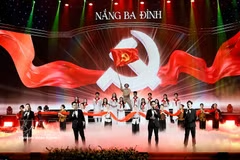
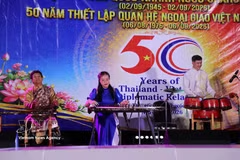
A performance at the programme (Photo: VNA)

NA President attends political-artistic programme celebrating national milestones

The programme contributed to educating younger generations about their responsibility to preserve and build on the achievements of the revolution, while fostering a spirit of enthusiasm and patriotic emulation and encouraging officials, Party members and people from all walks of life to harness the strength of great national unity to join hands in building and firmly safeguarding the nation.

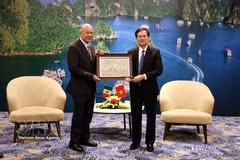
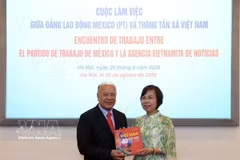
Deputy Secretary of the Quang Ninh provincial Party Committee Vu Quyet Tien (R) presents a painting of Ha Long Bay to Senator, PT General Secretary Alberto Anaya Gutiérrez. (Photo: VNA)

Quang Ninh pledges to facilitate Mexican investment

Quang Ninh hopes to further strengthen cooperation with Mexican localities, organisations and businesses, particularly by attracting investment in tourism, processing and manufacturing, science and technology, education and training, and healthcare.

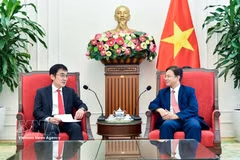
Deputy Foreign Minister Ngo Le Van (R) receives Watanabe Tetsuya, President of the Economic Research Institute for ASEAN and East Asia (ERIA), in Hanoi on August 20. (Photo: VNA)

Indonesia-based research institute ready to contribute ideas to APEC 2027 discussions

ERIA attaches great importance to collaboration with Vietnam and stands ready to further promote its strengths in research and policy advice to contribute to the country’s development goals through ASEAN and Mekong subregional cooperation, particularly in energy connectivity, infrastructure, digital connectivity, green transformation and high-quality human resources development.

Deputy Prime Minister Pham Thi Thanh Tra (R) receives Chinese Ambassador to Vietnam He Wei on August 20. (Photo: chinhphu.vn)

Tightening ties with China remains top priority in Vietnam’s foreign policy: Deputy PM

Amid complex, rapid and unpredictable developments in the regional and international situation, Vietnam and China should effectively implement important common perceptions reached by their top leaders, and continuously consolidate and develop bilateral ties, especially in areas of substantive cooperation, said Deputy Prime Minister Pham Thi Thanh Tra.

☕ Afternoon briefing on August 20

☕ Afternoon briefing on August 20

A meeting to discuss a project reviewing the five-year implementation of Resolution No. 28-NQ/TW, Vietnam's plan to award 1,500 full scholarships for strategic technology training abroad, and Dak Lak province seeking the UNESCO Global Geopark recognition for Phu Yen Geopark are among news highlights on August 20.

General Secretary of the Communist Party of Vietnam Central Committee and President To Lam speaks at the working session with the Party Central Committee’s Commission for Organisation on August 20. (Photo: VNA)

Party leadership must closely link with targets, outcomes, accountability: Top leader

General Secretary and President To Lam said the review of the Resolution No. 28-NQ/TW implementation is an important political task in the building of the Party and the political system. It should examine how the Party exercises its leadership and ruling role and how the entire political system translates the Party’s guidelines and policies into action and concrete results.

Chairman of the National Assembly's Committee for Legal and Judicial Affairs Phan Chi Hieu delivers a verification report on three draft laws - the revised Penal Code, the revised Criminal Procedure Code, and the revised Law on Organisation of Criminal Investigation Agencies on August 20. (Photo: VNA)

Bill seeks to narrow application scope of death penalty for six offences

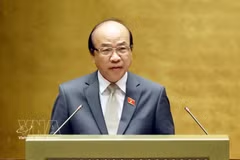
Lawmakers on August 20 discussed the Government's proposal and a verification report on the draft revised Penal Code, which narrows the application scope of the death penalty for six offences, retaining it for only four, namely treason, murder, terrorism and illegal drug production.

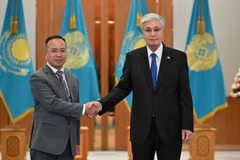
Vietnamese Ambassador to Kazakhstan Nguyen Thanh Le (L) and Kazakh President Kassym-Jomart Tokayev at their meeting on August 19. (Photo published by VNA)

Vietnam seeks to deepen strategic partnership with Kazakhstan

Ambassador Nguyen Thanh Le affirmed that he will work closely with Kazakhstan’s Ministry of Foreign Affairs, ministries, agencies and localities to effectively implement high-level agreements, strengthen political trust and promote cooperation in trade, investment, transport and logistics, tourism, culture, education and people-to-people exchanges.

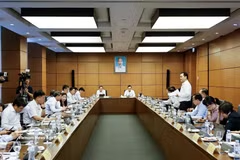
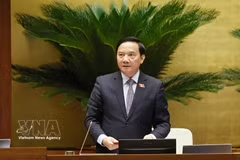
National Assembly Vice President Nguyen Khac Dinh precides over the discussion (Photo: VNA)

Amendments to bills aim to close loopholes in criminal laws

The amendments to the Penal Code focus on four major areas - revising and supplementing provisions on offences and penalties; revising provisions on grounds for exclusion, postponement and exemption from criminal liability and the statute of limitations for criminal prosecution; and ensuring consistency, feasibility and sound legislative drafting.