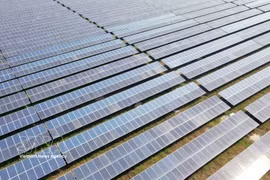
Hanoi (VNA) – Energy infrastructure, particularly power generation systems, transmission networks and offshore renewable energy sources, plays a crucial role in developing marine economic hubs, seaports, free trade zones, tourism services, and emerging maritime industries.
Resolution No 20-NQ/TW, adopted by the 14th Communist Party of Vietnam (CPV) Central Committee at its third plenum on July 28, 2026, on building and developing Vietnam into a strong maritime nation, identifies the marine economy as important for growth and calls for expanding development space into offshore and deep-sea areas.
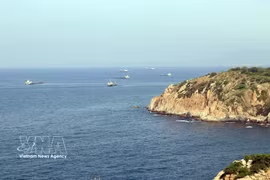
In coastal localities across central Vietnam, energy infrastructure is becoming increasingly closely linked to the expansion of the development space for the marine economy.
According to Deputy General Director of the Central Power Corporation (EVNCPC) Tran Nguyen Bao An, the corporation has been implementing measures for power generation, grid investment, and service quality to meet growth targets. However, a major challenge is the imbalance between power supply and local demand.
Under the National Power Development Plan VIII, around 50,000MW of power capacity is expected to be put into operation in the seven provinces managed by EVNCPC by 2030, while demand is projected at around 10,000MW. This gap highlights the need for coordinated grid development and better balancing of supply and demand.
Quang Tri province illustrates how power infrastructure is being developed alongside its marine economy.
Director of Quang Tri Power Company Hoang Hieu Trung said that the province boasts a long coastline and significant advantages in terms of natural landscapes and tourism, including Phong Nha and Thien Duong Caves. Tourism has been identified as one of the province’s key development sectors, particularly in coastal areas.
To ensure a stable supply for tourism activities, power lines serving coastal areas are being built to meet the N-1 reliability criterion, providing backup capacity. In Bao Ninh, a dedicated 110kV substation has been developed to meet growing electricity demand, while interconnected systems are helping create a flexible and smart grid.
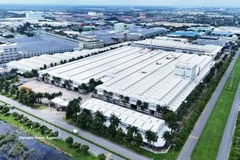
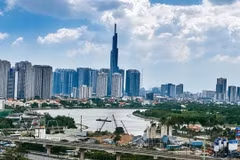
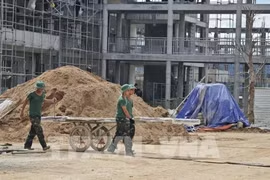
Da Nang is also preparing its power infrastructure in tandem with emerging drivers of the marine economy. For the marine economy, the city focuses on the Lien Chieu port area, coastal free trade zones, tourism, and other forms of maritime economic activity. Power has been supplied to the Lien Chieu Port area from the early stage of infrastructure development. Plans are in place for a 110kV Lien Chieu Port substation when the port begins large-scale operations, and coastal free trade zones have also been incorporated into the city’s power supply plan.
The power system has also been developed along the coastal routes from Son Tra, Ngu Hanh Son to Hoi An, Tam Ky, and Nui Thanh. From 110 kV substations to medium-voltage lines, distribution substations, and low-voltage lines, power infrastructure is being developed in accordance with the N-1 criterion, thereby enhancing the reliability of electricity supply for loads and marine economic activities.
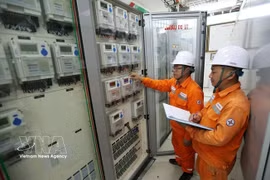
Digital transformation is adding a new layer to this infrastructure. EVNCPC has deployed unmanned 110kV substations, remote control centres and automated distribution grids. In Da Nang, 26 unmanned 110kV substations are in operation, while GIS technology has been applied at the Chi Lang 110kV substation to reduce land use and improve safety and urban aesthetics.
Paving the way for new marine economic spaces
Resolution No. 20 calls for the development of strategic, dual-use, digital, and energy infrastructure; strengthening connectivity between the mainland and islands, as well as between coastal growth hubs and major economic centres; and the formation of industrial, service, logistics, energy, and innovation hubs tailored to the strengths of each region.
Nguyen Tai Anh, Deputy General Director of Vietnam Electricity (EVN), said the group is involved in six areas of the maritime economy. These include tourism and marine services; the maritime economy; oil, gas and marine mineral exploitation; aquaculture and fisheries; the coastal industry; and renewable energy.
He stressed that ensuring electricity supplies for coastal and island areas is an important political mission. It has called for greater investment in offshore wind, new marine energy sources, coastal transmission systems and power suuply infrastructure for islands, alongside stronger mobilisation of private investment.
He also emphasised that energy infrastructure must be planned together with ports, logistics, tourism, aquaculture, industry and environmental conservation. Such an integrated approach would enable new energy sources to become a foundation for new marine economic spaces rather than simply meeting existing electricity demand.
Energy infrastructure for the marine economy is being developed as part of an integrated framework, encompassing power generation, grid development, maritime spatial planning, and the establishment of new growth hubs. This integrated approach will provide a vital infrastructure foundation for effectively harnessing the marine potential, helping realise the goal of making Vietnam a strong maritime nation and achieving sustainable and prosperous development from the sea./.