Hanoi (VNA) – The World Bank Group’s recent upgrade of Vietnam to the upper-middle-income economy category marks a historic milestone after 17 years of sustained efforts.
However, to escape the middle-income trap and achieve high-income status by 2045, Vietnam must address new development challenges as traditional growth drivers approach their limits. International organisations broadly agree that shifting the growth model from reliance on traditional factors toward technology and innovation is no longer an option for Vietnam, but an imperative of the times.
An urgent requirement
According to the World Bank Group’s latest classification, Vietnam’s gross national income (GNI) per capita has reached 4,970 USD, exceeding the threshold for entry into the upper-middle-income group. The achievement marks the end of the country’s 17-year period in the lower-middle-income category since 2009.
However, to become a high-income country by 2045, Vietnam’s GNI per capita must nearly triple. This is a formidable challenge, as only 27 economies have successfully escaped the middle-income trap since 1990. More than one-third of them benefited from special conditions that are difficult to replicate, such as EU accession or abundant natural resources.
Shantanu Chakraborty, Country Director of the Asian Development Bank (ADB) in Vietnam, said the real challenge is not achieving short-term growth milestones, but sustaining high, resilient and quality growth over consecutive years.
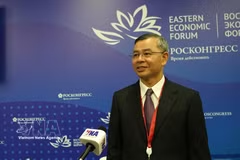
International experts share the view that Vietnam’s previous growth model, which relied heavily on capital, low-cost labour and FDI, is nearing its limits. Economist Irina Dezhina of the Institute of Sociology under the Russian Academy of Sciences said Vietnam’s openness has enabled a technological leap, but domestic technological self-reliance remains a major gap.
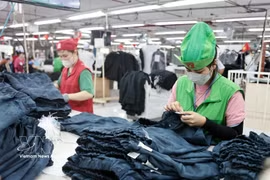
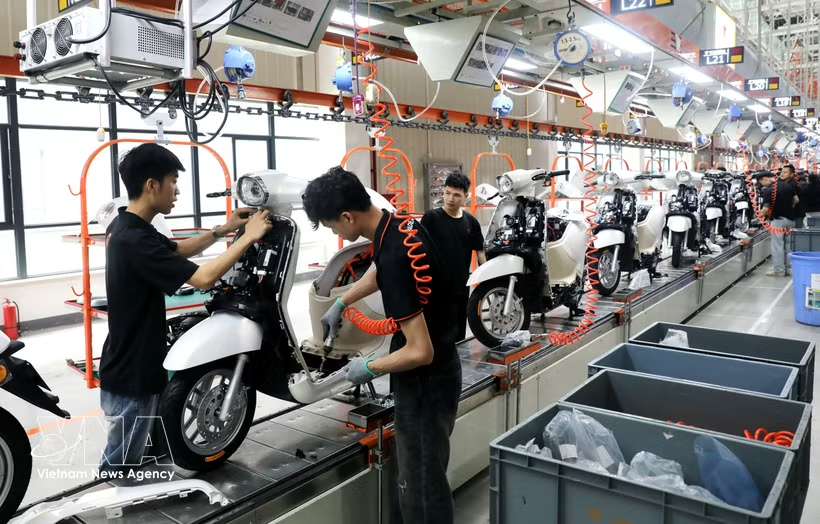
She noted that although FDI has made a significant contribution to GDP growth, technology transfer and management skills to domestic firms remain limited. Vietnam therefore continues to focus largely on lower-value-added stages such as assembly. The country has succeeded in attracting and absorbing technology but has yet to develop a fully-fledged ecosystem capable of generating domestic technologies.
The urgency of the transformation is also heightened given risks associated with Vietnam’s high degree of economic openness. With total trade turnover equivalent to around 170% of GDP, the country is highly exposed to global trade fluctuations, new tariff barriers and weaker demand in major export markets.
ADB Chief Economist Bui Minh Giap said this makes Vietnam particularly vulnerable to international headwinds, while World Bank Country Director for Vietnam Mariam J. Sherman recommended diversifying growth drivers and strengthening domestic resilience.
Two strategic levers
Vietnam nevertheless has important advantages for technology development, according to Dezhina. These include its proximity to major technology manufacturing hubs in Southeast Asia, favourable access to the Chinese and Indian markets, rare earth resources important for semiconductor production, and its increasingly market-oriented economic institutions.
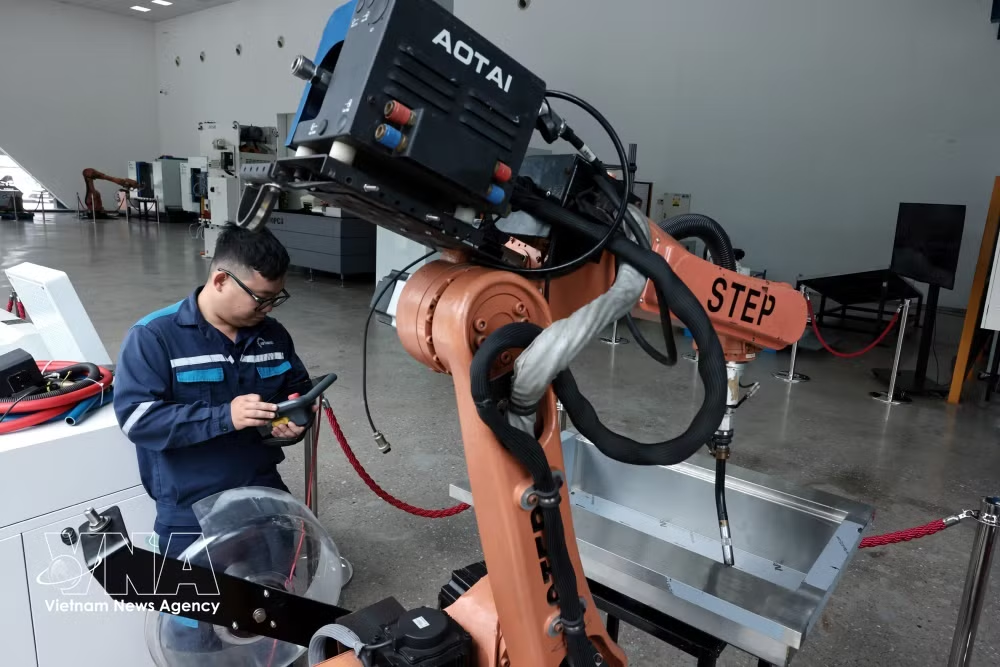
The country has also taken strong steps to promote technology and innovation. Citing the Global Innovation Index 2025, Dezhina noted that Vietnam ranked 44th out of 139 economies, while its overall innovation efficiency ranked 37th, well above its input ranking of 50th. Vietnam also has strong telecommunications infrastructure and nationwide 5G coverage.
The country’s progress is reflected in global technology trade. The World Bank Group’s World Development Report 2026: The Promise of Artificial Intelligence noted that Vietnam has entered the world’s top five developing-country exporters of products supporting AI systems, including semiconductors, electronic components and data-centre equipment.
To accelerate the transition to a technology-driven growth model, Vietnam is focusing on two key sectors: semiconductors and artificial intelligence (AI). Nikkei Asia said the rapid development of the semiconductor industry offers Vietnam an opportunity to move from labour- and manufacturing-intensive activities toward higher-value-added segments. Vietnam aims to train more than 50,000 engineers and bachelor’s degree holders for the semiconductor industry by 2030.
Alongside semiconductors, AI is emerging as another strategic lever. Indermit Gill, World Bank Group Senior Vice President and Chief Economist, said AI offers developing countries a historic opportunity to compress development trajectories from a century to just a decade. Countries do not necessarily need massive AI models or data centres to benefit; by adapting small, affordable AI tools to local conditions, they can improve healthcare, education, justice and agricultural services.
By recognising the limits of its traditional growth model and harnessing opportunities in semiconductors, AI, technology and innovation, Vietnam is gradually laying the foundations for a new development model. This transformation is crucial to strengthening economic resilience and helping the country achieve its goal of becoming a high-income nation by 2045./.