Hanoi (VNA) – The Ministry of Agriculture and Environment is completing the remaining procedures in an effort to raise durian export revenue in 2026 to at least the level recorded last year, at 3.85 billion USD, or potentially higher, around 4 billion USD, Deputy Minister Dang Ngoc Diep said.
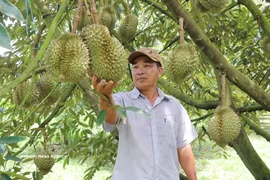
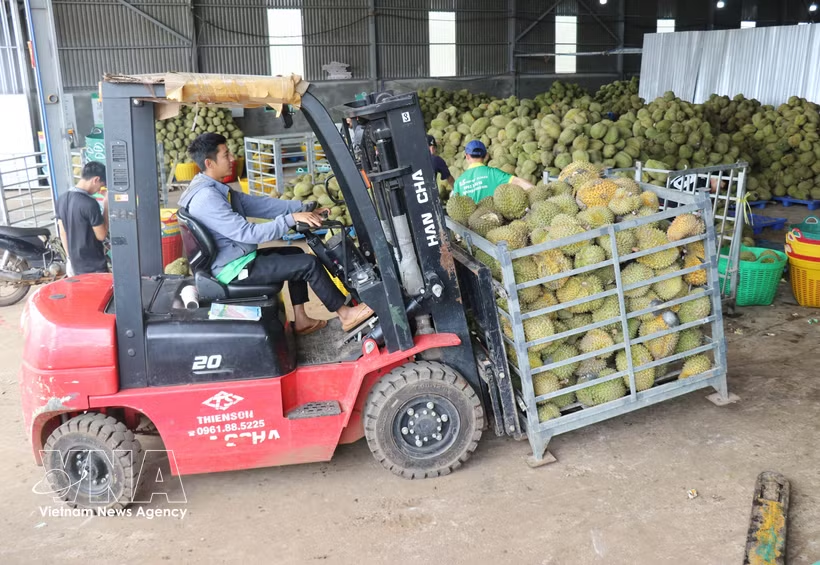
Speaking at the Government's regular press conference for August on the afternoon of September 3, Diep said durian is one of the agricultural products with relatively high value, with a cultivation area of about 200,000 hectares and output of approximately 2.08 million tonnes. It is a key crop of the sector, accounting for about 40% of its total export turnover.
In the first eight months, durian export revenue was estimated at 1.95 billion USD, of which exports to China alone fetched 1.85 billion USD or 95%.
According to him, in response to difficulties facing the fruit’s exports, the ministry has sent working delegations led by deputy ministers to work directly with localities, particularly high-output growing areas in the Central Highlands, the southeastern and southwestern regions, and Dong Nai province, to remove bottlenecks.
On July 1, the ministry launched origin tracing through its electronic system.
“We met with the trade counsellors of the US and China. They highly appreciated the ministry's implementation of origin tracing for the first time and its efforts to promote Vietnamese agricultural products as reputable brands domestically and internationally,” Diep said, noting that this is one of the solutions to boost exports and increase the value of durian.
The ministry has also worked to address difficulties and obstacles related to the issuance of growing-area codes.
“All durian growing areas are now decentralised, allowing ward- and commune-level authorities to issue growing-area and packing-facility codes, making the process more convenient,” he said.
Following a meeting between ministry leaders and the Chinese side on August 14, the General Administration of Customs of China granted 567 growing-area codes for Vietnamese durian, bringing the total number to more than 1,800.
The Deputy Minister went on to point out several limitations in the durian sector, including rapid growth that has not yet been matched by the organisation of value chains. In addition, technical and market requirements are becoming increasingly stringent.
He also highlighted challenges from international competition, noting that countries such as Malaysia and Thailand have introduced policies to promote durian exports to China.
Regarding measures to be implemented, the ministry will step up trade promotion and diversify export markets, including continuing negotiations to expand access and increase share in promising markets such as India, Australia and New Zealand.
In July, India agreed to allow Vietnam to export durian to its market. This is a market of more than 1 billion people with very strong demand in the coming period. We are working to expand export promotion activities in India, he said.
The second measure is to reorganise production and develop sustainable raw-material areas, while reviewing production-area planning to ensure compatibility with land, water resources, climate and infrastructure conditions.
The third is to standardise quality, food safety and origin tracing, while improving research, application and transfer of science and technology, as well as digital transformation. The two other measures are developing storage, processing and logistics infrastructure; and expanding and strengthening the capacity of the laboratory system./.
VNA