Hanoi (VNA) - Ho Chi Minh City is set to kick off 16 major infrastructure projects on September 2, with a total investment of around 249 trillion VND (9.5 billion USD). This adds to a lineup that already features 14 mega-projects launched earlier this year.
The drive is expected to bolster growth in Vietnam’s economic hub through year-end while expanding urban space and improving living standards.
Long-awaited roads to break ground
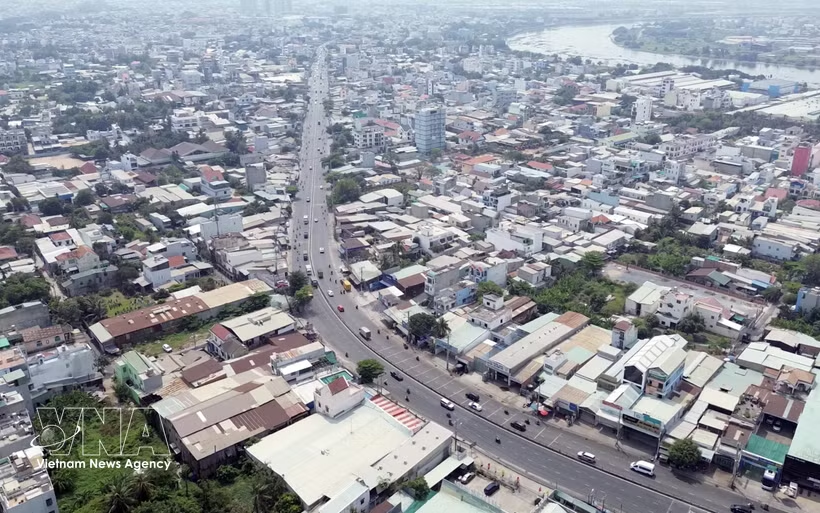
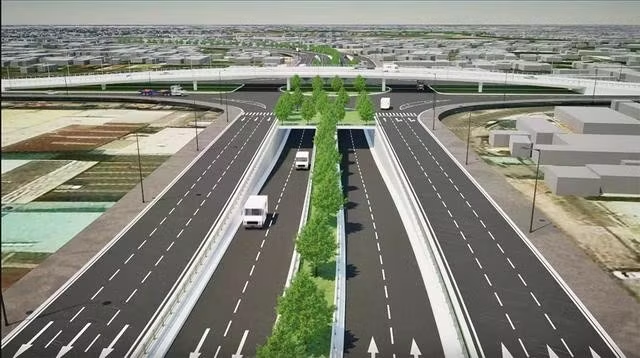
The municipal People’s Committee has approved an upgrade and expansion of National Highway 1 from Kinh Duong Vuong street to the former Long An province boundary.
The corridor, now 20-25m wide, will receive more than 6.67 trillion VND to triple to 60m with 10-12 lanes. New flyovers and underpasses at the Kinh Duong Vuong and Binh Thuan intersections will target chronic congestion choking the city’s southwestern gateway.
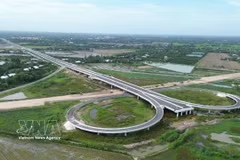
The September 2 package also includes two Ring Road No. 4 components, particularly a section from the Toc Tien-Chau Pha intersection to Chau Duc bridge worth more than 4.77 trillion VND, and a stretch from the Saigon River to Thay Cai Canal, including Phu Thuan and Thay Cai bridges costing more than 7.05 trillion VND.
The projects are designed to tackle gateway congestion and improve seamless links between the expressway network and inter-regional ring roads.
When it’s up and running, the Ring Road No. 4 will form a smooth transport corridor, providing a solid infrastructure backbone to boost cargo movement and drive economic growth throughout the Ho Chi Minh City metro area.
The Thu Thiem-Long Thanh metro line is the only railway project and the largest, and among the most anticipated, on the National Day 2026 list.
With an investment of roughly 134 trillion VND, the line will be developed by Dai Quang Minh Real Estate Investment JSC and serve as the first metro artery directly linking downtown Ho Chi Minh City with Long Thanh International Airport, set to open in December.
The 47.7km line will cross seven wards and communes in Ho Chi Minh City and Dong Nai city and comprise 18 stations, including two underground and 16 elevated.
The early start is expected to spur a transit-oriented development corridor along the route, unlocking new growth across the southern key economic region.
Housing and urban renewal
Beyond transport links, many of the projects target housing needs, living conditions, and urban upgrading.
Specifically, the city is accelerating five social housing projects with about 10,000 apartments, targeting workers, public employees and low-income earners.
The developments also prioritise units for conversion into rental housing, directly supporting vulnerable groups that cannot afford to buy and building a sustainable social welfare base.
Key among them are social housing projects combined with urban renewal in the Cho Ga - Gao and Ma Lang areas of the former District 1.
Another model is in Ba Diem commune, where enterprises acquired land through private negotiations and then invested systematically in infrastructure.
Ho Chi Minh City and neighbouring areas are also rolling out environmental and cultural infrastructure projects, including the 7.211 trillion VND Binh Duong water environment improvement and a nearly 69 billion VND renovation of the Ho Chi Minh Museum’s city branch, set to open on September 2./.