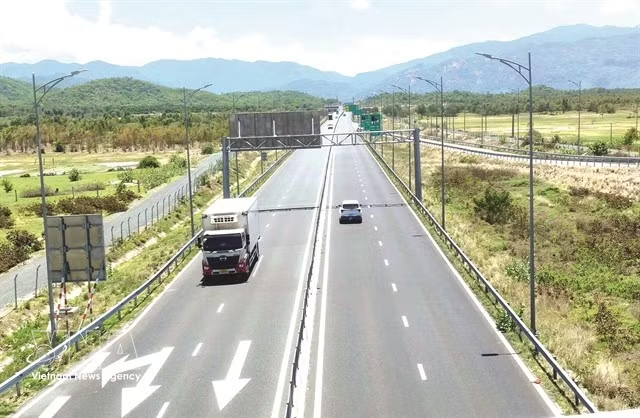
Lam Dong (VNS/VNA) - With its mountains, highlands and long coastline brought together under one administrative roof, the enlarged Lam Dong is now Vietnam’s largest province by area – and a place where stronger transport links could help turn its diverse economic strengths into a more integrated engine of growth.
Against this backdrop, the province is prioritising an integrated transport network to strengthen regional connectivity, expand development space and lay the foundation for sustainable socio-economic growth.
According to the provincial Department of Construction, the enlarged Lam Dong stretches from former Dak Nong province in the Central Highlands to former Binh Thuan province on the south-central coast, and is now served by all four major modes of transport: road, railway, waterway and aviation.
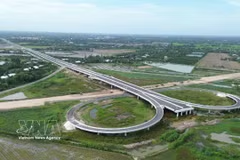
Road transport remains the backbone of the network, with more than 22,582 kilometres of roads, including nearly 180km of expressways in operation, more than 1,459km of national highways and over 1,521km of provincial roads, alongside extensive urban, commune and rural networks.
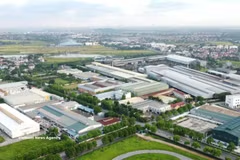
The system has gradually improved connections among agricultural production areas, industrial parks, urban centres, seaports, border gates and tourism destinations, facilitating the movement of goods and supporting economic development.
In 2026, the province is concentrating resources on major transport projects aimed at strengthening inter-regional links.
Key projects include the Tan Phu–Bao Loc and Bao Loc–Lien Khuong expressways, as well as the Gia Nghia–Chon Thanh section of the western North–South Expressway.
Once completed, the routes are expected to shorten travel and freight transport times between the Central Highlands and the southern key economic region, lower logistics costs and improve competitiveness.
They are also expected to attract greater investment in processing industries, high-tech agriculture, tourism and services.
Accelerating construction
Construction preparations for the Tan Phu–Bao Loc and Bao Loc–Lien Khuong expressways are being accelerated, with investors and contractors mobilising workers and equipment so work can expand as soon as cleared land becomes available.
Twenty construction fronts have been established across the two projects.
The Tan Phu–Bao Loc Expressway has seven construction fronts, with 110 workers and 68 pieces of equipment mobilised.
So far, 111 hectares out of the required 402ha have been handed over, equivalent to 27 %.
The Bao Loc–Lien Khuong Expressway has 13 construction fronts, involving 149 workers and 75 pieces of equipment. Land handover has reached 471ha out of 621ha, or nearly 76%.
During a recent inspection, Vice Chairman of the provincial People’s Committee Nguyen Hong Hai asked local authorities to work closely with investors and the Land Fund Development Centre to accelerate compensation and site clearance.
He called for priority to be given to bridges, interchanges and sections where construction conditions are already in place, while contractors should be ready to increase manpower and equipment and open additional construction fronts as soon as sites are handed over.
Relevant departments and agencies were also asked to promptly address obstacles to ensure progress on key projects.
Alongside the expressways, Lam Dong is coordinating upgrades to major routes including National Highways 27, 28 and 55, while completing National Highway 28B.
The province is also preparing investment in the Gia Nghia–Bao Lam arterial road and the national coastal road.
The planned addition of the Phan Thiet–Bao Loc–Gia Nghia Expressway to the national road network is expected to create a strategic transport corridor linking the Central Highlands with the South Central Coast.
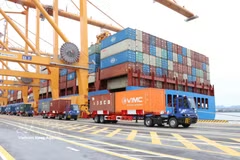
The route would help the province better connect its inland production centres with coastal areas, while tapping the potential of seaports and the marine economy following the merger.
Connecting regions
Lam Dong is also seeking to make better use of rail and aviation infrastructure as part of its broader strategy to develop a multimodal transport network.
The province has about 196km of railway lines, including sections of the North–South railway, the Da Lat–Trai Mat railway and the Binh Thuan–Phan Thiet branch.
The planned North–South high-speed railway will run for more than 156km through the province.
Local authorities are accelerating compensation and site clearance and preparing resettlement areas to meet the project's implementation schedule.
In aviation, Lien Khuong International Airport remains an important air gateway to the Central Highlands, with capacity of around 2 million passengers a year.
Work to repair its runway and taxiways has just been completed.
The project is expected to improve the airport's operational capacity and strengthen connections between Lam Dong and major economic and tourism centres at home and abroad.
Meanwhile, Phan Thiet Airport is being developed under the approved plan, with a targeted capacity of two million passengers annually by 2030.
The airport is expected to provide another growth driver for the province's eastern coastal area, supporting tourism, services, logistics and the marine economy while strengthening connections between the coast and the Central Highlands.
According to the provincial Department of Construction, transport infrastructure has received increasing investment in recent years, improving both passenger travel and freight movement and contributing to socio-economic development.
Alongside physical infrastructure, Lam Dong is stepping up digital transformation in transport management and urban planning.
The province is developing digital databases, geographic information system maps and an online planning information portal, while digitising construction plans.
These measures are expected to improve state management and make planning information more accessible to residents and businesses.
Unlocking potential
Looking ahead, the province will continue prioritising an integrated, modern transport network with stronger regional connectivity.
Besides accelerating major expressway projects, it plans to mobilise resources to upgrade national and provincial highways and rural roads, put Phan Thiet Airport into operation according to schedule, expand domestic and international air routes and develop logistics and multimodal transport services.
By treating transport infrastructure as a foundation for development, Lam Dong aims to create stronger connections among production areas, industrial centres, tourism destinations, seaports and airports.
With support from the central Government and efforts to address bottlenecks related to mechanisms, funding and site clearance, the expanding network is expected to help Lam Dong unlock its potential following its merger with Dak Nong and Binh Thuan provinces, attract investment and improve competitiveness.
Improved connectivity will give Lam Dong greater scope to bring together the economic strengths of its Central Highlands and coastal areas, turning its vast geographical scale into a more integrated development space and creating stronger foundations for investment, competitiveness and the province’s goal of double-digit economic growth in the new development period./.

Lam Dong steps up global tourism push
Lam Dong welcomed around 900,000 international visitors in the first seven months of 2026, up 15% year-on-year, while international tourist-days increased 18% to nearly 2.9 million.