Khanh Hoa (VNA) - The south-central province of Khanh Hoa is restructuring its fisheries sector toward modern, green and sustainable development, drawing on a diverse marine ecosystem, integrated infrastructure, and strong processing and export capacity.
The move is a step toward realising the Party Central Committee’s Resolution 20-NQ/TW dated July 28, 2026, to build Vietnam into a maritime power.
Post-merger, Khanh Hoa now spans about 490km of coastline, with lagoons, sheltered bays such as Van Phong, Nha Trang, and Cam Ranh, the Vinh Hy marine area, and more than 200 islands. It sits near major fishing grounds around Truong Sa and DK1 and has seaports, deep-water ports and logistics facilities, underpinning integrated development of fishing, aquaculture, breed production, processing, and exports.
Nguyen Duy Quang, Director of the provincial Department of Agriculture and Environment, said fisheries remain a key driver of the local economy and support tens of thousands of coastal workers.
In 2025, its total seafood output exceeded 274,472 tonnes, up 1.77% year-on-year. Of the total, more than 238,316 tonnes came from capture fisheries, while aquaculture output rose 7.62% to over 36,156 tonnes. The province produced nearly 49 billion aquatic breed units of various types.
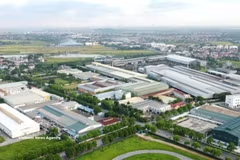
Processing and export capacity has continued to improve. Seafood exports reached 391.1 million USD in the first half of this year, accounting for 32.88% of the province’s total export turnover and remaining a key export group.
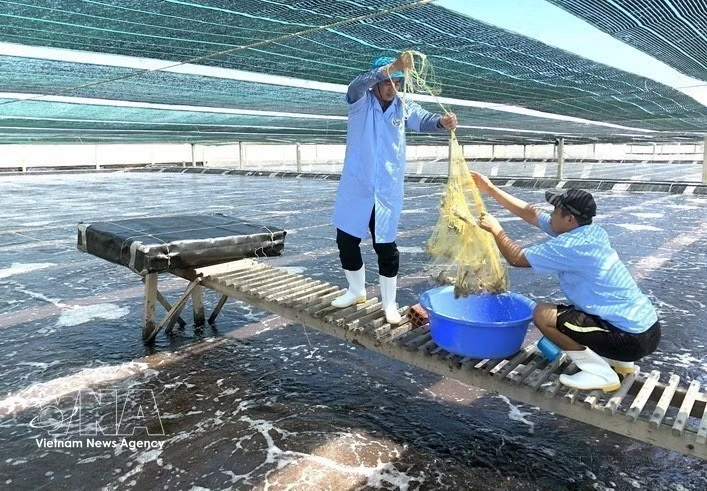
Under Resolution 20-NQ/TW, Khanh Hoa has identified industrial-scale, high-tech marine farming as a breakthrough. The resolution targets average annual growth of 8% in marine aquaculture value by 2030, with marine farming 15% of total fisheries production value. The province is reorganising farming zones to ease pressure on coastal waters and expand offshore.
Aquaculture is managed within environmental carrying capacity. Specialised agencies are strengthening early warning systems, controlling cage density and disease outbreaks. The allocation of marine areas is accelerating, laying a legal basis for concentrated, infrastructure-ready farming zones.
Under the provincial People’s Council Resolution 12/2026/NQ-HDND, Khanh Hoa is helping residents replace traditional fish cages with new materials built to withstand waves and strong winds. The province is promoting the use of automated feeding, surveillance cameras, environmental sensors and remote data management. Companies are being encouraged to invest in large-scale farming and apply integrated technology across the production chain, from breed production, feed and husbandry to harvest and preservation.
To underpin industrial-scale marine aquaculture, Khanh Hoa has called for investment in infrastructure for the offshore aquaculture zone. In July, the Ministry of Agriculture and Environment assigned investment preparations for a concentrated marine aquaculture zone in Khanh Hoa. The province is also studying interest rate support to help citizens, cooperatives and businesses access capital for cages, equipment and new technology.
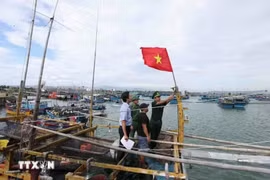
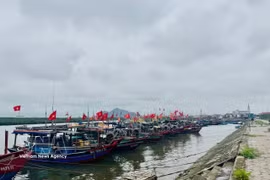
In capture fisheries, Khanh Hoa is revamping its fleet to reduce pressure on coastal resources, boost offshore efficiency, and help restore marine life. Efforts to combat illegal, unreported, and unregulated fishing are being tied in with vessel management, port checks on boats and catches, and improved traceability. All fishing vessels 15 metres or longer are now equipped with voyage monitoring systems.
Quang said Khanh Hoa aims to establish industrial-scale, high-tech marine aquaculture zones managed within environmental carrying capacity and with full traceability. The value chain will run from breed production and grow-out farming to preservation, processing, consumption and exports./.