Rice exports expected to gain momentum in year-end months

The total rice export value is forecast at around 3.94 billion USD for 2026, down about 4% from 2025 due to low average export prices in the first months of the year. However, the recovery in prices since July is expected to help improve export turnover in the remaining months.

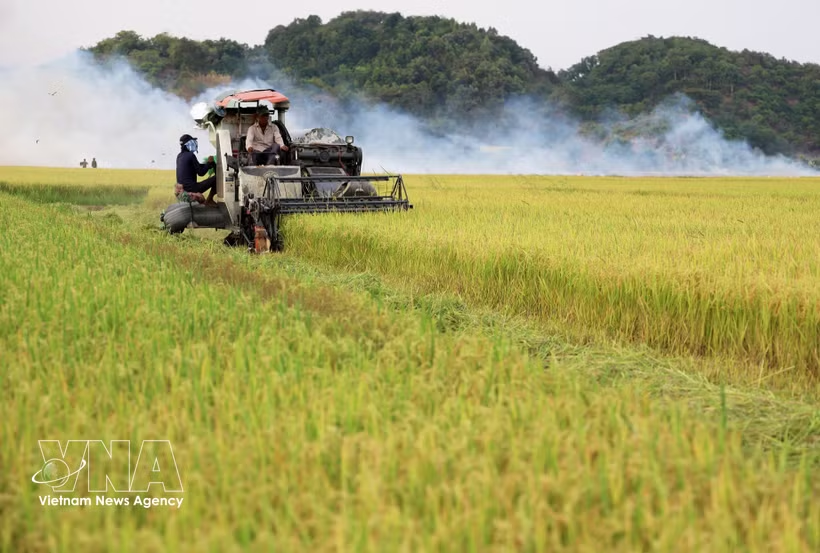
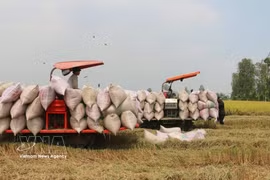
As of August 15, Vietnam exported an estimated 5.726 million tonnes of rice. The full-year volume is projected at about 7.738 million tonnes. (Photo: VNA)

Hanoi (VNA) – Vietnam’s rice exports are expected to improve in value during the final months of 2026 as export prices show signs of recovery while stronger demand in several major markets could support shipments.

The Vietnam Food Association reported that as of August 15, Vietnam exported an estimated 5.726 million tonnes of rice. The full-year volume is projected at about 7.738 million tonnes.

The total rice export value is forecast at around 3.94 billion USD for 2026, down about 4% from 2025 due to low average export prices in the first months of the year. However, the recovery in prices since July is expected to help improve export turnover in the remaining months.

According to the Ministry of Agriculture and Environment, several developments in the global rice market could support Vietnam’s exports toward the end of the year.

Export prices in July were 5.8% higher than in the same month last year, marking the first year-on-year increase in 2026 and the highest level since June 2025. If prices remain at this level, export revenue could improve in the coming months.

Global rice supply and demand in the 2026–2027 crop year are forecast to move into a deficit while global rice trade is expected to reach a record level. The possibility of a strong El Nino could also encourage countries to increase food reserves.

The Philippines, Vietnam’s largest rice export market, has confirmed that it will not suspend rice imports in 2026 and will continue purchases to build up reserves. It is expected to import around 5.6 million tonnes of rice in the 2026–2027 crop year, the world’s largest volume. In the first seven months of 2026, its rice imports rose about 27% year on year.

China has also recorded a sharp increase in rice import volume, particularly broken rice used as animal feed, creating greater opportunities for Vietnam’s raw rice, broken rice and glutinous rice.

Nigeria is forecast to face a rice shortfall of around 3.5 million tonnes in the 2026–2027 crop year, promising chances for Vietnamese exporters if they can improve price competitiveness. Kenya has also waived import duties on white rice under a quota through November 2026.
vnanet-potal-an-giang-da-dang-hoa-thi-truong-tao-don-bay-cho-xuat-khau-gao-8082160.jpg
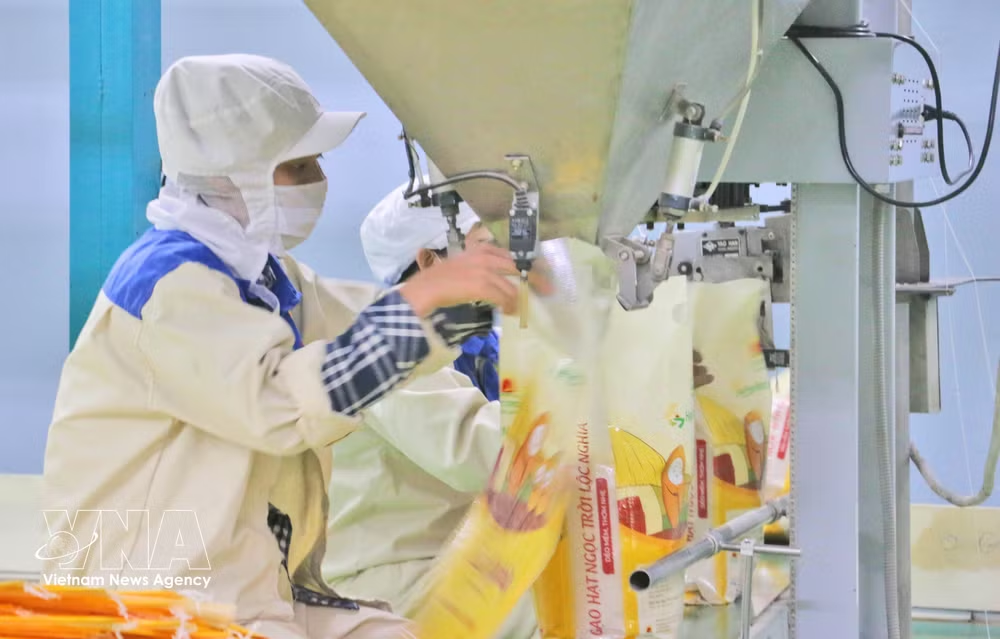
Packaging rice for export at the factory of Thao Son Food One-member Limited Liability Company, a subsidiary of Loc Troi Group. (Photo: VNA)

Domestically, tighter rice supplies are reducing pressure on farmers and traders to sell at low prices, giving exporters more room to negotiate. Notably, high-quality, low-emission certified rice has fetched more than 1,000 USD per tonne in some markets, including Japan, the EU and Australia, highlighting the potential to increase the value of Vietnamese rice.

Market and input cost risks

Despite these favourable factors, the rice export sector still faces several challenges.

The Philippines is considering additional safeguard duties on the grain from Vietnam, as well as Thailand, Myanmar and Pakistan. If approved, the combined tariff could exceed 35%. This is a significant risk because the Philippines currently accounts for the largest share of Vietnam’s rice export value.

Indonesia has no plans to import rice in 2026 as its domestic production and reserves remain high, making this market almost shut down to Vietnamese rice for the time being.

Some African markets, including Côte d’Ivoire and Ghana, have sharply reduced imports of Vietnamese rice because it is more expensive than that from India and Pakistan in the mainstream segment. Meanwhile, Thailand is strengthening its presence in China through government-to-government contracts, and Cambodia is increasing shipments of fragrant rice, creating stronger direct competition for Vietnamese grain.

Input costs, including fertiliser, transportation and energy, remain high amid geopolitical tensions and export restrictions imposed by some countries, affecting farmers’ production efficiency.

In addition, El Nino is predicted to affect the 2026–2027 winter–spring crop. Drought and saltwater intrusion could occur from late December 2026 to April 2027, requiring the sector to prepare response measures early, including adjustments to planting schedules and crop varieties./.
VNA

See more

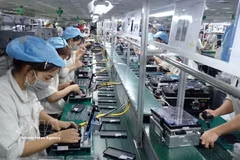
Workers assemble phone components at Handanbi Vina Co., Ltd. in Diem Thuy Industrial Park, Thai Nguyen province. (Photo: VNA)

Vietnam poised to benefit from new wave of technology investment

The successful development and production of high-end Pixel smartphones in Vietnam – a more complex process than manufacturing smartwatches and wireless earbuds – is reportedly giving Google confidence in moving its entire Pixel production out of China.

The panel discussion at the conference on sustainable trade practices for effective exports by women-owned and gender-responsive enterprises in Hanoi on August 27. (Photo: VNA)

Women-led firms encouraged to adopt sustainable practices to boost exports

Nguyen Kim Lan, Manager of UN Women Vietnam’s Women’s Economic Empowerment Programme, said export markets are imposing increasingly stringent requirements on businesses to demonstrate their commitment to sustainable development, including environmental, labour, social responsibility, corporate governance and gender equality standards.

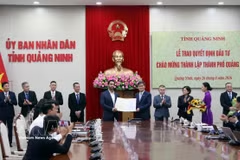
The Quang Ninh provincial People's Committee presents investment approval decisions to 16 projects with a total investment of about 16.075 trillion VND on August 26. (Photo: VNA)

Quang Ninh attracts nearly 183 trillion VND in investment

Pham Hong Bien, Director of the provincial Department of Finance, said in August alone, domestic investment from non-State sources totalled 39.082 trillion VND, with the province granting investment certificates to 12 new projects and approving increased investment capital for one existing project.

General Secretary of the Communist Party of Vietnam Central Committee and President To Lam (R) meets with President and CEO of Qualcomm Incorporated Cristiano Amon in Hanoi on August 27. (Photo: VNA)

Vietnam welcomes US tech companies' long-term operations: Top leader

Party General Secretary and President To Lam endorsed Qualcomm's plan to position Vietnam as a key Asian hub and significant global R&D centre, which aligns with the two countries' science, technology and innovation cooperation under the Comprehensive Strategic Partnership framework.

The Vietnamese and US delegations at the meeting in New York. (Photo courtesy of SSC)

Nasdaq sees growing potential in Vietnam’s stock market

The upgrade of Vietnam’s stock market by FTSE Russell from Frontier to Secondary Emerging Market opens up new opportunities to attract capital and greater participation from international investors, said State Securities Commission (SSC) Chairwoman Vu Thi Chan Phuong.

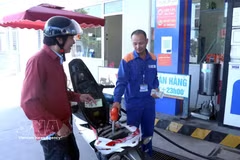
A customer purchases E10 biofuel at a Petrolimex station in Pho Hien ward, Hung Yen province (Photo: VNA)

Petrol, diesel prices fall in August 27 adjustment

Accordingly, the price of E5 RON92 biofuel is capped at 21,763 VND (0.83 USD) per litre, down 70 VND, while E10 RON95-III is priced at no more than 22,602 VND per litre, down 66 VND. That of 0.05S diesel is set at no more than 28,084 VND per litre, a decrease of 311 VND.

The 15th meeting of the Vietnam-RoK Joint Committee on Trade, Industry and Energy Cooperation and the ninth meeting of the Vietnam-RoK Free Trade Agreement (FTA) Committee are held in Seoul on August 26. (Photo: VNA)

Vietnam, RoK step up cooperation in key economic sectors

Regarding key minerals, they agreed to speed up necessary procedures to begin construction of the Vietnam-RoK key minerals supply chain technology centre. Vietnam will also work with relevant agencies to address difficulties that Korean businesses are facing when investing in the sector.

Lang Son's delegation works with the management board of the Chelmos-Vouraikos Global Geopark to exchange experiences regarding the management, conservation, and promotion of the global geopark's values. (Photo: Embassy of Vietnam in Greece)

Vietnam, Greece step up subnational cooperation

Addressing the event, Vietnamese Ambassador to Greece Pham Thi Thu Huong stressed that as a bridge between Vietnamese localities and partners in host countries, the embassy’s organisation of the dialogue was among its key economic diplomacy activities in 2026. The initiative aims to support localities in strengthening ties with Greek partners, particularly businesses, thereby contributing to their socio-economic development and that of the country as a whole.

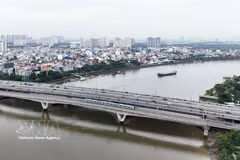
The Ben Thanh–Can Gio metro line will run alongside Rung Sac road, helping lay the foundation for the green transition of Can Gio. (Photo: VNA)

Vietnam seeks to unlock 700 billion USD for green transition

To fulfil its commitment to achieve net-zero emissions by 2050, Vietnam needs to mobilise around 700 billion USD over the course of its long-term transition. The scale of the funding requirement highlights the need to expand sources beyond the State budget, particularly private and international capital.

Cast of the 2026 edition of “Anh trai vuot ngan chong gai”. (Photo: Yeah1)

Efforts needed to unlock copyright to drive cultural industry development

As Vietnam’s economy grows and living standards improve, demand for cultural products such as publications, music and films has increased strongly. Domestic products are also becoming increasingly competitive with foreign counterparts, with a number of Vietnamese films and music programmes achieving impressive commercial success.