Hanoi (VNA) – Trade relations between Vietnam and Morocco have maintained positive growth in recent years, making the country a gateway for Vietnamese goods to access the North African market.
In 2025, two-way trade reached approximately 380 million USD, up around 25% from 2024. In the first six months of 2026, bilateral trade continued its positive momentum, rising 26%.
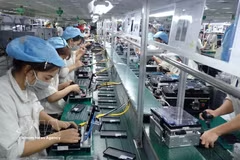
Tran Le Dung, Head of the Vietnam Trade Office in Morocco, said Vietnamese exports to Morocco are relatively diverse. Key export items include telephones and components; computers, electronic products and components; textiles and garments; footwear; coffee, pepper and cashew nuts; seafood; rice products; machinery; processed foods and a number of consumer goods.
Vietnam, meanwhile, mainly imports fertilisers and raw materials for fertiliser production, chemicals, minerals and other manufacturing inputs from Morocco.
A notable feature of bilateral trade is Vietnam's large trade surplus with Morocco. This shows that Morocco is not only a noteworthy consumer market but could also serve as a gateway for Vietnamese goods to access North Africa and parts of West Africa.
Through direct engagement with Moroccan importers, distributors and businesses, the Vietnam Trade Office in Morocco has found that Vietnamese products are generally well regarded for their quality, competitive prices and flexibility in meeting customer requirements. In particular, at business-matching activities organised by the Trade Office in recent years, Moroccan partners have shown interest in Vietnamese coffee, cashew nuts, pepper and spices, seafood, processed foods, confectionery and consumer goods. Vietnamese dried rice vermicelli and rice paper used for spring rolls are especially popular among Moroccan consumers.
However, Dung noted that the Moroccan market has its own specific characteristics. Consumers are highly price-conscious and pay considerable attention to packaging, labels in French or Arabic, product origin and compliance with Islamic cultural norms. For food products and other items subject to requirements on Halal certification, food safety, quarantine and traceability, Vietnamese businesses need to pay particular attention to meeting these requirements in order to ensure smooth market access. Another issue is that the visibility of Vietnamese brands in Morocco remains relatively limited. Many Vietnamese products are of good quality, but Moroccan consumers are not always aware that they originate from Vietnam because they are imported through intermediaries or sold under distributors' own brands.
Therefore, according to Dung, Vietnamese businesses should not focus solely on selling products but should also attach greater importance to brand building, adapting packaging to the local market, providing information in French and Arabic, and cooperating with distributors with established local sales networks.
Morocco has a relatively open economy, with strong demand for imported raw materials, machinery, equipment and energy, as well as food products and consumer goods. In particular, Morocco's efforts to accelerate investment in infrastructure, industry, logistics and tourism, along with preparations for the 2030 FIFA World Cup, are creating additional demand for machinery, equipment, construction materials, furniture, consumer goods and products for the hotel and restaurant sectors.
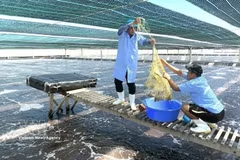
In terms of production capacity, Vietnam is well positioned to supply many of the products Morocco needs to import. Vietnam has strong production capacity in tropical agricultural products, seafood, processed foods, textiles and garments, footwear, wooden products and electronics.
Nevertheless, Vietnamese businesses continue to face several challenges.
The first one is the geographical distance and associated logistics costs. Vietnam and Morocco have not had a regular direct maritime shipping route, resulting in relatively long transportation times.
Second, Vietnam and Morocco have yet to conclude a free trade agreement (FTA), while Morocco has signed FTAs with a number of major partners. As a result, Vietnamese products in some categories face competition from goods originating in the European Union, Türkiye and countries enjoying preferential tariff treatment in the Moroccan market.
Third, Morocco has increasingly stringent requirements concerning technical standards, food safety, quarantine, labeling, Halal certification and customs procedures. The country is also strengthening trade-defence measures against certain products when imports rise rapidly.
Against this backdrop, Dung recommended that Vietnamese businesses carefully examine import tariffs based on HS codes, mandatory standards and required certifications before signing contracts. They should also verify the credibility of business partners, exercise caution over payment methods and, particularly when dealing with new customers, prioritize secure payment mechanisms.
Dung noted that since the beginning of the year, the Vietnam Trade Office in Morocco has conducted a number of trade promotion activities aimed at bringing Vietnamese businesses and products into more direct contact with Moroccan importers, distributors and retail networks, rather than merely providing market information.
One of the major trade promotion activities was Vietnam's participation in the 2026 International Agricultural Show in Morocco (SIAM 2026) in Meknès, one of the largest agricultural and food-related events in Morocco and Africa./.