Hanoi (VNA) – Vietnam has sustained export pace, but room for stronger overseas shipments in the year’s final months will be expanded substantively only when businesses move beyond volume-driven growth and focus on market diversification, higher value-added products and greater competitiveness, said insiders.
At a recent meeting on the draft import – export strategy to 2030, with a vision to 2045, Deputy Minister of Industry and Trade Nguyen Sinh Nhat Tan stressed that the new strategy must be practical, feasible and aligned with the goal of double-digit economic growth. Import and export activities should be viewed in a dynamic balance, with exports, imports, domestic production and supply chains considered as an integrated whole.
Assoc. Prof. Dr Nguyen Thuong Lang, an expert in economics and international trade, said export growth not only expands markets for businesses but also generates resources for production, directly contributing to GDP expansion.
Expanding exports also helps turn domestic resources into goods capable of competing in international markets, thereby improving the efficiency of resource use, he said.
Another important driver is the close relationship between exports and foreign direct investment (FDI) attraction.
Vietnam’s extensive network of free trade agreements (FTAs) enables foreign-invested enterprises operating in the country to access major markets, he said, stressing that stronger overseas shipments can make Vietnam more attractive to investors while FDI brings additional capital, technology, market access and management expertise.
Lang said Vietnam should continue attracting FDI alongside technology transfer and stronger linkages with domestic businesses to generate greater added value. Trade promotion should focus on markets with considerable potential, including Europe, ASEAN, the Middle East and Africa. Businesses, meanwhile, need to upgrade products, pursue greener and more organic production, and improve supply-chain transparency to meet increasingly demanding international standards.
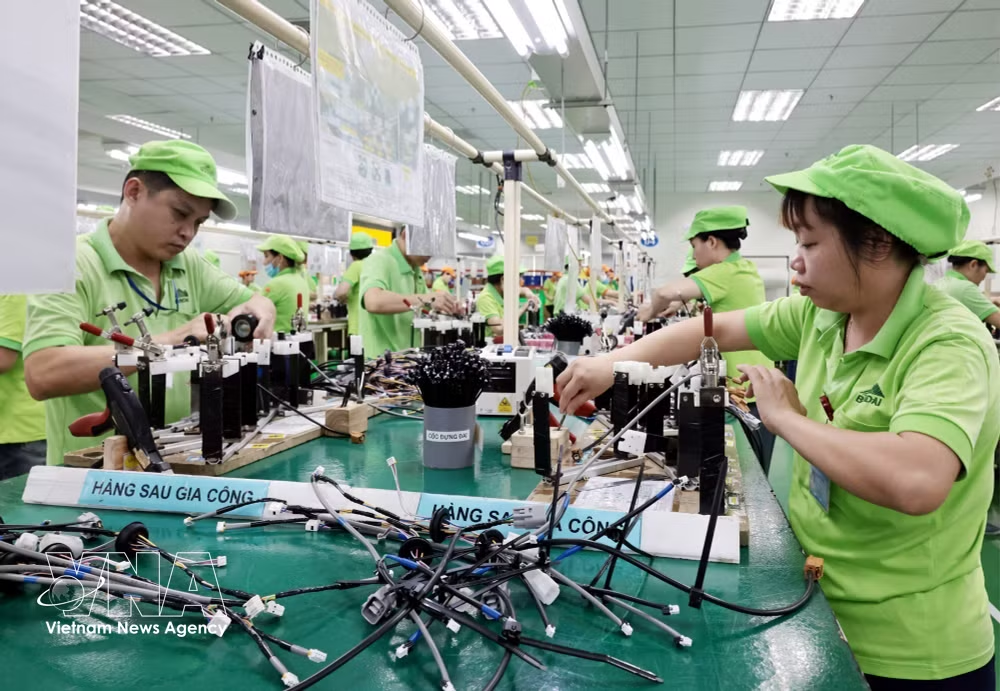
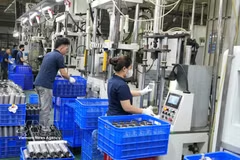
A production line for wire harness assemblies at Bandai Company, a foreign-invested enterprise that provides jobs for nearly 1,000 workers. (Photo: VNA)
Amid intensifying competition, businesses can no longer rely solely on traditional advantages but must venture into higher value-added sectors, invest in technology, enhance governance capacity and develop markets, Lang said, adding that a supportive ecosystem is also needed to provide a springboard for faster growth.
Experts also stressed the importance of allocating resources based on development efficiency rather than administrative boundaries. They said that better links among raw material supply areas, processing facilities, supporting industries, logistics and markets will help turn individual local advantages into collective strength across export value chains.
Amidst ongoing global trade uncertainties, sustaining export growth cannot rely solely on market advantages or production costs; it also requires support from a favourable business environment, flexible policy governance, and the increasing competitiveness of enterprises, they opined.
The Government has identified several focal tasks for the final months of 2026, including maintaining macroeconomic stability, keeping inflation under control, guaranteeing macro-economic balances and taking decisive measures for securing double-digit economic growth. Exports are viewed as one of the key growth drivers linked with the effective use of FTAs and market and supply-chain diversification,
The Government also demanded stronger domestic production, closer connections between domestic and foreign-invested enterprises, development of supporting industries and higher localisation rates, expected to help improve the economy's self-reliance and create a solid stepping stone for sustainable export growth.
A representative from the Foreign Trade Agency at the Ministry of Industry and Trade said export performance so far has provided a positive foundation for continued expansion. However, amid global uncertainties, businesses need to adapt proactively and capitalise on FTAs, particularly by meeting rules of origin to qualify for preferential tariffs.
Trade promotion programmes will continue to help businesses find partners, expand markets and maintain orders, while efforts to reduce logistics, transport, insurance and international financial costs will help facilitate import – export activities and support more stable global trade flows, participants in the meeting said./.