Online agricultural wholesale market launched to connect Vietnamese produce with Singapore

An online agricultural wholesale market aimed at expanding trade links between Vietnamese agricultural producers and buyers in Singapore is expected to become operational by the end of September 2026, offering flexible wholesale purchasing options.

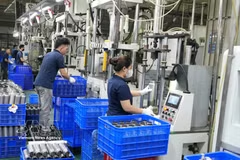
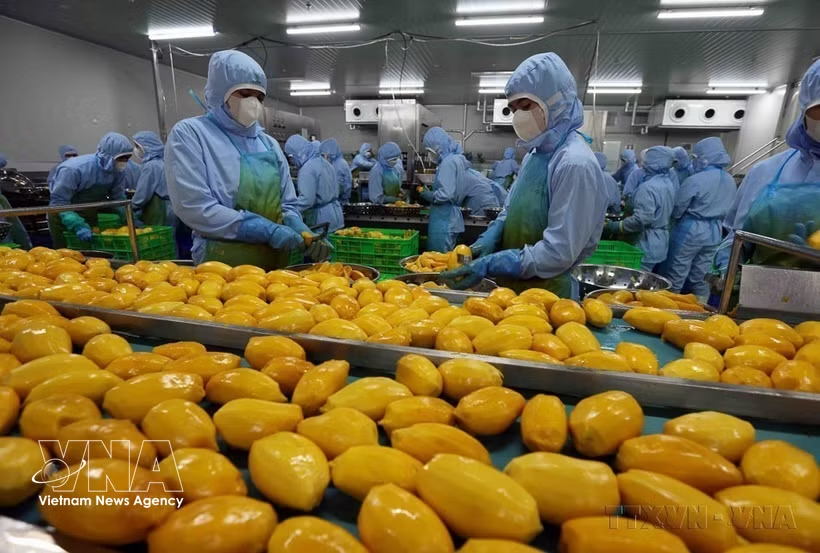
Workers processing agricultural products for exports. (Photo: VNA)

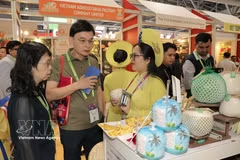
Ho Chi Minh City (VNA) – VNFruitVegMarket -Vietnam Agri Wholesale Platform on September 3 announced the development of an online agricultural wholesale market aimed at expanding trade links between Vietnamese agricultural producers and buyers in Singapore.

The announcement was made at a forum on green transition held in Ho Chi Minh City by the Ministry of Industry and Trade’s Agency for Innovation, Green Transition and Industry Promotion.

Le Ngoc Nguyen, a representative from VNFruitVegMarket, said the platform, the first of its kind, is expected to become operational by the end of September 2026, offering flexible wholesale purchasing options. Buyers will be able to source Vietnamese agricultural products in quantities ranging from a single carton or pallet to large orders, with product information and pricing policies made transparent. The online marketplace is designed to broaden access to Vietnamese produce among a wider range of buyers in Singapore, including small and medium-sized enterprises, retailers, restaurants, food and beverage businesses, distributors and other trading partners, rather than focusing only on traditional large-scale import orders.

Beyond online transactions, VNFruitVegMarket will connect with warehousing facilities in Singapore to support storage, consolidation, distribution and domestic delivery. The platform will also integrate technology tools tailored to agricultural trading, she said.

A group-buying mechanism will combine demand from multiple buyers to optimise order volumes and costs, while a multi-dimensional auction system will enable more flexible transactions based on supply, demand, volume and timing.

Artificial intelligence will also be used to analyse market demand and supply plans, helping reduce the risks of shortages and excess inventory. Transparent information on supply and prices will allow buyers to access reliable details on products, specifications and available volumes, she added.

Nguyen said Vietnam has a diverse agricultural supply, but its products still face challenges in reaching international markets, including buyer connections, order volumes, logistics, inventory management and distribution speed in destination markets.

She said a flexible trading platform capable of addressing these supply-chain bottlenecks is needed to boost export efficiency.

Singapore, meanwhile, has strong demand for imported food and agricultural products and is geographically close to Vietnam, offering advantages for the transportation of fresh produce. Its high standards for quality, food safety, traceability and professional trading also make it a demanding but potentially important market for Vietnamese products.

Meeting Singapore's standards could provide Vietnamese agricultural products with a foundation for entering other markets, Nguyen noted./.

VNA

See more

Production line at Yadea Vietnam’s smart manufacturing plant, which has an investment of more than 100 million USD, in Tan Hung Industrial Park, Bac Ninh province. (Photo: VNA)

Development model for new era – An inevitable trend

International organisations broadly agree that shifting the growth model from reliance on traditional factors toward technology and innovation is no longer an option for Vietnam, but an imperative of the times.

At a commune administrative service centre in Hung Yen province (Photo: VNA)

Government determined to cut administrative procedures to drive double-digit growth

Resolution No. 258/NQ-CP, dated August 31, 2026, calls for substantive and comprehensive reform, with a focus on maximum cuts and simplification of administrative procedures and business conditions. It also seeks to shift management from pre-licence inspection to post-licence inspection based on risk management, while strengthening real-time, data-driven oversight and putting people and businesses at the centre of public services.

(Illustrative photo: VNA)

Vietnam eyes entry into 40-billion-USD Southeast Asian CCS market: experts

A clear, transparent and stable legal framework would not only enable Petrovietnam to play a leading role in new energy development but also strengthen investor confidence, encouraging both domestic and foreign enterprises to invest, transfer technology and cooperate in developing large-scale CCS projects.

Durian is stockpiled at a company warehouse in Dong Gia Nghia ward, Lam Dong province, for sorting and distribution to the market. (Photo: VNA)

Vietnam targets durian exports of around 4 billion USD in 2026

In the first eight months, Vietnam's durian export revenue was estimated at 1.95 billion USD, of which exports to China alone fetched 1.85 billion USD or 95%. The country is working very hard to earn 4 billion USD from durian exports this year.

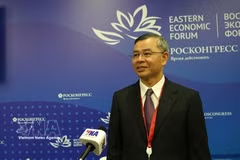
Minister of Finance Ngo Van Tuan grants an interview to Vietnam News Agency correspondents in Russia. (Photo: VNA)

Vietnam businesses poised to tap opportunities in Russia’s Far East: minister

Following the elevation of bilateral ties to a comprehensive strategic partnership and the entry into force of the Vietnam-Eurasian Economic Union Free Trade Agreement, Vietnam-Russia trade increased by an average of 10.8% annually during 2016-2025. However, it reached only about 4.7 billion USD in 2025, remaining modest compared to the two countries' potential and strong political ties.

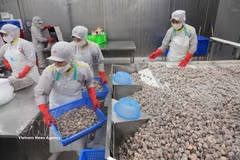
Workers process clams for export at the factory of Thanh Hoa Seafood Import-Export Joint Stock Company in Thanh Hoa province. (Photo: VNA)

Vietnam’s agro-forestry-aquatic exports rise 7% in eight months

Asia remained the largest export market for Vietnam’s major agro-forestry-aquatic products, accounting for 45.5% of the total. It was followed by the Americas and Europe, with shares of 21.5% and 13.4%, respectively. Africa and Oceania made up 2.3% and 1.5%.