Vietnam, Singapore seek to make technology a strategic cooperation pillar

The Joint Statement on the Technology Connectivity Strategy issued after the first Vietnam-Singapore Strategic Dialogue reaffirmed the shared interest in deepening cooperation in science and technology, innovation, connectivity and the digital economy. The two sides shared a vision of making Vietnam and Singapore leading strategic technology partners in Southeast Asia, with both countries becoming more technologically self-reliant through cooperation and connectivity.

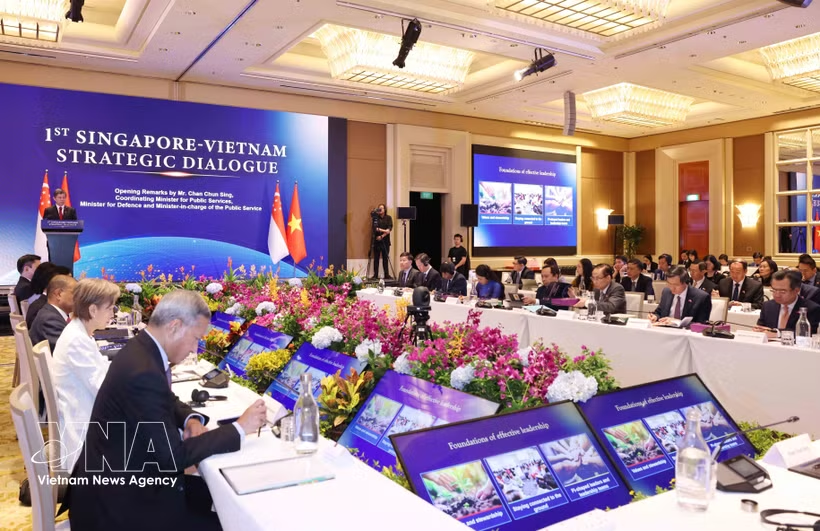
At the first Vietnam-Singapore Strategic Dialogue (Photo: VNA)

Hanoi (VNA) – The official visit to Singapore by Politburo member and Standing Member of the Communist Party of Vietnam (CPV) Central Committee’s Secretariat Tran Cam Tu and a high-ranking CPV delegation on August 24-25 marked a historic step forward, opening a new vision for making science and technology, innovation, digital transformation and human resources development key pillars of the Vietnam-Singapore Comprehensive Strategic Partnership.

The Joint Statement on the Technology Connectivity Strategy issued after the first Vietnam-Singapore Strategic Dialogue reaffirmed the shared interest in deepening cooperation in science and technology, innovation, connectivity and the digital economy. The two sides shared a vision of making Vietnam and Singapore leading strategic technology partners in Southeast Asia, with both countries becoming more technologically self-reliant through cooperation and connectivity.

The action-oriented spirit has been strengthened and translated into concrete initiatives following the state visit to Singapore by the General Secretary of the CPV Central Committee and President To Lam. Both sides have identified innovation and strategic technology cooperation as crucial to socio-economic development in the next phase, with emphasis placed on the involvement of the State, researchers and businesses.

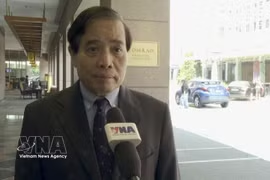
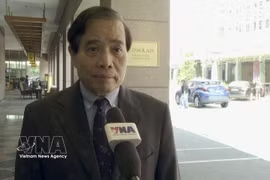
Cao Xuan Thang, head of the Vietnam Trade Office in Singapore, said several challenges in connecting the three sides need to be addressed. These include establishing mechanisms linking technology supply and demand, with clearer processes for commissioning research and commercialising results; developing cross-border mechanisms for cooperation and sharing of high-quality human resources; and creating frameworks for risk-sharing in research, application, intellectual property, venture investment, innovative startups and product commercialisation.

He stressed the need for complementary cooperation, noting that Singapore has strengths in technology, logistics infrastructure, finance and international connectivity, while Vietnam has advantages in human resources, market and production capacity. Businesses from the two countries can complement each other and contribute more deeply to global supply chains.

Strategic voice

At the first Vietnam-Singapore Strategic Dialogue, participants discussed two issues of strategic importance: personnel training, human development and capacity building; and connectivity in science and technology and innovation.

In his presentation, Politburo member, Secretary of the CPV Central Committee and head of its Commission for Organisation Nguyen Duy Ngoc said Vietnam has identified science and technology, innovation and digital transformation as its top strategic breakthroughs, with people remaining the decisive factor for success. Personnel training is therefore a strategic priority, he said, expressing Vietnam’s wish for Singapore to share its experience to meet the development requirements of both sides.

Earlier, Ngoc held a working session with Hongyi Li, Director of Open Government Products at Singapore’s Government Technology Agency (GovTech), to exchange experience in science and technology development, innovation and digital transformation, as well as the application of artificial intelligence (AI) to improve the performance of the public administration system.

Also at the dialogue, Politburo member and President of the Ho Chi Minh National Academy of Politics Doan Minh Huan said cooperation in human resource training and capacity building between the academy and Singaporean partners already has a substantive foundation, expressing his hope for a more long-term and systematic cooperation framework to establish a network for theoretical research and exchange and knowledge sharing between Vietnam and Singapore.

Member of the CPV Central Committee and Minister of Science and Technology Vu Hai Quan called for stronger links among the State, businesses, research institutions and universities, and a greater role of enterprises in bringing technologies to market, adding that the State should focus on creating institutions, sharing risks and facilitating the development of new technologies and products.

From a policy perspective, Politburo member, Secretary of the Party Central Committee and head of its Commission for Policy and Strategy Nguyen Thanh Nghi highlighted the building of a “common development space” as an appropriate approach for the new phase of bilateral cooperation.

Politburo member and Minister of Foreign Affairs Le Hoai Trung underscored the significance of the strategic dialogue mechanism between the two Parties and said the Ministry of Foreign Affairs would closely coordinate with relevant agencies to implement key conclusions.

The substantive discussions and adoption of the conclusions of the first Strategic Dialogue, together with the Joint Statement on the Technology Connectivity Strategy, have laid a firm foundation for future cooperation.

Elevating the VSIP model

As 2026 marks 30 years since the establishment of the Vietnam-Singapore Industrial Park (VSIP) model, Quan proposed three breakthroughs for a new phase of cooperation: upgrading VSIP into technology ecosystems; developing a model involving the State, VSIP and leading universities in both countries, including the National University of Singapore, Nanyang Technological University, Vietnam National University, Hanoi and Vietnam National University, Ho Chi Minh City; and jointly leading the digital transformation.

Thang said experts have viewed Tu’s visit and the Strategic Dialogue as important in creating new momentum for bilateral economic cooperation, with VSIP serving as a prominent symbol of successful partnership.

He said the parks are expected to evolve beyond conventional manufacturing zones toward smart, green and circular industrial ecosystems that apply high technologies and embrace social responsibility. This trend will help attract industrial investment while strengthening bilateral economic cooperation and the two countries’ roles in global supply chains./.
VNA

See more

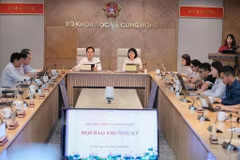
Delegates at the regular press briefing on August 28 hosted by Ministry of Science and Technology (Photo: mst.gov.vn.webp)

2026 Make in Vietnam Digital Product Awards launched

Launched in 2020, the Make in Vietnam Digital Technology Product Awards are the official annual awards in the digital technology sector organised by the Ministry of Science and Technology. Over six editions, the awards attracted nearly 1,500 entries, with 299 outstanding digital technology products honoured.

A area showcasing products at AI Day 2026 held in Hanoi on April 5, 2026 (Photo: VNA)

Vietnam targets top-three ASEAN ranking in AI by 2030

By 2030, Vietnam aims for 60% of businesses using AI to improve efficiency, all civil servants using AI in their work weekly, and 60% of administrative decisions supported by data and AI. The satisfaction rate for AI-supported public services is expected to rise by at least 30%.

VNPT’s data centre (IDC) at Hoa Lac Hi-Tech Park, the largest of its kind in Vietnam, is equipped with state-of-the-art technologies and fully meets international technical standards. (Photo: VNA)

Vietnam’s data centre race draws multibillion-dollar investment

Ho Chi Minh City currently has 20 operational data centres and nine proposed projects, according to the municipal Department of Science and Technology. New projects are moving beyond traditional data centres toward large complexes integrating AI and other digital infrastructure.

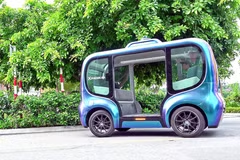
A mini autonomous bus undergoing testing in Hanoi (Photo: Phenikaa-X)

Hanoi allows 24-month trial of autonomous vehicles at Hoa Lac

The project aims to assess the safety, reliability and readiness of autonomous vehicles under real traffic conditions, as well as the effectiveness of autonomous public transport and compatibility with existing systems. Its results will contribute to developing technical standards, operating procedures and management models suited to Hanoi’s traffic conditions.

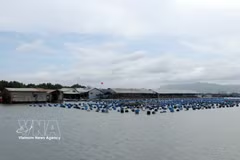
Aquaculture rafts on the Rang river in Long Son commune, Ho Chi Minh City, have benefited greatly from expanded digital connectivity, using technology in farming and selling their products online. (Photo: VNA)

Resolution 57 opens digital door to drive marine economic development

Through persistent, hands-on efforts and a determination to “leave no one behind”, the Ho Chi Minh City authorities are working to ensure that every resident has the opportunity to access and benefit from digital transformation under Politburo Resolution No. 57-NQ/TW

Professor Vu Minh Khuong of the National University of Singapore. (Photo: VNA)

Singapore’s experience suggests solutions to Vietnam’s human resources challenge in AI era

As Vietnam accelerates digital transformation and high-tech development, Singapore’s experience and the engagement of global technology companies demonstrate that human resources preparation must stay ahead of the curve. The ability to filter knowledge, collaborate, innovate and effectively use AI will increasingly become essential to helping workers adapt to a changing labour market and strengthening the competitiveness of Vietnam’s economy in the new era.

Online public services in Thanh Khe ward, Da Nang city, help residents protect personal data. (Photo: nhandan.vn)

Vietnam moves to strengthen digital shield amid rise of AI, deepfakes

An effective “digital shield” should have three key capabilities: early warning to identify unusual topics, sources and dissemination patterns, as well as signs of fabrication or coordinated activity; rapid verification through coordination among authorities, databases, experts and the press; and proactive communications, providing accurate, accessible and multimedia content to the right audiences once information is verified.

Shanti Alexander (centre), Meta’s Director of Policy Programmes and Campaigns for Asia-Pacific and Thao Dao, Country Strategy & Operations Lead at Google at a seminar in Singapore (Photo: VNA)

Singapore’s experience offers lessons for Vietnam

Singapore’s experience in linking policies with business needs, mobilising technology corporations to address national challenges and ensuring vulnerable groups are not left behind could provide valuable lessons for Vietnam.

The product exhibition area at the AI Day 2026, organised by Hanoi University of Science and Technology and STEAM for Vietnam in collaboration with the US Embassy in Vietnam and the National Innovation Centre (Photo: VNA)

Building AI capabilities tailored to Vietnam’s needs

Vietnam is entering a new phase of AI development, moving beyond the adoption of existing technologies to building its own capabilities by advancing models, computing infrastructure, data, and talent in parallel to create an ecosystem capable of developing technologies tailored to the country’s needs.

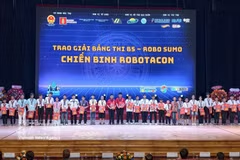
Top-performing teams at ROBOTACON WRO 2026 national finals are honoured at a ceremony on August 23 (Photo: VNA)

Top-performing teams at ROBOTACON WRO 2026 national finals honoured

The national finals of the ROBOTACON WRO 2026 robot talent competition concluded in the central province of Gia Lai on August 23, providing students with a valuable learning and experiential environment where they could develop STEM skills, learn to work together, think creatively and solve complex problems.

The LH-FOF team from Vietnam's Lac Hong University represents the country at ABU Robocon 2026. (Photo: VTV)

Vietnam team wins three awards at ABU Robocon 2026

The LH-FOF team from Vietnam's Lac Hong University won three awards the 2026 Asia-Pacific Broadcasting Union Robot Contest (ABU Robocon): third place overall, the best design award and a sponsor’s award.

Panoramic view of the site designated for the Ninh Thuan 1 nuclear power plant in Phuoc Dinh commune, Khanh Hoa province. (Photo published by VNA)

Skilled workforce vital to Vietnam’s nuclear power programme

The long-term challenge Vietnam must proactively address is building a pool of personnel in management, regulation, research and development, and technical support. These are areas in which the country must take the initiative in training and building up its own capabilities so that it can independently conduct assessments, evaluate safety, verify technical calculations, carry out research, and provide support for the sustainable development of the nuclear programme.

Officers and soldiers of the Department of Cybersecurity and High-Tech Crime Prevention under the Ministry of Public Security monitor malware trend charts and directly assess potential threats in cyberspace. - Illustrative image (Photo: VNA)

Vietnam issues new cybersecurity rules for domestic, foreign businesses

Issued on August 19, the decree comprises six chapters and 32 articles, covering cybersecurity protection measures, information security assurance, specialised cybersecurity training, and management of IP address identification for telecommunications and Internet service providers.

Students compete in the national finals of the ROBOTACON WRO (World Robot Olympiad) 2026. (Photo: VNA)

Nearly 500 contestants compete at ROBOTACON WRO 2026 national finals

Held under the theme “Robots Meet Culture”, this year’s competition aims to connect technology with cultural values, encouraging students to apply their knowledge of science, engineering and programming to real-world problems while promoting cultural values through creative solutions.

Scientific and technological research and development in Vietnam - Illustrative image (Photo: VNA)

Singapore’s tech adaptation offers lessons for Vietnam: Insiders

Prof. Vu Minh Khuong from the Lee Kuan Yew School of Public Policy noted that Vietnam is also making positive progress in this area, with officials increasingly focused on updating knowledge, learning from new models and adapting to changes. The key, he stressed, is to quickly translate these efforts into concrete results, which can build trust, strengthen motivation and drive further development.

Ang Wee Seng, Executive Director of the Singapore Semiconductor Industry Association (Photo published by VNA)

Expert suggests Vietnam, Singapore combine complementary strengths in semiconductors

Singapore, Vietnam and other ASEAN economies have different but complementary strengths. By linking these strengths through infrastructure, talent mobility, research partnerships, reliable supply chains and joint industry development, ASEAN can become an integrated, sustainable and globally significant semiconductor ecosystem rather than merely a collection of separate semiconductor manufacturing locations.