Resolution 57 opens digital door to drive marine economic development

Through persistent, hands-on efforts and a determination to “leave no one behind”, the Ho Chi Minh City authorities are working to ensure that every resident has the opportunity to access and benefit from digital transformation under Politburo Resolution No. 57-NQ/TW

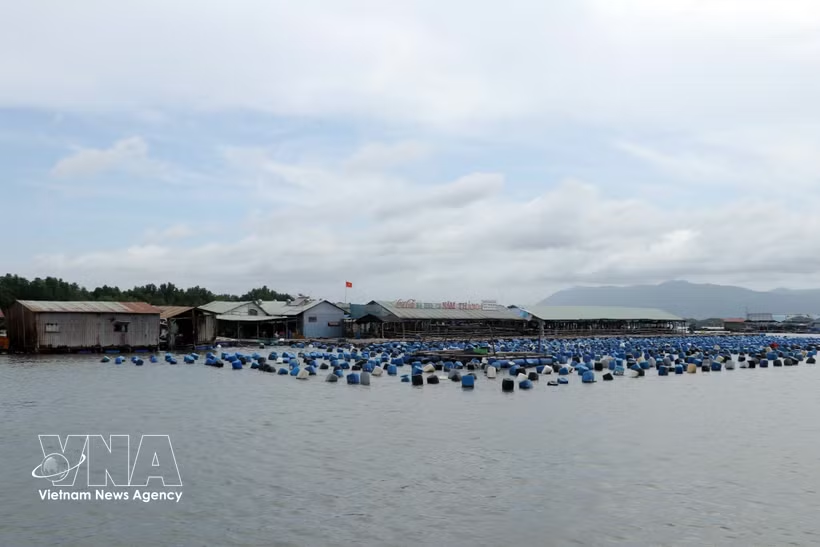
Aquaculture rafts on the Rang river in Long Son commune, Ho Chi Minh City, have benefited greatly from expanded digital connectivity, using technology in farming and selling their products online. (Photo: VNA)

Ho Chi Minh City (VNA) – A campaign on digital literacy for all, launched to implement Politburo Resolution No. 57-NQ/TW, is being rolled out vigorously in Long Son commune of Ho Chi Minh City.

Guided by the grassroots approach of “going down every alley, knocking on every door and checking every floating fish farm”, the initiative is bringing digital technology closer to residents and injecting fresh momentum into the island community surrounded by water.

Once almost cut off from the mainland by a dense network of rivers, bays and mangrove forests, Long Son is now gradually erasing those boundaries through technology.

Bringing technology to every floating fish farm

In recent years, Long Son has emerged as a convergence point for new development drivers in the southern economic hub, home to the more-than-5-billion-USD Long Son petrochemical complex, supporting factories and an international port. Yet behind its rapidly developing industrial landscape lies an island commune whose geographical conditions kept residents largely isolated from the urban centre for many years. Politburo Resolution No. 57-NQ/TW, issued on December 22, 2024, on breakthroughs in science and technology development, innovation and national digital transformation, has provided fresh impetus, with the commune's Party Committee and authorities moving swiftly to translate it into concrete action. With residents scattered across aquaculture ponds and floating fish farms along the rivers, the commune has adopted a hands-on approach rather than relying on centralised training sessions to promote digital literacy. Digital technology teams, working with village officials, go directly to people's homes and floating farms to help them install and use online public services and digital platforms. They patiently guide residents through each step on their mobile phones until they can use the services confidently.

Bui Thi Thu Huong, Vice Chairwoman of the Long Son commune People's Committee, said that digital transformation would struggle to become part of everyday life if infrastructure was developed and advanced technologies introduced without enabling people to use them effectively. The locality therefore considers it essential to demonstrate the practical benefits of technology in people's daily lives and livelihoods, making digital transformation more accessible and effective.

Tran Van Tin, a village head in Long Son, said the biggest initial obstacle was people's reluctance to change and their fear that technology would be complicated. However, once they received hands-on guidance and saw the convenience of services such as online administrative procedures, information searches and cashless payments, residents became more proactive in learning and sharing their knowledge with one another.

Alongside digital literacy programmes, Long Son is accelerating the development of its telecommunications infrastructure. The commune now has 60 base transceiver stations, 11 more than before July 1, 2025, extending coverage to remote floating fish farms and enabling residents to access high-speed digital services. A number of delivery companies supporting online sales have also set foot in the commune.

Digitalisation is also changing the way the grassroots administration operates. All commune officials and civil servants now use electronic document-management software with digital signatures, while administrative documents are processed entirely online. During the first six months of 2026, the commune's public administration service centre received nearly 4,000 applications and processed all of them on time, helping residents save time and travel costs.

Taking local brands into the digital space

As a locality with strong potential in aquaculture, Long Son has identified the sector as a priority in its digital transformation. The authorities are encouraging aquaculture households to adopt technology in managing farming areas, tracing product origins and connecting with markets, gradually moving away from production methods based largely on traditional experience.

At many floating farms along the Cha Va river, residents are becoming familiar with water-quality monitoring equipment and product traceability technology. A notable example is Long Son oysters, a local speciality now equipped with QR codes. With a simple scan, customers can check the entire farming process, product origin and production facility. The initiative is helping build a more professional, transparent and sustainable local brand. Ly Phuong Truc, manager of the Nam Thang oyster and fish farm, part of the local Duc Thinh aquaculture services cooperative, said that in the past the cooperative raised oysters largely by relying on established habits. Once harvested, the oysters were sold to traders, leaving prices highly volatile. Since receiving guidance on registering a trademark, using QR codes and promoting products online, the products have reached a much wider customer base, with selling prices rising significantly and outlets becoming more stable.

Alongside brand development, Long Son is encouraging and supporting residents in putting agricultural and aquatic products on e-commerce platforms to expand their market reach. Cashless payments have also been introduced at numerous businesses, floating restaurants and historical sites, helping establish digital transaction habits within the community while making it more convenient for visitors.

According to Long Son authorities, the commune will continue to develop its 5G infrastructure, apply geographic information systems (GIS) to manage aquaculture areas, digitise its cultural heritage using virtual reality technology and develop digital maps to support tourism, with the aim of building a comprehensive digital government, digital economy and digital society.

Effective digital transformation is particularly significant as Long Son stands to benefit from its strategic location. On one side is the bustling Cai Mep–Thi Vai deep-water port cluster and established large-scale industrial parks, while the Cai Mep Ha free trade zone is being shaped. On the other is a chain of renowned coastal tourism hubs stretching from Vung Tau to Ho Tram. More recently, Long Son was selected as the site for a national data centre, further underscoring the locality's important position in the digital infrastructure structure of the region and the country.

From QR codes tracing the origins of seafood and administrative procedures conducted online to cashless payments at businesses and floating fish farms, technology is steadily finding its way into every aspect of life in the island commune. Long Son is increasingly joining Ho Chi Minh City's wider development landscape of industry, the marine economy and innovation.

Through persistent, hands-on efforts and a determination to “leave no one behind”, the authorities are working to ensure that every resident has the opportunity to access and benefit from digital transformation under Politburo Resolution No. 57-NQ/TW./.

VNA
See more

Professor Vu Minh Khuong of the National University of Singapore. (Photo: VNA)

Singapore’s experience suggests solutions to Vietnam’s human resources challenge in AI era

As Vietnam accelerates digital transformation and high-tech development, Singapore’s experience and the engagement of global technology companies demonstrate that human resources preparation must stay ahead of the curve. The ability to filter knowledge, collaborate, innovate and effectively use AI will increasingly become essential to helping workers adapt to a changing labour market and strengthening the competitiveness of Vietnam’s economy in the new era.

Shanti Alexander (centre), Meta’s Director of Policy Programmes and Campaigns for Asia-Pacific and Thao Dao, Country Strategy & Operations Lead at Google at a seminar in Singapore (Photo: VNA)

Singapore’s experience offers lessons for Vietnam

Singapore’s experience in linking policies with business needs, mobilising technology corporations to address national challenges and ensuring vulnerable groups are not left behind could provide valuable lessons for Vietnam.

The product exhibition area at the AI Day 2026, organised by Hanoi University of Science and Technology and STEAM for Vietnam in collaboration with the US Embassy in Vietnam and the National Innovation Centre (Photo: VNA)

Building AI capabilities tailored to Vietnam’s needs

Vietnam is entering a new phase of AI development, moving beyond the adoption of existing technologies to building its own capabilities by advancing models, computing infrastructure, data, and talent in parallel to create an ecosystem capable of developing technologies tailored to the country’s needs.

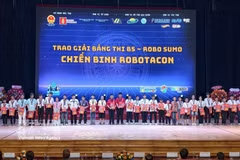
Top-performing teams at ROBOTACON WRO 2026 national finals are honoured at a ceremony on August 23 (Photo: VNA)

Top-performing teams at ROBOTACON WRO 2026 national finals honoured

The national finals of the ROBOTACON WRO 2026 robot talent competition concluded in the central province of Gia Lai on August 23, providing students with a valuable learning and experiential environment where they could develop STEM skills, learn to work together, think creatively and solve complex problems.

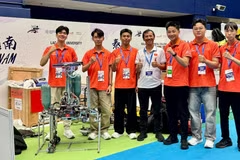
The LH-FOF team from Vietnam's Lac Hong University represents the country at ABU Robocon 2026. (Photo: VTV)

Vietnam team wins three awards at ABU Robocon 2026

The LH-FOF team from Vietnam's Lac Hong University won three awards the 2026 Asia-Pacific Broadcasting Union Robot Contest (ABU Robocon): third place overall, the best design award and a sponsor’s award.

Panoramic view of the site designated for the Ninh Thuan 1 nuclear power plant in Phuoc Dinh commune, Khanh Hoa province. (Photo published by VNA)

Skilled workforce vital to Vietnam’s nuclear power programme

The long-term challenge Vietnam must proactively address is building a pool of personnel in management, regulation, research and development, and technical support. These are areas in which the country must take the initiative in training and building up its own capabilities so that it can independently conduct assessments, evaluate safety, verify technical calculations, carry out research, and provide support for the sustainable development of the nuclear programme.

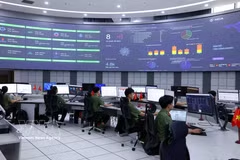
Officers and soldiers of the Department of Cybersecurity and High-Tech Crime Prevention under the Ministry of Public Security monitor malware trend charts and directly assess potential threats in cyberspace. - Illustrative image (Photo: VNA)

Vietnam issues new cybersecurity rules for domestic, foreign businesses

Issued on August 19, the decree comprises six chapters and 32 articles, covering cybersecurity protection measures, information security assurance, specialised cybersecurity training, and management of IP address identification for telecommunications and Internet service providers.

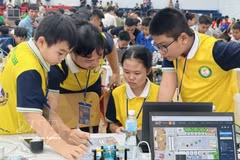
Students compete in the national finals of the ROBOTACON WRO (World Robot Olympiad) 2026. (Photo: VNA)

Nearly 500 contestants compete at ROBOTACON WRO 2026 national finals

Held under the theme “Robots Meet Culture”, this year’s competition aims to connect technology with cultural values, encouraging students to apply their knowledge of science, engineering and programming to real-world problems while promoting cultural values through creative solutions.

Scientific and technological research and development in Vietnam - Illustrative image (Photo: VNA)

Singapore’s tech adaptation offers lessons for Vietnam: Insiders

Prof. Vu Minh Khuong from the Lee Kuan Yew School of Public Policy noted that Vietnam is also making positive progress in this area, with officials increasingly focused on updating knowledge, learning from new models and adapting to changes. The key, he stressed, is to quickly translate these efforts into concrete results, which can build trust, strengthen motivation and drive further development.

Ang Wee Seng, Executive Director of the Singapore Semiconductor Industry Association (Photo published by VNA)

Expert suggests Vietnam, Singapore combine complementary strengths in semiconductors

Singapore, Vietnam and other ASEAN economies have different but complementary strengths. By linking these strengths through infrastructure, talent mobility, research partnerships, reliable supply chains and joint industry development, ASEAN can become an integrated, sustainable and globally significant semiconductor ecosystem rather than merely a collection of separate semiconductor manufacturing locations.

Israeli experts introduce several areas with potential for cooperation, including AI, cybersecurity, quantum technology, data, health technology and the application of artificial intelligence in businesses. (Photo: VNA)

Vietnam, Israel explore stronger cooperation in technology, innovation

During the meeting, Ambassador Nguyen Ky Son said science, technology, innovation and artificial intelligence (AI) are becoming key drivers of Vietnam’s development, stressing that the application of AI and emerging technologies must go hand in hand with data security and safety.

The report “Vietnam’s Technological Leap: Sources of Success and Limitations” (Photo: screenshot)

Vietnam makes significant technological progress thanks to open-door policy: Russian expert

Dezhina, a senior researcher at the Institute of Sociology under the Federal Research Center of the Russian Academy of Sciences, said the rapid development of Vietnam’s services sector and knowledge-based industries represents a technological leap driven largely by foreign investment and government policies aimed at developing infrastructure, boosting exports and attracting FDI.

The Da Nang People’s Committee presents awards to the Top 10 projects in the Student Category of the Da Nang Innovation and Startup Competition at SURF 2026. (Photo: VNA)

Da Nang runs biggest annual startup event

Themed “A New Era of Growth – Pioneering Innovation”, the festival focused on expanding international connectivity, promoting cross-border investment cooperation and highlighting strategic technology sectors such as artificial intelligence (AI), semiconductors, digital technology, blockchain, green technology and digital transformation.