OVs serve as bridge for knowledge, technology for Vietnam

According to Nguyen Phuong Chung, lecturer and Director of the Vietnamese Language Programme at Columbia University’s Department of East Asian Languages and Cultures in the US, Resolution 23 represents an important shift in how the position, role, and contributions of overseas Vietnamese are viewed.

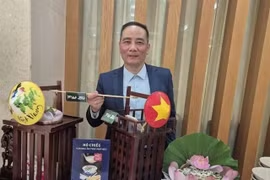
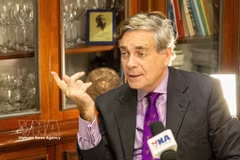
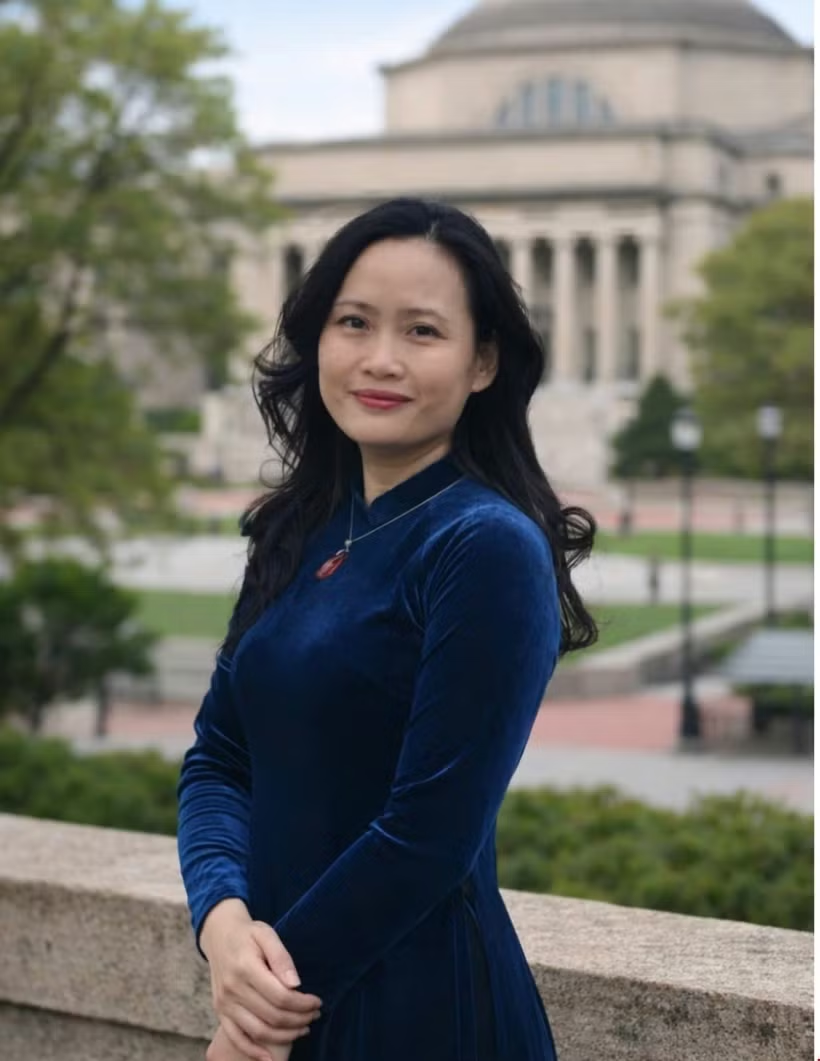
Nguyen Phuong Chung, lecturer and Director of the Vietnamese Language Programme at Columbia University’s Department of East Asian Languages and Cultures in the US (Photo published by VNA)

New York (VNA) - The Politburo's Resolution No. 23-NQ/TW on overseas Vietnamese affairs comes as Vietnam enters a new phase of development, in which mobilising international science, technology, and knowledge networks has become increasingly important.

According to Nguyen Phuong Chung, lecturer and Director of the Vietnamese Language Programme at Columbia University’s Department of East Asian Languages and Cultures in the US, Resolution 23 represents an important shift in how the position, role, and contributions of overseas Vietnamese are viewed.

Chung said the resolution reaffirmed that overseas Vietnamese are an integral part of the Vietnamese nation. More importantly, it identifies the diaspora as a key strategic resource and a bridge between Vietnam and the world, enabling them to directly contribute to national development.

This marks a significant change in approach. Overseas Vietnamese should not merely be seen as people maintaining ties with their homeland, but as active contributors capable of bringing knowledge, experience, technology, international partnerships and other resources to Vietnam’s development in the new era.

After eight years working on Vietnam-related activities at Columbia University, Chung said the orientation set out in Resolution 23 closely reflects the realities of academic and international cooperation undertaken by overseas educational and research institutions.

Through its Global Vietnam Studies programme, Columbia University has organised numerous conferences and seminars on Vietnam, creating platforms for Vietnamese and international scholars to examine the country from different perspectives. The programme has also connected US scholars, experts, businesspeople and students with counterparts in Vietnam, while working with Vietnamese universities and partners on academic exchanges and new areas of cooperation.

Such activities show that the strength of the overseas Vietnamese community lies not only in individual contributions, but also in its ability to build networks and bring Vietnam closer to international universities, research centres, businesses and communities.

Chung said she welcomed the resolution’s emphasis on improving mechanisms and policies to connect, attract, and leverage the intellectual resources of overseas Vietnamese, especially experts, academics, scientists, businesspeople and young people. This could provide a stronger foundation for the Vietnamese community in the US to participate in Vietnam’s science and technology, innovation and digital transformation programmes.

Another important area highlighted by Resolution 23 is promoting the Vietnamese language, history and national cultural identity among younger generations of overseas Vietnamese. Chung said this is also a key focus of Columbia University’s Vietnamese Language Programme.

The resources of overseas Vietnamese, she stressed, should be viewed not merely in terms of financial contributions or investment, but as part of a broader pool of knowledge, science, technology, education and highly skilled human resources. These resources are increasingly important to Vietnam’s goals of rapid and sustainable development and stronger national competitiveness.

From the perspective of a Vietnamese expert working in US higher education, Chung said she hopes the new thinking embodied in Resolution 23 will be translated into practical, long-term and accessible mechanisms for engagement.

In the US and many other countries, Vietnamese have achieved success in universities, research institutes, businesses and science and technology. The challenge is to establish effective mechanisms to connect “the right people, with the right expertise and networks, to the right development needs of Vietnam.”

She stressed that younger generations of overseas Vietnamese should not only be regarded as people whose Vietnamese language and cultural identity need to be preserved, but also as a future national resource.

Therefore, implementation of Resolution 23 should seek to shift from “connecting the community” to “connecting resources”, and from “attracting contributions” to “co-creating”. This will enhance Vietnam’s international standing, soft power and global presence while helping build strong pools of knowledge, technology and human resources for national development in the new era./.

VNA
See more

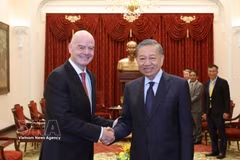
General Secretary of the Communist Party of Vietnam (CPV) Central Committee and President To Lam (right) receives FIFA President Gianni Infantino in Hanoi on August 26 (Photo: VNA)

Top leader receives FIFA President in Hanoi

General Secretary of the Communist Party of Vietnam (CPV) Central Committee and President To Lam called on FIFA to continue assisting Vietnam with the training of coaches and referees, enhancing professional expertise and football management capacity, while promoting the development of women’s, school and grassroots football, professional leagues and national teams.

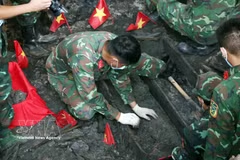
The search for fallen soldiers’ remains has been conducted by Military Region 7 carefully, meticulously and in accordance with regulations, ensuring that no remains are left undiscovered (Photo: VNA)

Vietnam steps up search, repatriation of fallen soldiers’ remains

As of August 26, 917 sets of remains had been recovered in localities across the country. A total of 264 sampling teams have been established, involving 3,500 personnel. Samples have been collected from the remains of fallen soldiers at 159,370 graves, representing 74.9% of the target. Of these, 109,897 graves were eligible for sampling, accounting for 68.96%.

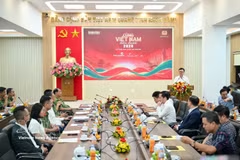
The event announcing the campaign “Moving forward with Vietnam” (Photo: VNA)

Campaign spreads community spirit through 10 billion green steps

Under the message “10 billion green steps – For a sustainable Vietnam,” the walking campaign “Moving forward with Vietnam" aims to strengthen national solidarity and encouraging regular exercise; advance the “All people exercise following the example of great President Ho Chi Minh” movement; and fostet closer ties between the People’s Public Security Force and the public while encouraging healthy and active lifestyles.

VNUA President Prof. Dr. Nguyen Thi Lan introduces the university to President of the National Assembly of Côte d'Ivoire Patrick Achi and his delegation. (Photo: VNA)

NA President of Côte d'Ivoire visits agriculture university

President of the National Assembly of Côte d'Ivoire Patrick Achi praised Vietnam's major achievements in agriculture, particularly improvements in productivity, livestock and fisheries, as well as policies promoting agro-processing and higher added value, while visiting the Vietnam National University of Agriculture (VNUA) in Hanoi on August 24.

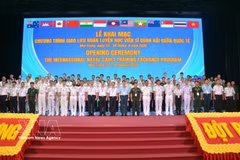
Military officials at the INCATEP 2026 opening ceremony in Khanh Hoa province on August 24 (Photo: VNA)

Vietnamese navy opens 2026 int’l training programme

Nearly 50 naval officers, instructors and cadets from 12 countries, including Australia, Cambodia, Canada, China, India, Indonesia, Laos, Malaysia, Myanmar, New Zealand, Singapore and Thailand, are joining the event. It is designed to foster solidarity, mutual respect and friendship among participating countries.

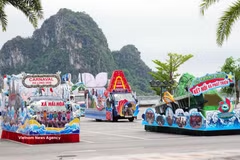
At Carnaval Ha Long 2026. (Photo: VNA)

NA approves establishment of Quang Ninh and Bac Ninh cities

The establishment of Quang Ninh and Bac Ninh is not merely an administrative restructuring, he said, but also aims to reorganise development space, improve local governance models and create a new growth driver for the two localities, the Red River Delta, the northern region and the country as a whole.

The Vietnam Coast Guard Region 3 Command presents national flags to fishermen in Tien Thanh ward, Lam Dong province (Photo: VNA)

Coast Guard force joins fishermen in fight against IUU fishing

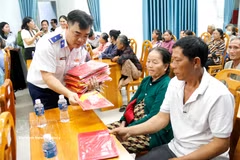
The outreach focused on maritime and island laws, particularly regulations on combating IUU fishing. Through dialogues, leaflets, consultations and question-and-answer sessions, coast guard officers helped fishermen better understand fishing-zone boundaries, requirements for installing vessel monitoring systems, and necessary legal procedures for offshore fishing.

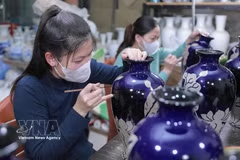
Intricate ceramic shaping techniques at Bat Trang craft village in Hanoi. (Photo: VNA)

Hanoi promotes craft village tourism as a driver of growth

Hanoi’s experience shows that linking craft villages with tourism and digital transformation is no longer simply a local initiative. By preserving heritage, promoting products through digital platforms and using tourism as a channel to showcase traditional crafts, the capital’s craft villages can integrate more deeply into the creative economy and create momentum for sustainable growth in rural areas.