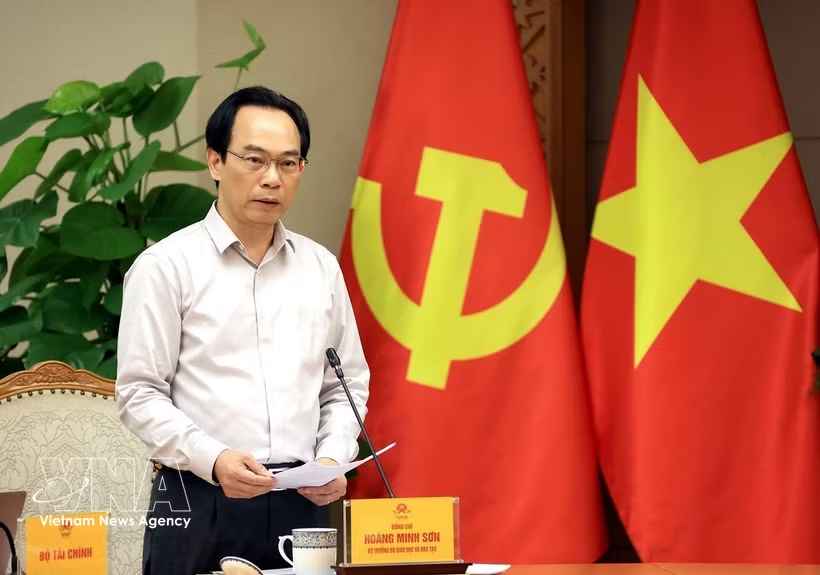
Hanoi (VNA) – As the 2026-2027 academic year is approaching and one year has passed since the Politburo issued Resolution No. 71-NQ/TW on breakthrough development of education and training, Minister of Education and Training Hoang Minh Son has outlined the sector’s initial achievements, remaining challenges and priorities for the next phase.
In an interview with the Vietnam News Agency (VNA), Son said one year was not long enough to fully assess the impact of a resolution with such a broad scope and long-term goals. However, the first year of implementation has laid an important foundation for the next stage of breakthroughs. As of mid-August, 35 of 76 specific tasks had been completed, with none overdue. Four laws, two resolutions of the National Assembly, 25 decrees and resolutions of the Government, 16 decisions of the Prime Minister and 78 ministry-level circulars had been issued.
Several major policies have begun to take effect, including tuition exemption and preparations for a common set of textbooks. The construction of 108 inter-level boarding schools in border communes have also been launched, with the first phase expected to add 4,396 classrooms for nearly 113,000 students. STEM and strategic technology training have made notable progress, with STEM students accounting for 32.5% of university enrolments in 2026, while around 110,000 students are studying key engineering and strategic technology fields. Ninety STEM talent programmes for engineers and master’s students are being implemented at 23 higher education institutions.
These are concrete steps towards expanding learning opportunities and preparing human resources and talents needed to meet the country’s new development requirements, said Son.
At the same time, education governance is shifting from a predominantly administrative and procedural approach towards one based more heavily on standards, quality, data and learning outcomes, accompanied by greater decentralisation and accountability. Digital transformation has progressed from digitising procedures to developing data infrastructure for administration, teaching, examinations and admissions. The sector’s databases now cover about 50,000 educational institutions, more than 27 million students and over 1.4 million teachers. By August, more than 18 million digital academic records and over 13 million diplomas and certificates had been digitised.
Son stressed that AI should be used appropriately to serve education, helping students develop deeper thinking and greater creativity rather than replacing teachers or students’ own learning and reasoning.
However, he acknowledged that the first year has mainly focused on creating foundations and enabling conditions, while qualitative improvements in education, teachers, learners and human resources remained insufficiently visible. The gap between policy and implementation continued to pose a major challenge, alongside shortages of teachers and classrooms, overcrowding in some urban areas and industrial zones, and problems including achievement-driven education, academic and examination cheating, inappropriate private tutoring and school violence.
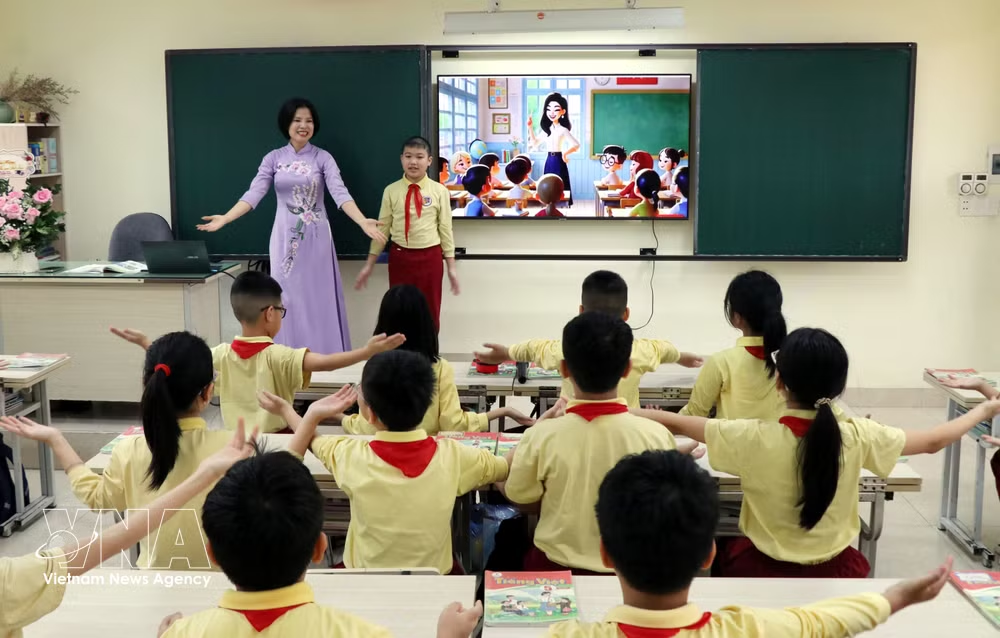
The minister said the next phase must therefore focus on substantive changes. He argued that breakthroughs should not come solely from institutions, policies or additional resources, but, more importantly, from deep internal reforms within the education sector, covering school governance, teachers, curricula, teaching and learning methods, examinations and assessment. Ultimately, he said, success must be reflected in better teachers, better learners, better schools and higher-quality human resources.
Regarding the restructuring of the school network ahead of the new academic year, Son said the process should not be viewed as a mechanical reduction in the number of institutions. Its highest objective aims to create a more rational system, use teachers, facilities and investment resources more effectively, and expand equitable access to quality education.
He emphasised that restructuring was only the beginning. Localities will need to continue reviewing teacher allocation, addressing shortages and surpluses, improving school governance and ensuring that restructuring does not reduce educational opportunities, particularly for students in remote, mountainous and border areas.
On reducing unnecessary pressure on students, the minister said the priority for the 2026-2027 academic year will be substantive reforms within schools, particularly in teaching methods and assessment. Education should move away from one-way instruction, rote learning and studying merely for examinations, while encouraging self-learning, practical experience, independent thinking, creativity and problem-solving.
He also stressed that students’ success should not be measured solely by grades or diplomas. Each student has different abilities, strengths and development paths, and education should help them grow, acquire knowledge and skills, maintain good health and character, and build confidence for the future.
Looking ahead, Son expressed his appreciation for teachers and education managers nationwide, while calling for continued improvements in teachers’ policies and working conditions. He encouraged students to learn for understanding, practical application and personal growth, and urged parents to place greater emphasis on their children’s progress rather than comparing them with others.
The minister concluded that the major goals of Resolution No. 71-NQ/TW will be realised through concrete changes in every classroom and every school, with education reforms reflected in better teachers, better learners and a stronger education system./.