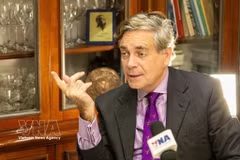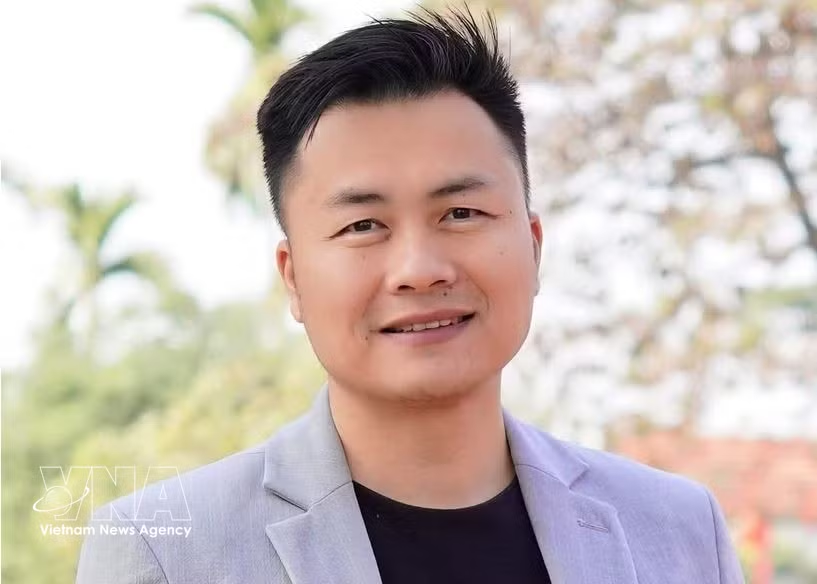
Sydney (VNA) – The Politburo's Resolution No. 23-NQ/TW on overseas Vietnamese affairs marks an important shift in thinking, from “care and mobilisation” to “accompanying and creating mechanisms.” The move opens up greater room for overseas Vietnamese (OVs) to contribute knowledge, experience, and resources to national development, said Dr. Nguyen Tuan Nghia, an artificial intelligence (AI) expert and the founder and CEO of the Australian company ANSCENTER.
Talking to Vietnam News Agency correspondents in Sydney, Nghia, who is also co-president of the Vietnam-Australia Scholars and Experts Association (VASEA) New South Wales Chapter, said the priority now is to translate the resolution’s spirit into practical mechanisms enabling overseas Vietnamese intellectuals to help address specific development challenges.
Australia is home to about 300,000 people of Vietnamese origin, many of them in New South Wales. Cultural ties remain an important bond, while the elevation of Vietnam-Australia relations to a Comprehensive Strategic Partnership in 2024 has further strengthened the community’s role as a bridge between the two countries, he said.
For overseas intellectuals and entrepreneurs, the desire to create meaningful social value is another major motivation. Nghia stressed that remittances, while readily measurable, are not necessarily the most valuable resource OVs can provide. Greater potential lies in knowledge, technology, governance standards and international networks.
He mentioned that Vietnamese experts abroad are involved in areas like AI, semiconductors, biomedical technology, and clean energy. They contribute through knowledge sharing, research co-supervision, tech consulting, and supporting Vietnamese businesses in connecting to global supply chains.
Drawing on ANSCENTER’s experience, Nghia said the company has developed platforms for construction engineers and deployed them in Dien Bien province for production quality control, monitoring and smart management. Cooperation with international groups such as Advantech and NVIDIA has also helped introduce and test advanced solutions in Vietnam.
Education and human resource development are also a priority. VASEA has worked to link Australian universities with Vietnamese partners, fostering joint programs, scholarships, and faculty training while introducing international standards and research practices to Vietnam.
From “calling for” to “commissioning”
Nghia said the key aspect of Resolution 23 is its shift from “care and mobilisation” to “accompanying and creating mechanisms.” This should be translated into clear policies enabling overseas intellectuals to participate directly in national development.
First, he proposed replacing general appeals with targeted commissioning of tasks, including a list of major science and technology challenges, with designated agencies, funding, and timelines. This would enable overseas experts to identify where and how they could contribute.
Second, there should be mechanisms for remote and part-time contributions, he said. Many overseas experts cannot return permanently because of family and professional commitments. Roles such as visiting professors, research project co-leaders, council members and advisers should therefore be facilitated without requiring permanent residence in Vietnam. Procedures for contracts and cross-border payments should also be simplified.
Third, administrative procedures should be streamlined through a dedicated focal point and digital platform for overseas Vietnamese talent, together with coordinated procedures for visas, work permits, qualification recognition, taxation and intellectual property.
Finally, greater investment should be made in younger generations through scholarships, internships and programmes bringing Vietnamese-origin students to Vietnam to participate in practical projects.
The effectiveness of policies to mobilise overseas resources should be measured by tangible outcomes, such as completed projects, technologies transferred and people trained, rather than the number of conferences or meetings, Nghia said.
OV intellectuals do not seek special privileges, he stressed, but want to be involved from the policy-design stage, trusted, assigned meaningful tasks and able to see their contributions produce concrete results for their homeland./.