Vietnam targets top-three ASEAN ranking in AI by 2030

By 2030, Vietnam aims for 60% of businesses using AI to improve efficiency, all civil servants using AI in their work weekly, and 60% of administrative decisions supported by data and AI. The satisfaction rate for AI-supported public services is expected to rise by at least 30%.

A area showcasing products at AI Day 2026 held in Hanoi on April 5, 2026 (Photo: VNA)

Hanoi (VNA) – Vietnam aims to rank among the three leading ASEAN countries in artificial intelligence (AI) by 2030, with the AI economy expected to account for around 6% of GDP and exports of AI products, services and solutions reaching about 5 billion USD, according to the National AI Strategy to 2045.

At a regular press briefing in August hosted by the Ministry of Science and Technology, Nguyen Khac Lich, Director of the ministry's Authority for Digital Technology and AI, said the strategy represents a move from just researching, developing, and applying AI to driving a full-scale national transformation powered by it.

​AI is evolving beyond a technology tool into a core capability for policymaking, economic development and social governance. Human resources, infrastructure and data form the foundation, while effective institutions and AI governance are key to breakthroughs. The approach puts people at the centre, promotes AI skills among citizens, and calls for coordinated development of AI infrastructure, data and platforms while safeguarding safety, security and sovereignty.

By 2030, Vietnam aims for 60% of businesses using AI to improve efficiency, all civil servants using AI in their work weekly, and 60% of administrative decisions supported by data and AI. The satisfaction rate for AI-supported public services is expected to rise by at least 30%.

All ministries, sectors and localities are expected to have AI deployment plans, while all online public services and administrative dossiers will be AI-supported. The strategy also targets the development of a national AI computing capacity coordination platform, a platform for evaluating Vietnamese-language AI models, at least five shared AI platforms, 10 Vietnamese AI brands and eight Vietnamese-language AI models of four different scales.

To support these goals, annual total investment in AI is expected to reach 1-1.5% of GDP. Key datasets will be digitised, standardised, cleaned, and made AI-ready.

Vietnam also aims to develop a strong AI workforce, including 10,000 highly qualified AI professionals and 50,000 university-level or higher personnel with AI application skills by 2030. Some 500,000 workers will be trained to operate AI, while 10 million trained workers will receive basic AI skills.

The strategy sets out nine key pillars, focusing on AI talent and skills, data and models, infrastructure, research and technological capabilities, AI in governance and economic sectors, support for SMEs and cooperatives, and the development of a strong, safe and trustworthy AI ecosystem.

Vietnamese AI firms will play a central role, with emphasis on “Make in Vietnam” solutions and AI-native businesses. The strategy also calls for international cooperation while strengthening domestic capabilities and strategic autonomy through diversification of partners, technologies and supply chains.

The strategy’s breakthrough and strategic solutions focus on institutions and policies, national coordination and accountability, resource mobilisation, international cooperation and standards setting, public awareness and responsible AI, as well as monitoring and evaluation.

According to Lich, the implementation will follow the “six clear” principle - clear people, clear tasks, clear timelines, clear responsibilities, clear outputs and clear authority.

The Ministry of Science and Technology will be responsible for directing inter-sectoral coordination for implementation, while ministries, sectors and localities will formulate plans and mobilise resources. Businesses, research and training institutions, and other relevant organisations will contribute to assigned tasks, he said.

By 2045, Vietnam aims to join Asia’s top 10 in AI research, development and technological mastery, with AI serving as a core platform for the State, economy and society, he went on.

At the briefing, the ministry also launched its one-stop-shop AI portal at ai.dda.gov.vn to support implementation of the AI Law and related regulations. The platform enables businesses, developers, State agencies, experts and citizens to handle procedures, submit declarations, access information and engage with regulators through a unified system.

Its key functions include receiving applications for controlled testing, AI risk classification and system registration, serious incident and periodic reporting, publication of assessment results and violations, and connecting businesses with support programmes, shared infrastructure and data, and other AI development resources./.
VNA

See more

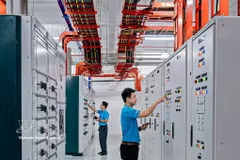
VNPT’s data centre (IDC) at Hoa Lac Hi-Tech Park, the largest of its kind in Vietnam, is equipped with state-of-the-art technologies and fully meets international technical standards. (Photo: VNA)

Vietnam’s data centre race draws multibillion-dollar investment

Ho Chi Minh City currently has 20 operational data centres and nine proposed projects, according to the municipal Department of Science and Technology. New projects are moving beyond traditional data centres toward large complexes integrating AI and other digital infrastructure.

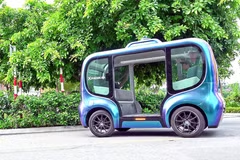
A mini autonomous bus undergoing testing in Hanoi (Photo: Phenikaa-X)

Hanoi allows 24-month trial of autonomous vehicles at Hoa Lac

The project aims to assess the safety, reliability and readiness of autonomous vehicles under real traffic conditions, as well as the effectiveness of autonomous public transport and compatibility with existing systems. Its results will contribute to developing technical standards, operating procedures and management models suited to Hanoi’s traffic conditions.

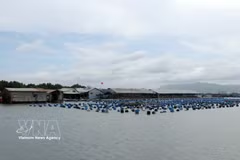
Aquaculture rafts on the Rang river in Long Son commune, Ho Chi Minh City, have benefited greatly from expanded digital connectivity, using technology in farming and selling their products online. (Photo: VNA)

Resolution 57 opens digital door to drive marine economic development

Through persistent, hands-on efforts and a determination to “leave no one behind”, the Ho Chi Minh City authorities are working to ensure that every resident has the opportunity to access and benefit from digital transformation under Politburo Resolution No. 57-NQ/TW

Professor Vu Minh Khuong of the National University of Singapore. (Photo: VNA)

Singapore’s experience suggests solutions to Vietnam’s human resources challenge in AI era

As Vietnam accelerates digital transformation and high-tech development, Singapore’s experience and the engagement of global technology companies demonstrate that human resources preparation must stay ahead of the curve. The ability to filter knowledge, collaborate, innovate and effectively use AI will increasingly become essential to helping workers adapt to a changing labour market and strengthening the competitiveness of Vietnam’s economy in the new era.

Shanti Alexander (centre), Meta’s Director of Policy Programmes and Campaigns for Asia-Pacific and Thao Dao, Country Strategy & Operations Lead at Google at a seminar in Singapore (Photo: VNA)

Singapore’s experience offers lessons for Vietnam

Singapore’s experience in linking policies with business needs, mobilising technology corporations to address national challenges and ensuring vulnerable groups are not left behind could provide valuable lessons for Vietnam.

The product exhibition area at the AI Day 2026, organised by Hanoi University of Science and Technology and STEAM for Vietnam in collaboration with the US Embassy in Vietnam and the National Innovation Centre (Photo: VNA)

Building AI capabilities tailored to Vietnam’s needs

Vietnam is entering a new phase of AI development, moving beyond the adoption of existing technologies to building its own capabilities by advancing models, computing infrastructure, data, and talent in parallel to create an ecosystem capable of developing technologies tailored to the country’s needs.

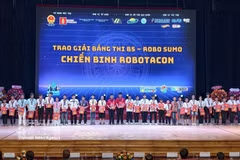
Top-performing teams at ROBOTACON WRO 2026 national finals are honoured at a ceremony on August 23 (Photo: VNA)

Top-performing teams at ROBOTACON WRO 2026 national finals honoured

The national finals of the ROBOTACON WRO 2026 robot talent competition concluded in the central province of Gia Lai on August 23, providing students with a valuable learning and experiential environment where they could develop STEM skills, learn to work together, think creatively and solve complex problems.

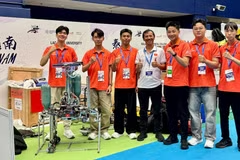
The LH-FOF team from Vietnam's Lac Hong University represents the country at ABU Robocon 2026. (Photo: VTV)

Vietnam team wins three awards at ABU Robocon 2026

The LH-FOF team from Vietnam's Lac Hong University won three awards the 2026 Asia-Pacific Broadcasting Union Robot Contest (ABU Robocon): third place overall, the best design award and a sponsor’s award.

Panoramic view of the site designated for the Ninh Thuan 1 nuclear power plant in Phuoc Dinh commune, Khanh Hoa province. (Photo published by VNA)

Skilled workforce vital to Vietnam’s nuclear power programme

The long-term challenge Vietnam must proactively address is building a pool of personnel in management, regulation, research and development, and technical support. These are areas in which the country must take the initiative in training and building up its own capabilities so that it can independently conduct assessments, evaluate safety, verify technical calculations, carry out research, and provide support for the sustainable development of the nuclear programme.

Officers and soldiers of the Department of Cybersecurity and High-Tech Crime Prevention under the Ministry of Public Security monitor malware trend charts and directly assess potential threats in cyberspace. - Illustrative image (Photo: VNA)

Vietnam issues new cybersecurity rules for domestic, foreign businesses

Issued on August 19, the decree comprises six chapters and 32 articles, covering cybersecurity protection measures, information security assurance, specialised cybersecurity training, and management of IP address identification for telecommunications and Internet service providers.

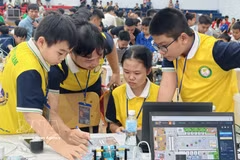
Students compete in the national finals of the ROBOTACON WRO (World Robot Olympiad) 2026. (Photo: VNA)

Nearly 500 contestants compete at ROBOTACON WRO 2026 national finals

Held under the theme “Robots Meet Culture”, this year’s competition aims to connect technology with cultural values, encouraging students to apply their knowledge of science, engineering and programming to real-world problems while promoting cultural values through creative solutions.

Scientific and technological research and development in Vietnam - Illustrative image (Photo: VNA)

Singapore’s tech adaptation offers lessons for Vietnam: Insiders

Prof. Vu Minh Khuong from the Lee Kuan Yew School of Public Policy noted that Vietnam is also making positive progress in this area, with officials increasingly focused on updating knowledge, learning from new models and adapting to changes. The key, he stressed, is to quickly translate these efforts into concrete results, which can build trust, strengthen motivation and drive further development.

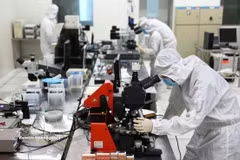
Ang Wee Seng, Executive Director of the Singapore Semiconductor Industry Association (Photo published by VNA)

Expert suggests Vietnam, Singapore combine complementary strengths in semiconductors

Singapore, Vietnam and other ASEAN economies have different but complementary strengths. By linking these strengths through infrastructure, talent mobility, research partnerships, reliable supply chains and joint industry development, ASEAN can become an integrated, sustainable and globally significant semiconductor ecosystem rather than merely a collection of separate semiconductor manufacturing locations.

Israeli experts introduce several areas with potential for cooperation, including AI, cybersecurity, quantum technology, data, health technology and the application of artificial intelligence in businesses. (Photo: VNA)

Vietnam, Israel explore stronger cooperation in technology, innovation

During the meeting, Ambassador Nguyen Ky Son said science, technology, innovation and artificial intelligence (AI) are becoming key drivers of Vietnam’s development, stressing that the application of AI and emerging technologies must go hand in hand with data security and safety.

The report “Vietnam’s Technological Leap: Sources of Success and Limitations” (Photo: screenshot)

Vietnam makes significant technological progress thanks to open-door policy: Russian expert

Dezhina, a senior researcher at the Institute of Sociology under the Federal Research Center of the Russian Academy of Sciences, said the rapid development of Vietnam’s services sector and knowledge-based industries represents a technological leap driven largely by foreign investment and government policies aimed at developing infrastructure, boosting exports and attracting FDI.