Hanoi allows 24-month trial of autonomous vehicles at Hoa Lac

The project aims to assess the safety, reliability and readiness of autonomous vehicles under real traffic conditions, as well as the effectiveness of autonomous public transport and compatibility with existing systems. Its results will contribute to developing technical standards, operating procedures and management models suited to Hanoi’s traffic conditions.

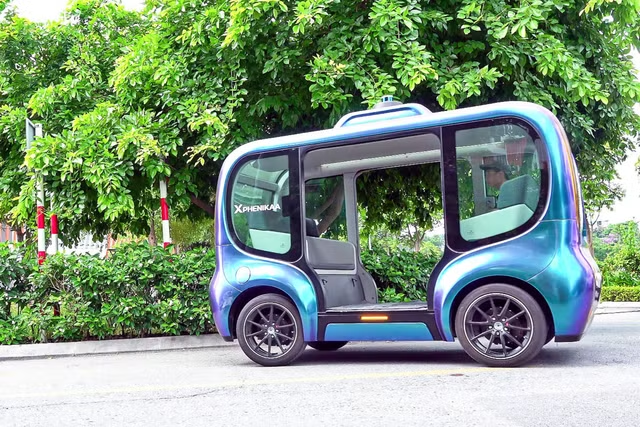
A mini autonomous bus undergoing testing in Hanoi (Photo: Phenikaa-X)

Hanoi (VNA) – Hanoi has allowed Phenikaa-X JSC to conduct controlled testing of a smart autonomous transport system, including autonomous buses, robotaxis, automated cleaning robots and delivery robots, at Hoa Lac Hi-Tech Park and the Hoa Lac campus of Vietnam National University, Hanoi.

Under Decision No. 4554/QD-UBND issued by the Hanoi People’s Committee on August 25, the trial will last 24 months. Vehicles may operate only on designated routes equipped with high-resolution digital maps and monitoring systems.

The project aims to assess the safety, reliability and readiness of autonomous vehicles under real traffic conditions, as well as the effectiveness of autonomous public transport and compatibility with existing systems. Its results will contribute to developing technical standards, operating procedures and management models suited to Hanoi’s traffic conditions.

The system integrates LiDAR, cameras, HD 2D and 3D digital maps, high-precision GPS and artificial intelligence algorithms, including machine learning and deep learning. Operations will be conducted in for specific groups of vehicles and routes under defined conditions an din designated phases.

At Hoa Lac Hi-Tech Park, robotaxis and delivery robots will be tested for on-demand passenger transport and deliveries along a route of about 11.5km.

At the Hoa Lac campus, autonomous buses are expected to transport students between dormitories, lecture halls, military training facilities and bus connections. Cleaning and delivery robots will also be tested along a route of about 2.8km.

Testing will take place from 9am to 4:30pm daily, including weekends and holidays where necessary. Speeds will be determined for each route and are expected not to exceed 40km per hour. Vehicles must not operate during heavy rain, thunderstorms, flooding, strong winds, dense fog, natural disasters or infrastructure incidents affecting traffic safety.

Autonomous buses and robotaxis must have onboard safety supervisors capable of taking manual control in emergencies or when safe operating limits are exceeded. Supervisors must hold appropriate driving licences and receive relevant training. Cleaning and delivery robots must also have personnel supervising them on site.

Each trial run is limited to eight passengers on an autonomous bus and four on a robotaxi, excluding safety supervisors. Commercial transport services and fees are prohibited during the trial.

The city will temporarily waive certain requirements on registration, licence plates, inspection and operating permits within the trial area, subject to alternative safety measures.

The Hanoi Management Board of Hi-Tech Parks and Industrial Parks will oversee the trials, while the Department of Science and Technology will evaluate the results and advise the municipal administration on post-trial policies./.
VNA

See more

Aquaculture rafts on the Rang river in Long Son commune, Ho Chi Minh City, have benefited greatly from expanded digital connectivity, using technology in farming and selling their products online. (Photo: VNA)

Resolution 57 opens digital door to drive marine economic development

Through persistent, hands-on efforts and a determination to “leave no one behind”, the Ho Chi Minh City authorities are working to ensure that every resident has the opportunity to access and benefit from digital transformation under Politburo Resolution No. 57-NQ/TW

Professor Vu Minh Khuong of the National University of Singapore. (Photo: VNA)

Singapore’s experience suggests solutions to Vietnam’s human resources challenge in AI era

As Vietnam accelerates digital transformation and high-tech development, Singapore’s experience and the engagement of global technology companies demonstrate that human resources preparation must stay ahead of the curve. The ability to filter knowledge, collaborate, innovate and effectively use AI will increasingly become essential to helping workers adapt to a changing labour market and strengthening the competitiveness of Vietnam’s economy in the new era.

Online public services in Thanh Khe ward, Da Nang city, help residents protect personal data. (Photo: nhandan.vn)

Vietnam moves to strengthen digital shield amid rise of AI, deepfakes

An effective “digital shield” should have three key capabilities: early warning to identify unusual topics, sources and dissemination patterns, as well as signs of fabrication or coordinated activity; rapid verification through coordination among authorities, databases, experts and the press; and proactive communications, providing accurate, accessible and multimedia content to the right audiences once information is verified.

Shanti Alexander (centre), Meta’s Director of Policy Programmes and Campaigns for Asia-Pacific and Thao Dao, Country Strategy & Operations Lead at Google at a seminar in Singapore (Photo: VNA)

Singapore’s experience offers lessons for Vietnam

Singapore’s experience in linking policies with business needs, mobilising technology corporations to address national challenges and ensuring vulnerable groups are not left behind could provide valuable lessons for Vietnam.

The product exhibition area at the AI Day 2026, organised by Hanoi University of Science and Technology and STEAM for Vietnam in collaboration with the US Embassy in Vietnam and the National Innovation Centre (Photo: VNA)

Building AI capabilities tailored to Vietnam’s needs

Vietnam is entering a new phase of AI development, moving beyond the adoption of existing technologies to building its own capabilities by advancing models, computing infrastructure, data, and talent in parallel to create an ecosystem capable of developing technologies tailored to the country’s needs.

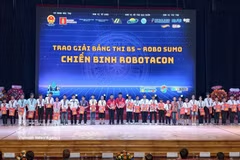
Top-performing teams at ROBOTACON WRO 2026 national finals are honoured at a ceremony on August 23 (Photo: VNA)

Top-performing teams at ROBOTACON WRO 2026 national finals honoured

The national finals of the ROBOTACON WRO 2026 robot talent competition concluded in the central province of Gia Lai on August 23, providing students with a valuable learning and experiential environment where they could develop STEM skills, learn to work together, think creatively and solve complex problems.

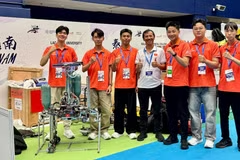
The LH-FOF team from Vietnam's Lac Hong University represents the country at ABU Robocon 2026. (Photo: VTV)

Vietnam team wins three awards at ABU Robocon 2026

The LH-FOF team from Vietnam's Lac Hong University won three awards the 2026 Asia-Pacific Broadcasting Union Robot Contest (ABU Robocon): third place overall, the best design award and a sponsor’s award.

Panoramic view of the site designated for the Ninh Thuan 1 nuclear power plant in Phuoc Dinh commune, Khanh Hoa province. (Photo published by VNA)

Skilled workforce vital to Vietnam’s nuclear power programme

The long-term challenge Vietnam must proactively address is building a pool of personnel in management, regulation, research and development, and technical support. These are areas in which the country must take the initiative in training and building up its own capabilities so that it can independently conduct assessments, evaluate safety, verify technical calculations, carry out research, and provide support for the sustainable development of the nuclear programme.

Officers and soldiers of the Department of Cybersecurity and High-Tech Crime Prevention under the Ministry of Public Security monitor malware trend charts and directly assess potential threats in cyberspace. - Illustrative image (Photo: VNA)

Vietnam issues new cybersecurity rules for domestic, foreign businesses

Issued on August 19, the decree comprises six chapters and 32 articles, covering cybersecurity protection measures, information security assurance, specialised cybersecurity training, and management of IP address identification for telecommunications and Internet service providers.

Students compete in the national finals of the ROBOTACON WRO (World Robot Olympiad) 2026. (Photo: VNA)

Nearly 500 contestants compete at ROBOTACON WRO 2026 national finals

Held under the theme “Robots Meet Culture”, this year’s competition aims to connect technology with cultural values, encouraging students to apply their knowledge of science, engineering and programming to real-world problems while promoting cultural values through creative solutions.

Scientific and technological research and development in Vietnam - Illustrative image (Photo: VNA)

Singapore’s tech adaptation offers lessons for Vietnam: Insiders

Prof. Vu Minh Khuong from the Lee Kuan Yew School of Public Policy noted that Vietnam is also making positive progress in this area, with officials increasingly focused on updating knowledge, learning from new models and adapting to changes. The key, he stressed, is to quickly translate these efforts into concrete results, which can build trust, strengthen motivation and drive further development.

Ang Wee Seng, Executive Director of the Singapore Semiconductor Industry Association (Photo published by VNA)

Expert suggests Vietnam, Singapore combine complementary strengths in semiconductors

Singapore, Vietnam and other ASEAN economies have different but complementary strengths. By linking these strengths through infrastructure, talent mobility, research partnerships, reliable supply chains and joint industry development, ASEAN can become an integrated, sustainable and globally significant semiconductor ecosystem rather than merely a collection of separate semiconductor manufacturing locations.

Israeli experts introduce several areas with potential for cooperation, including AI, cybersecurity, quantum technology, data, health technology and the application of artificial intelligence in businesses. (Photo: VNA)

Vietnam, Israel explore stronger cooperation in technology, innovation

During the meeting, Ambassador Nguyen Ky Son said science, technology, innovation and artificial intelligence (AI) are becoming key drivers of Vietnam’s development, stressing that the application of AI and emerging technologies must go hand in hand with data security and safety.

The report “Vietnam’s Technological Leap: Sources of Success and Limitations” (Photo: screenshot)

Vietnam makes significant technological progress thanks to open-door policy: Russian expert

Dezhina, a senior researcher at the Institute of Sociology under the Federal Research Center of the Russian Academy of Sciences, said the rapid development of Vietnam’s services sector and knowledge-based industries represents a technological leap driven largely by foreign investment and government policies aimed at developing infrastructure, boosting exports and attracting FDI.