Vietnam’s garment-textile sector embraces transformation to sustain export momentum

In response to market changes, many Vietnamese garment and textile companies have proactively shifted their strategies, treating green transition and innovation as integral to business development rather than merely export requirements.

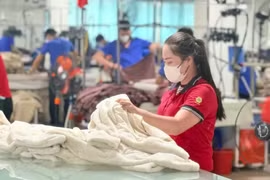
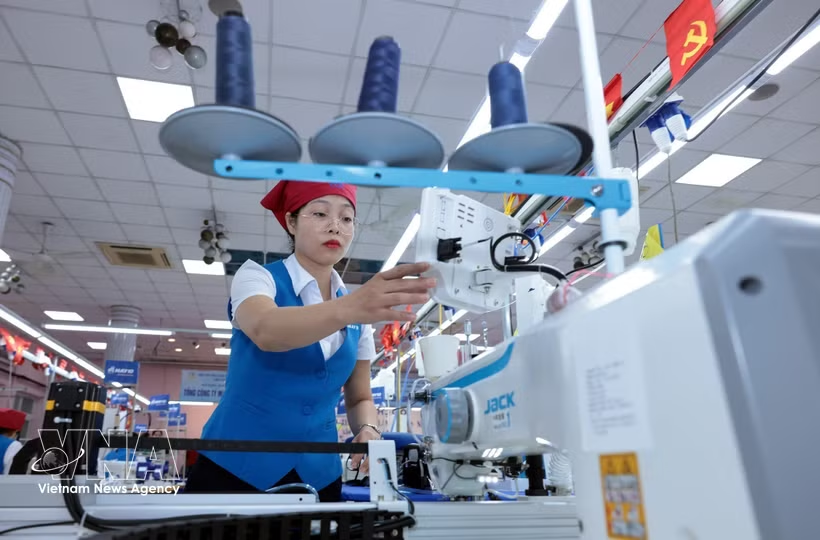
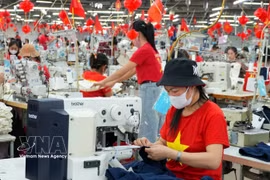
Garment and textile exports generated 46 billion USD in 2025, with the sector targeting 48 billion USD in 2026. (Photo: VNA)

Ho Chi Minh City (VNA) – As global brands impose increasingly stringent requirements on sustainability, social responsibility and clean energy and traceability, green transition, technological innovation, sustainable materials and supply-chain upgrading are becoming essential for Vietnamese garment and textile businesses to retain orders and move further up global value chains.

Green transition becomes competitive requirement

According to the Ministry of Industry and Trade, garment and textile exports generated 46 billion USD in 2025, with the sector targeting 48 billion USD in 2026. As of August, exports has reached about 26.9 billion USD, up 1.6% year on year. The result shows the sector remains competitive, but faces growing pressure from production costs, trade policies and new standards on green transition, emissions and circularity.

The global garment and textile market is also changing how suppliers are selected. Alen Wei, CFO of H&M Production China and Southeast Asia, said fashion brands are no longer looking only for commercially capable supply chains, but also for sustainability, innovation, resilience and long-term value creation.

For H&M, products remain central to business decisions, but competitiveness is increasingly seen as a combination of fashion, quality, price and sustainability. Suppliers are expected to continuously improve efficiency, productivity and innovation.

While production capacity, costs and delivery times were once decisive, businesses must now meet requirements covering materials, environment, energy, chemicals, working conditions and responsibility throughout the supply chain. Emissions reduction is particularly relevant to garment and textile production, an energy- and resource-intensive industry.

According to Alen Wei, H&M and many other fashion brands are pursuing net-zero emissions across their value chains while promoting recycled materials.

At Vietnam International Sourcing 2026, organised by the Ministry of Industry and Trade in Ho Chi Minh City, international garment and textile buyers said Vietnam has established itself as an important global textile manufacturing hub thanks to its production capacity, workforce, economic integration and adaptability. The next stage requires the sector to shift from primarily being a manufacturing hub to becoming a destination for green, high-tech, circular and high-value production.

Alongside environmental requirements, Vietnamese garment and textile businesses are also affected by international trade-policy changes. Do Ngoc Hung, Trade Counsellor and head of the Vietnam Trade Office in the US, said US tariff policies applied to many economies would affect consumer purchasing power and importers, potentially reducing the price competitiveness of Vietnamese exports. Nevertheless, major US suppliers and distributors have yet to plan changes to their sourcing partners, while Vietnam remains a strategic partner for major groups, including in garment and textile, footwear and other labour-intensive industries.

He said this is a positive signal, but also highlights the urgent need to strengthen the competitiveness of Vietnamese goods through factors beyond price. Businesses need to improve production capacity and increase the use of domestic materials and technologies to generate greater added value while reducing the risk of trade-remedy investigations or allegations of opaque sourcing from third countries.

Transforming the supply chain

In response to market changes, many Vietnamese garment and textile companies have proactively shifted their strategies, treating green transition and innovation as integral to business development rather than merely export requirements.

Nguyen Thi Hong Trang, deputy head of the Research, Development and Investment Division at Corporation 28, international customers have increasingly prioritised green and sustainable products, from materials and energy use to working conditions, she said. In response, the company has upgraded production capacity and gradually shifted towards greener operations.

Meanwhile, Faslink Vietnam has focused on researching new and recycled materials and applying technology. Tran Hoang Phu Xuan, Director of Faslink Vietnam, said the company has shifted from simply manufacturing products to providing solutions for buyers.

Through recycling solutions, Faslink can cut CO2 emissions by about 59% and water consumption by 47% compared with conventional production processes, Xuan said.

As international brands seek suppliers able to combine price, quality, speed, innovation and sustainability, Vietnam’s garment and textile sector still has significant opportunities.

Experts recommend that the sector move beyond simple processing towards higher-value stages, strengthening design, product development, supply-chain management and control over raw materials. This should be accompanied by investment in workforce skills, digital technologies, automation, trend forecasting and data management to improve productivity./.

VNA
See more

Ho Chi Minh City targets third-quarter growth of over 11% (Photo: VNA)

Ho Chi Minh City targets third-quarter growth of over 11%

Ho Chi Minh City will continue to implement drastic measures to achieve double-digit growth, targeting GRDP growth of at least 11.07% in the third quarter of 2026, 9.43% in the first nine months and 12.3% in the fourth quarter, with a view to completing the full-year goal of 10% or more.

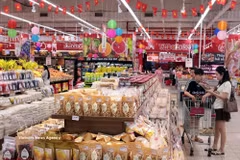
MM Mega Market An Phu supermarket in Ho Chi Minh City is brightly decorated for the National Day holiday. (Photo: VNA)

Domestic consumption up over 13%, tourism continues strong growth

The total retail sales of goods and consumer service revenues in August were estimated at 679.8 trillion VND (26 billion USD), up 1.6% from the previous month and 14.9% year-on-year. In the January-August period, the figure reached 5.24 quadrillion VND, representing a 13.3% increase year-on-year.

A production line of Onaga Co., Ltd. (Japan) at HANSSIP (Photo: nhandan.vn)

Hanoi moves to maintain appeal to FDI inflows

In the first eight months of 2026, the capital city attracted more than 3.7 billion USD in FDI, equivalent to 83% of the plan set for the year. Newly registered FDI exceeded 572 million USD across 450 projects, up 175.78% in project numbers and 209.46% in capital compared to the same period last year. Additional registered capital topped 492 million USD, while capital contributions and share purchases exceeded 2.6 billion USD.

Saigon Marina IFC is the first private-sector project contributing to realising the goal of developing the Vietnam International Financial Centre in Ho Chi Minh City. (Photo: VNA)

VIFC offers various opportunities to attract forein investment

Turning the VIFC into an effective channel for international capital will require clear rules, quality projects and strong connections between investors and domestic businesses. Meeting these requirements will be key to transforming investor interest into concrete capital flows and investment projects in Vietnam.

Production line at Yadea Vietnam’s smart manufacturing plant, which has an investment of more than 100 million USD, in Tan Hung Industrial Park, Bac Ninh province. (Photo: VNA)

Development model for new era – An inevitable trend

International organisations broadly agree that shifting the growth model from reliance on traditional factors toward technology and innovation is no longer an option for Vietnam, but an imperative of the times.

At a commune administrative service centre in Hung Yen province (Photo: VNA)

Government determined to cut administrative procedures to drive double-digit growth

Resolution No. 258/NQ-CP, dated August 31, 2026, calls for substantive and comprehensive reform, with a focus on maximum cuts and simplification of administrative procedures and business conditions. It also seeks to shift management from pre-licence inspection to post-licence inspection based on risk management, while strengthening real-time, data-driven oversight and putting people and businesses at the centre of public services.

(Illustrative photo: VNA)

Vietnam eyes entry into 40-billion-USD Southeast Asian CCS market: experts

A clear, transparent and stable legal framework would not only enable Petrovietnam to play a leading role in new energy development but also strengthen investor confidence, encouraging both domestic and foreign enterprises to invest, transfer technology and cooperate in developing large-scale CCS projects.

Durian is stockpiled at a company warehouse in Dong Gia Nghia ward, Lam Dong province, for sorting and distribution to the market. (Photo: VNA)

Vietnam targets durian exports of around 4 billion USD in 2026

In the first eight months, Vietnam's durian export revenue was estimated at 1.95 billion USD, of which exports to China alone fetched 1.85 billion USD or 95%. The country is working very hard to earn 4 billion USD from durian exports this year.

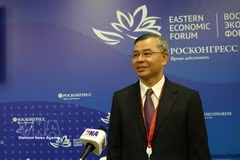
Minister of Finance Ngo Van Tuan grants an interview to Vietnam News Agency correspondents in Russia. (Photo: VNA)

Vietnam businesses poised to tap opportunities in Russia’s Far East: minister

Following the elevation of bilateral ties to a comprehensive strategic partnership and the entry into force of the Vietnam-Eurasian Economic Union Free Trade Agreement, Vietnam-Russia trade increased by an average of 10.8% annually during 2016-2025. However, it reached only about 4.7 billion USD in 2025, remaining modest compared to the two countries' potential and strong political ties.

Workers process clams for export at the factory of Thanh Hoa Seafood Import-Export Joint Stock Company in Thanh Hoa province. (Photo: VNA)

Vietnam’s agro-forestry-aquatic exports rise 7% in eight months

Asia remained the largest export market for Vietnam’s major agro-forestry-aquatic products, accounting for 45.5% of the total. It was followed by the Americas and Europe, with shares of 21.5% and 13.4%, respectively. Africa and Oceania made up 2.3% and 1.5%.