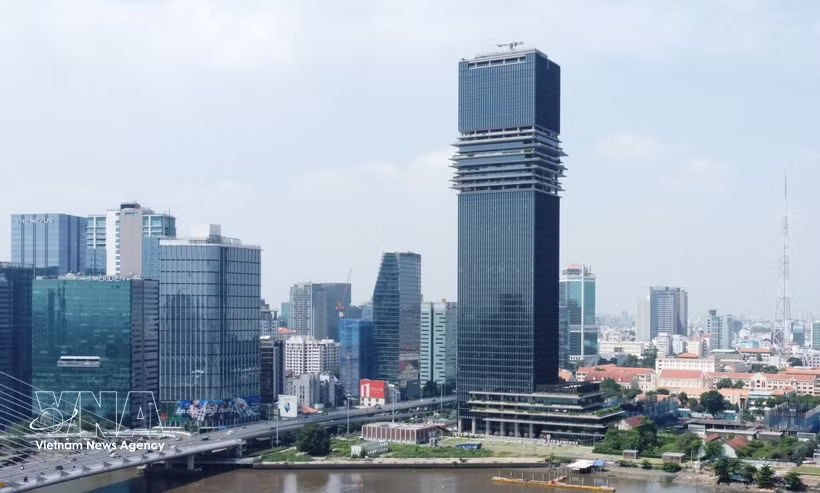
Ho Chi Minh City (VNA) – The Vietnam International Financial Centre (VIFC) is gradually completing its operational framework, while international investment funds are beginning to explore opportunities to participate. Investors say Vietnam’s market potential, together with a clear legal framework and a strong project pipeline, will be crucial to attracting international capital through the VIFC.
Investors see opportunities
Andrew Oldland, Head of the International Financial Centre Working Group at TheCityUK, said Vietnam has made significant progress in developing the VIFC, citing the National Assembly’s Resolution No. 222/2025/QH15 on the centre, a law on courts issued in December 2025 and subsequent Government decrees.
He said these steps demonstrated Vietnam’s policy commitment and political determination to establish an international financial centre. However, further work is needed for the VIFC to operate fully and effectively.
From an investor perspective, Oldland identified business opportunities in Vietnam as the most important factor determining the VIFC’s attractiveness. As a fast-growing emerging economy with strong long-term prospects, Vietnam offers substantial investment opportunities, particularly for UK investors.
Legal and regulatory certainty is another key consideration. Investors need clear guidance on where they can invest, as well as assurance that they will be able to recover their capital if problems arise through no fault of their own.
Oldland said the VIFC could help address these concerns, and at the same time contribute to developing Vietnam’s financial services market in line with international standards and creating a secure environment for fintech and financial technology development.
Vietnam clearly offers many business opportunities. But investors need an environment that helps them manage and mitigate risks. The VIFC can contribute significantly to this, enabling Vietnam to attract more capital and access funding at more competitive costs, he said.
Bui Quang Duy, Deputy Director of Global Investments at the Climate Finance Division of ResponsAbility Investments AG, said investors expected the VIFC to facilitate strategic transactions capable of setting market precedents.
Successful initial deals, he said, will help build investor confidence and encourage greater interest in the centre’s mechanisms, incentives and other advantages. He also called for policies and standards aligned with international practices and closer engagement with strategic investors already active in Vietnam.
Capital needs suitable projects
Deedee Panuvatvanich, Senior Investment Manager at Norway’s Norfund, said the fund has invested actively in Vietnam for more than 15 years and is continuing to seek opportunities in green and sustainable investment.
She welcomed the VIFC’s focus on green investment but stressed that a sufficiently large pipeline of quality projects and effective matching between domestic businesses and suitable sources of capital are essential.
Panuvatvanich also noted a gap between international investors’ requirements and domestic businesses’ capacity, particularly regarding environmental, social and governance (ESG) and corporate governance standards.
The VIFC could help businesses better understand these requirements through practical guidelines, workshops and direct consultations, she said.
Nguyen Ngoc Son Quynh, Head of Strategy at MEXC Ventures Vietnam, said the VIFC will create further opportunities for international funds to engage more deeply in Vietnam, where many businesses and projects still need foreign capital and expertise.
In addition, the young workforce and favourable demographic structure provide fertile ground for generating new ideas and projects. These factors could further expand the scope for investment funds seeking opportunities in Vietnam, she added.
The views of international investors show that turning the VIFC into an effective channel for international capital will require clear rules, quality projects and strong connections between investors and domestic businesses. Meeting these requirements will be key to transforming investor interest into concrete capital flows and investment projects in Vietnam./.
VNA