Resolution 79: Expectations of significant changes in state-owned enterprise sector

Previously regarded as the primary material force of the state sector, with a leading role across a broad range of areas, SOEs are now defined as an important material force, with their activities focused on a number of key and strategic industries and sectors, ensuring a pioneering, enabling and leading role in development.

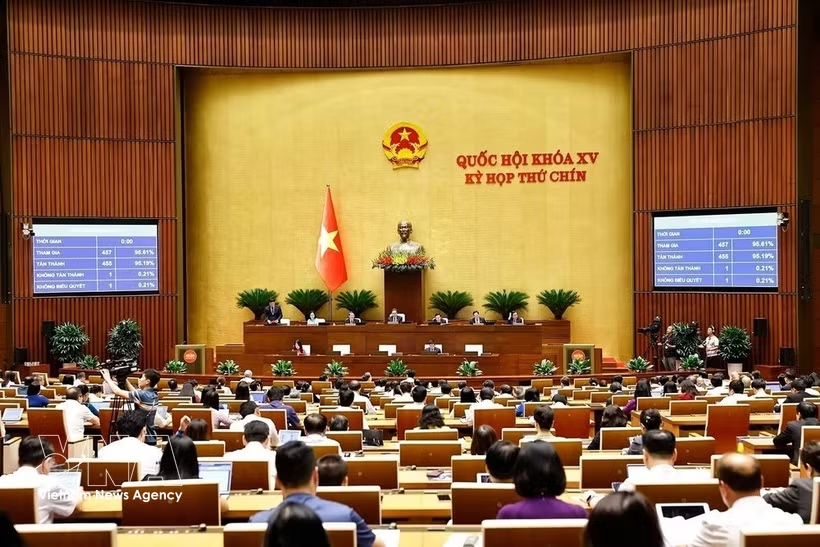
National Assembly members vote to pass the law amending and supplementing a number of articles of the Law on Enterprises. (Photo: VNA)

Hanoi (VNA) – As Vietnam undertakes a comprehensive restructuring of its economy to enter a new era, Politburo Resolution No. 79-NQ/TW on the development of the state economic sector (Resolution 79) has been identified as a guiding framework setting out strategic directions and goals for state-owned enterprises (SOEs) to develop strongly and sustainably in the new period.

According to Nguyen Thu Thuy, Deputy Director of the State Enterprise Development Department under the Ministry of Finance, a breakthrough aspect of Resolution 79 is its changed view of the role of SOEs.

Previously regarded as the primary material force of the state sector, with a leading role across a broad range of areas, SOEs are now defined as an important material force, with their activities focused on a number of key and strategic industries and sectors, ensuring a pioneering, enabling and leading role in development.

The resolution also sets out measures to develop a number of strong, large-scale economic groups and SOEs; promote investment in science and technology, innovation, digital transformation and green transition; improve and raise the effectiveness of corporate governance; and continue restructuring state capital at enterprises.

Resolution 79 is now being implemented through the assigned tasks. The Government issued its action programme under a resolution dated February 24, 2026, focusing on improving mechanisms and policies; strengthening corporate governance, digital transformation, risk management and information transparency; developing high-quality human resources; improving the efficiency of state-capital use; and promoting the leading role of SOEs in innovation and strategic projects.

“I expect the SOE sector to see clear changes by the end of 2026, in line with the orientations of the Party and the State,” Thuy said.

She also noted that while Resolution 79 opens up greater room for enterprises to take a more proactive and ambitious approach to investment, innovation and digital transformation, Conclusion No. 18-KL/TW on the five-year socio-economic development plan, national financial plan, public debt borrowing and repayment plan, and medium-term public investment plan for 2026-2030, linked to the goal of achieving “double-digit” economic growth, places a requirement on enterprises to quickly turn those opportunities into tangible growth results.

The pressure facing SOEs today, therefore, is not simply to achieve faster growth, but to ensure that growth is underpinned by higher productivity and efficiency, stronger competitiveness and improved corporate governance.

On changes in the private economic sector under the leadership of the state sector, Thuy said that, in the spirit of Resolution 79 and Resolution No. 68 on private-sector development, the two would become more closely interconnected. Private enterprises are expected to participate more deeply in large-scale value chains and production ecosystems.

If SOEs effectively fulfil their leading role through investment in strategic infrastructure, energy, logistics, digital transformation, high technology and foundational industries, private businesses will have greater scope to invest, innovate and expand their activities in supporting industries, services and higher-value-added manufacturing.

In other words, SOEs should not compete directly with private enterprises in areas where the market can operate efficiently on its own. Instead, they should play a role in “opening the way”, creating markets, leading technological development and connecting supply chains, thereby attracting wider social resources to contribute to development./.

VNA

See more

Saigon Marina IFC is the first private-sector project contributing to realising the goal of developing the Vietnam International Financial Centre in Ho Chi Minh City. (Photo: VNA)

VIFC offers various opportunities to attract forein investment

Turning the VIFC into an effective channel for international capital will require clear rules, quality projects and strong connections between investors and domestic businesses. Meeting these requirements will be key to transforming investor interest into concrete capital flows and investment projects in Vietnam.

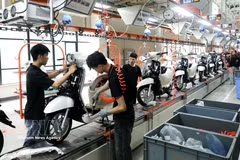
Production line at Yadea Vietnam’s smart manufacturing plant, which has an investment of more than 100 million USD, in Tan Hung Industrial Park, Bac Ninh province. (Photo: VNA)

Development model for new era – An inevitable trend

International organisations broadly agree that shifting the growth model from reliance on traditional factors toward technology and innovation is no longer an option for Vietnam, but an imperative of the times.

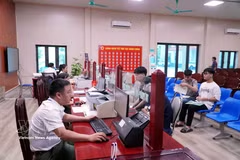
At a commune administrative service centre in Hung Yen province (Photo: VNA)

Government determined to cut administrative procedures to drive double-digit growth

Resolution No. 258/NQ-CP, dated August 31, 2026, calls for substantive and comprehensive reform, with a focus on maximum cuts and simplification of administrative procedures and business conditions. It also seeks to shift management from pre-licence inspection to post-licence inspection based on risk management, while strengthening real-time, data-driven oversight and putting people and businesses at the centre of public services.

(Illustrative photo: VNA)

Vietnam eyes entry into 40-billion-USD Southeast Asian CCS market: experts

A clear, transparent and stable legal framework would not only enable Petrovietnam to play a leading role in new energy development but also strengthen investor confidence, encouraging both domestic and foreign enterprises to invest, transfer technology and cooperate in developing large-scale CCS projects.

Durian is stockpiled at a company warehouse in Dong Gia Nghia ward, Lam Dong province, for sorting and distribution to the market. (Photo: VNA)

Vietnam targets durian exports of around 4 billion USD in 2026

In the first eight months, Vietnam's durian export revenue was estimated at 1.95 billion USD, of which exports to China alone fetched 1.85 billion USD or 95%. The country is working very hard to earn 4 billion USD from durian exports this year.

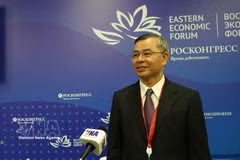
Minister of Finance Ngo Van Tuan grants an interview to Vietnam News Agency correspondents in Russia. (Photo: VNA)

Vietnam businesses poised to tap opportunities in Russia’s Far East: minister

Following the elevation of bilateral ties to a comprehensive strategic partnership and the entry into force of the Vietnam-Eurasian Economic Union Free Trade Agreement, Vietnam-Russia trade increased by an average of 10.8% annually during 2016-2025. However, it reached only about 4.7 billion USD in 2025, remaining modest compared to the two countries' potential and strong political ties.

Workers process clams for export at the factory of Thanh Hoa Seafood Import-Export Joint Stock Company in Thanh Hoa province. (Photo: VNA)

Vietnam’s agro-forestry-aquatic exports rise 7% in eight months

Asia remained the largest export market for Vietnam’s major agro-forestry-aquatic products, accounting for 45.5% of the total. It was followed by the Americas and Europe, with shares of 21.5% and 13.4%, respectively. Africa and Oceania made up 2.3% and 1.5%.