State Bank action plan seeks to develop State-owned economic sector

The State Bank of Vietnam (SBV) has issued an action plan to implement the Politburo's Resolution No. 79-NQ/TW on developing the State-owned economic sector, aiming to improve the operational efficiency of State-owned enterprises (SOEs), modernise governance, and reinforce the strategic role of this sector in national development.

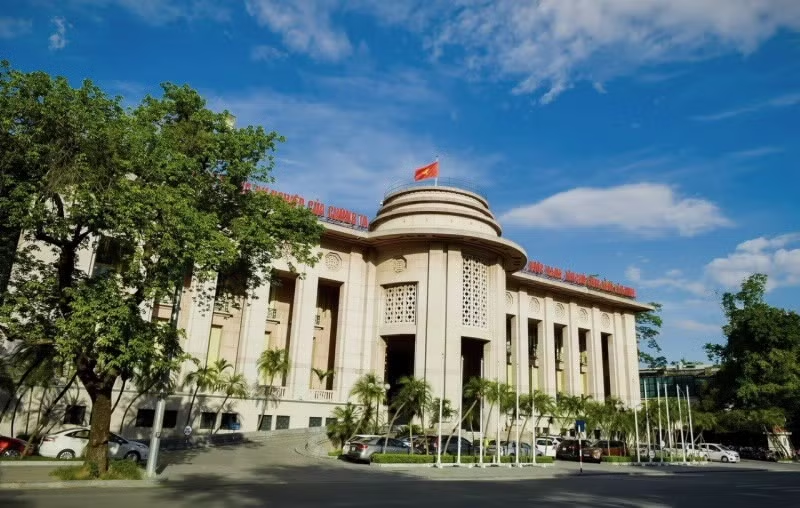
The State Bank of Vietnam has issued an action plan to implement the Politburo's resolution on developing the State-owned economic sector. (Photo: VietnamPlus)

Hanoi (VNA) – The State Bank of Vietnam (SBV) has issued an action plan to implement the Politburo's Resolution No. 79-NQ/TW on developing the State-owned economic sector, aiming to improve the operational efficiency of State-owned enterprises (SOEs), modernise governance, and reinforce the strategic role of this sector in national development.

Issued under Decision No. 464/QD-NHNN, the action plan is intended to implement the Government's Resolution No. 29/NQ-CP, dated February 24, 2026, to realise the objectives of the Politburo's Resolution No. 79-NQ/TW, dated January 6, 2026.

It sets tasks for units of the SBV, State-run credit institutions, SOEs where the SBV acts as the owner representative, and subordinate non-business units of the central bank.

The plan aims to enhance the efficiency of the State-owned economic sector, enabling it to better play its leading, pioneering and strategic role in supporting Vietnam's economy in the new period.

Accordingly, the SBV requests a fundamental shift in the governance mindset, moving away from traditional administrative management towards a development-enabling approach characterised by modern governance, greater efficiency and more decisive implementation.

A key task under the plan is reviewing legal documents governing the banking sector to identify institutional bottlenecks and recommend amendments to competent authorities. The SBV demands the review respect the principle of clearly distinguishing the ownership role, economic management functions, and political and non-profit public service responsibilities from the commercial activities of State-owned economic organisations.

The plan also underlines the requirement for pushing ahead with administrative reform by simplifying procedures, reducing compliance costs and processing time for businesses and citizens, stepping up power decentralisation, and strengthening the autonomy of subordinate units. It calls for wider application of risk-based management principles, shifting regulatory oversight from pre-licensing to post-licensing inspection.

Human resources development is another major priority. The SBV stresses the need to improve the quality of leadership, management and professional staff within State-owned economic organisations. It asks for remuneration policies that are competitive and aligned with labour market conditions, as well as more effective mechanisms to attract, develop and retain talented personnel based on professional competence, ethical standards and work performance.

The action plan also emphasises accountability, requiring the replacement or dismissal of officials whose lack of responsibility or poor performance results in losses, wastefulness, operational inefficiency or obstacles to enterprise development.
vietcombank-1.png
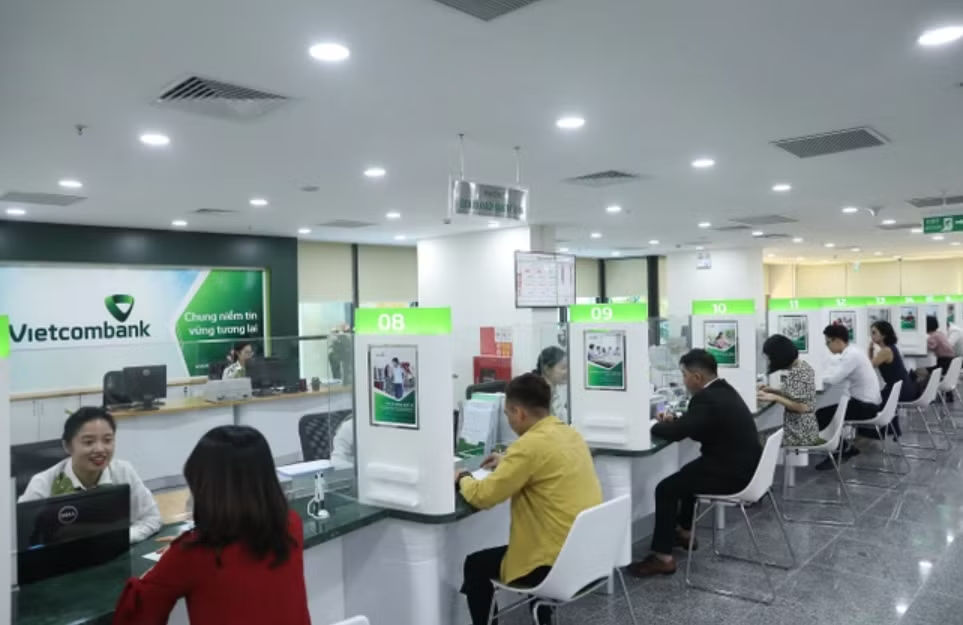
The State Bank of Vietnam identifies human resources development, particularly for leaders, managers and experts in State-owned economic organisations, as a crucial priority. (Photo: VietnamPlus)

In the area of digital transformation, relevant unit are requested to continue developing and upgrading banking sector databases while contributing to the completion of national databases to support supervision, policy making and the effective management of State capital, assets and other public resources. These databases are expected to improve the Government's ability to evaluate the performance of State-owned entities and make more informed decisions on resource allocation.

The central bank also instructs its subordinate units to strengthen coordination in inspection and supervisory activities to avoid overlaps and minimise disruption to the operations of State-owned enterprises and organisations.

At the same time, the plan reaffirms the Party's policy of protecting officials who act proactively, creatively and responsibly for the common good, provided their actions are free from corruption or personal gain.

The SBV also directs its units to expand dialogue with businesses and relevant stakeholders, proactively receiving feedback and recommendations in order to promptly resolve difficulties or report outstanding issues to competent authorities for consideration and settlement.

To raise public awareness of the Party's policies, the SBV Office is tasked with coordinating with the Thoi bao Ngan hang (Banking Times) newspaper to organise regular communication campaigns on the Politburo's Resolution No. 79-NQ/TW, the Government's Resolution No. 29/NQ-CP and the role of the State-owned economic sector. The campaigns should employ diverse communication channels and formats to improve the effectiveness of policy communication and foster public understanding./.
See more

Processing cashew nuts for export at Nguyen Thong Co., Ltd. in Dak Lak province. (Photo: VNA)

Vietnam’s exports to New Zealand post strong growth

According to the Customs Department, two-way trade reached 844 million USD in the first half of 2026, of which Vietnam’s exports to New Zealand totaled 399.7 million USD, up 18.8% year-on-year, while imports stood at 444 million USD.

Starting from September 2026, agricultural products from the Mekong Delta are expected to be transported directly from Cai Cui Port to Guangxi, China. (Photo: VNA)

Investing in logistics to boost agricultural production and exports

Logistics is increasingly becoming a major bottleneck for exports as transport costs rise and requirements for data management, low emissions and supply chain transparency become more stringent, requiring coordinated investment in logistics infrastructure, data infrastructure and transport capacity.

Harvesting rice in the Mekong Delta (Photo: VNA)

Vietnam seen as gateway for Canadian farm produce to ASEAN

As Canada steps up trade diversification and seeks to reduce its dependence on the North American market, Vietnam could serve both as a market for Canadian goods and a base for Canadian businesses to build production capacity and expand operations in the region.

Illustrative image (Photo: VNA)

Turkish cooperatives open sourcing channel for Vietnamese businesses

The Vietnam Trade Office recommended that Vietnamese businesses in agriculture and food actively study cooperative networks in different localities in Türkiye and consider them an additional channel for accessing raw materials, processing partners, and distribution networks.

Delegates at the signing ceremony (Photo: VNA)

VPI, Beicip-Franlab Asia deepen oil, gas cooperation

Under the MoU, VPI and Beicip-Franlab Asia will undertake advanced studies in geology, geophysics, and reservoir engineering to support exploration, field development, and oil and gas resource assessment.

A visitor explores Vietnamese coffee at the expo. (Photo: VNA)

Vietnam pushes coffee, farm produce at Hong Kong food expo

After nearly 200 years, especially since the Doi Moi (renewal) began in 1986, Vietnamese coffee is now exported to more than 100 countries and territories and supports about 2.6 million jobs. Vietnam remains the world’s second largest coffee exporter, holding roughly 19-21% of the global market, and is the top producer of Robusta coffee.

Delegates at the event (Photo: VNA)

Da Nang hosts 2026 International Logistics Forum

Co-hosted by the Ministry of Industry and Trade and the Da Nang People’s Committee, the forum put modern logistics, strategic infrastructure, digital transformation, green growth and international connectivity at the centre of discussions.

Prime Minister Le Minh Hung speaks at the working session. (Photo: VNA)

Monetary policy must ensure macro stability, support growth: PM

The SBV was required to keep policy interest rates steady and add liquidity so lenders can access cheaper funding. It must manage the exchange rate in line with market developments, coordinate monetary tools, and intervene to stabilise the foreign exchange market, while maintaining close oversight of gold. Lenders must continue cutting costs, stabilising lending rates, and delivering substantive reductions.

People buy petrol at a station in Hanoi (Photo: VNA)

Petrol prices cut from 15:00 on August 13

The price of E5 RON92 petrol is capped at 21,235 VND (0.81 USD) per litre, down 493 VND, while E10 RON95-III is priced at no more than 22,119 VND per litre, down 205 VND.

Domestic and foreign businesses engage in trade networking at the event series held at Ho Chi Minh's Saigon Exhibition and Convention Centre (SECC) on August 13, 2026. (Photo: VNA)

Int'l sports exhibitions, export trade fair open in Ho Chi Minh City

A series of events opened at the Saigon Exhibition and Convention Centre (SECC) in Ho Chi Minh City on August 13, including the Vietnam Sport Show 2026, Vietnam Cycle Expo 2026 and the 14th Zhejiang Export (Vietnam) Fair 2026. They feature 520 booths operated by 400 businesses from 15 countries and territories.

Production at Bumjim Electronics Vina Co., Ltd invested by the Republic of Korea in Quang Ninh province (Photo: VNA)

Resolution No. 19-NQ/TW sets new growth drivers for Vietnam

Science and technology, innovation, digital transformation and AI must be translated into higher productivity rather than pursued as ends in themselves. At the same time, people should be placed at the centre of development, not merely viewed as a resource but as the ultimate objective of development policies.

The conference on the implementation of socio-economic tasks for August and key measures for the rest of the year held in Ho Chi Minh Ciy, on August 12, 2026. (Photo: VNA)

Ho Chi Minh City mobilises resources to achieve double-digit growth target

The southern economic hub has identified accelerating public investment disbursement, strongly mobilising private-sector resources, promoting exports and consumption, and removing bottlenecks as key priorities to generate additional growth drivers in the remaining months of the year. These priorities were highlighted by its leadership at a conference on the implementation of socio-economic tasks for August and key measures for the rest of the year, held on August 12.

The opening ceremony of the East-West Economic Corridor International Trade, Tourism and Investment Fair 2026 (EWEC-Da Nang 2026) on August 12 (Photo: VNA)

EWEC-Da Nang 2026 trade, tourism, investment fair opens

The EWEC-Da Nang fair is not merely a product exhibition and promotion event, but also a platform for economic connectivity, enabling businesses to seek partners, expand markets, explore investment opportunities, cooperate in production and business, and engage more deeply in regional supply chains.

General Secretary of the Communist Party of Vietnam Central Committee and President To Lam speaks at the New Zealand–Vietnam Business Roundtable in Auckland on August 13. (Photo: VNA)

Top leader calls for joint Vietnam–New Zealand efforts to create new growth drivers

Party General Secretary and President To Lam called for joint efforts to create new growth drivers based on science, technology, innovation and green transformation, encouraging New Zealand businesses to view Vietnam not only as a market but also as a partner for research, product development, manufacturing and innovation in Southeast Asia.